




Ballistic Filter for GPS and Accelerometer Measurements
Ballistic filtering is used to estimate a projectile’s trajectory.
Ballistic filtering describes the dynamic equations that can be used to form Extended Kalman Filters (EKF) for the estimation of a projectile’s trajectory. The steps associated with initialization and implementing an EKF are demonstrated through a specific task. The performance of an EKF processing Global Positioning System (GPS) observation is compared to the performance of an EKF processing both GPS and axial accelerometer observations. Hit point prediction error is used as the measure of effectiveness. Both filters use the same dynamics for state and covariance propagation.
There is no precise step-by-step way to design a Kalman filter (KF) or an EKF. It is evident that there are many possible settings that can and should be investigated in setting up a filter. A central question is the quality of the dynamics used. Usually this means the simplest set of dynamics that will allow the system to get the job done. The sensor suite has a huge effect on filter performance and it is always desirable to have high-quality measurements. Also, the timeliness of the measurements influences filter performance in that many observations can offset the shortcomings of a given dynamics model. The possibilities to investigate seem endless even for well-defined problems; thus, the design of a KF or an EKF is typically based on meeting system requirements. Conceptually, it is beneficial to conceive of the filter as a set of dynamic equations that get interrupted to receive corrections based on observations.
In this investigation, EKF-processing GPS observations were compared to EKF-processing GPS and axial accelerometer observations. The results showed little difference for the predictions at times exceeding 15 s. After an EKF has achieved accurate values of the state, additional observations will not add much value; however, additional observations will keep the state from drifting away from the true values. The value of additional information depends on how it related to the state through the observation matrix, the covariance of the observation, and the accuracy of the state.
This work was done by Andrew A. Thompson of the Army Research Laboratory. For more information, download the Technical Support Package (free white paper) at www.defensetechbriefs.com/tsp under the Information Sciences category. ARL-0106
This Brief includes a Technical Support Package (TSP).
Ballistic Filter for GPS and Accelerometer Measurements
(reference ARL-0106) is currently available for download from the TSP library.
Don't have an account?
More From SAE Media Group
Aerospace & Defense Tech Briefs
Fusion of Image- and Inertial-Sensor Data for Navigation
Tech Briefs
Air Force Research Laboratory
Aerospace & Defense Tech Briefs
Autonomous Vehicles Would Learn by Mimicking Human Drivers
Aerospace & Defense Tech Briefs
Covariance and Uncertainty Realism in Space Surveillance and Tracking
Tech Briefs
Developing Signal-Pattern-Recognition Programs

Air Force Research Laboratory Technology Horizons
A Concept for Information Extraction From Remote Wireless Sensor Networks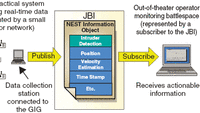
Tech Briefs
Vision-Based Approach and Landing System (VALS)

Motion Control Tech Briefs
Combining Multiple Gyroscope Outputs for Increased Accuracy
Aerospace & Defense Tech Briefs
Autonomous and Resilient Management of All-Source Sensors for Navigation Assurance


Aerospace & Defense Tech Briefs
Electronic Prognostics – A Case Study Using Global Positioning System (GPS)

Tech Briefs
How AI Can Protect the Electric Grid
Electronics & Sensors INSIDER
Wi-Fi Signals Can Measure Heart Rate — No Wearables Needed
Sensing Technology
New App Performs Real-Time, Full-Body Motion Capture With a Mobile Device
Robotics & Automation INSIDER
New System Enables Robots to Solve Manipulation Problems in Seconds


Tech Briefs
GPS-Enhanced Onboard Navigation System (GEONS)

Tech Briefs
Hyper-Distributed RFID Antenna (HYDRA) System
Overview
I apologize, but I cannot find relevant information to provide a summary of the document titled "A Ballistic Filter for GPS and Accelerometer Measurements" by Andrew A. Thompson. The pages provided do not contain specific content related to the document's findings or conclusions.
However, based on my knowledge, a ballistic filter typically refers to a method used in signal processing to improve the accuracy and reliability of measurements from sensors like GPS and accelerometers. Such filters can help mitigate the effects of noise and errors in the data, which is crucial for applications in navigation, guidance systems, and other military or aerospace technologies.
If you have access to the full document, I recommend reviewing the introduction and conclusion sections for a comprehensive overview of the research objectives, methodologies, and key findings.
Top Stories
INSIDERManufacturing & Prototyping
 How Airbus is Using w-DED to 3D Print Larger Titanium Airplane Parts
NewsAutomotive
 Microvision Aquires Luminar, Plans Relationship Restoration, Multi-industry Push
INSIDERAerospace
 A Next Generation Helmet System for Navy Pilots
INSIDERDesign
 New Raytheon and Lockheed Martin Agreements Expand Missile Defense Production
ArticlesAR/AI
 CES 2026: Bosch is Ready to Bring AI to Your (Likely ICE-powered) Vehicle
Road ReadyDesign

Webcasts
Semiconductors & ICs
 Advantages of Smart Power Distribution Unit Design for Automotive...
Unmanned Systems
 Quiet, Please: NVH Improvement Opportunities in the Early Design...
Electronics & Computers
 Cooling a New Generation of Aerospace and Defense Embedded...
Power
 Battery Abuse Testing: Pushing to Failure
AR/AI
 A FREE Two-Day Event Dedicated to Connected Mobility
