




Electronic Prognostics – A Case Study Using Global Positioning System (GPS)
Prognostic health management (PHM) of electronic systems presents challenges traditionally viewed as either insurmountable or not worth the cost of pursuit, but recent changes in weapons platform acquisition and support requirements has spurred renewed interest in electronics PHM, revealing possible applications, accessible data sources, and previously unexplored predictive techniques.
Many types of circuits compose avionics systems. One of the following categories can be used to classify each circuit topology at the time this research was performed:
High frequency analog
Low frequency analog
Low impedance
High impedance
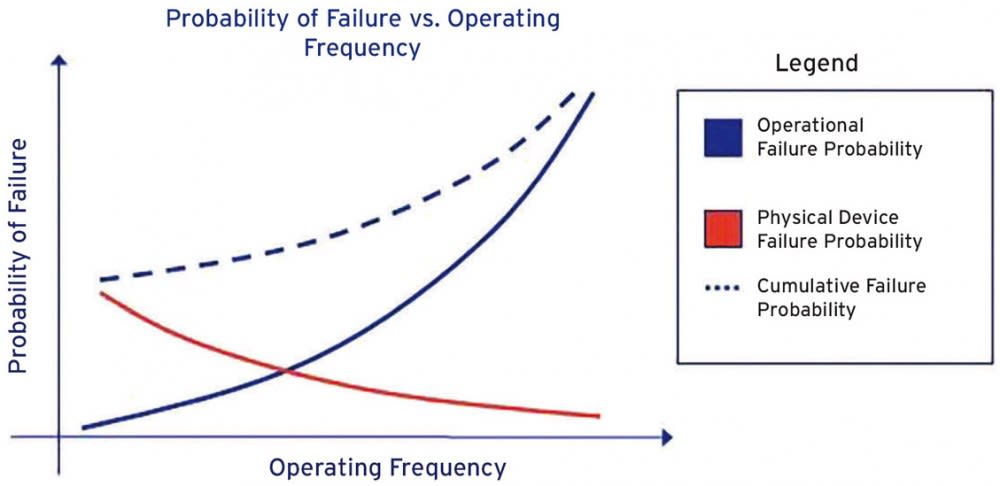
Common failure mode mechanisms for analog circuits depend largely on the architecture and relative operating frequencies of the circuit. In this research, high frequency analog circuits are categorized as operating above 1GHz, while low frequency analog circuits operate below 1GHz. High frequency analog circuits are sensitive to small changes in device parameters, resulting in non-destructive, or operational, failure modes. Unlike physical device failures, the cause of operational failures cannot be traced back to individual components. Low frequency analog circuits are more likely to undergo physical device failure. The accompanying figure illustrates the relationship between the operating frequency of an analog circuit and the different types of failure modes.
Avionic systems containing high frequency analog circuits or RF circuits have high failure rates. Therefore, an avionics-related electronic system containing high frequency RF components was considered to test this theory. Evaluation of the following criteria led to the specific avionic system investigated in this report:
Critical avionics subsystems
Representative failure modes
Thorough documentation
Commercial availability for failure testing
One such avionics system that met all selection criteria is the Global Positioning System (GPS). The Garmin GPS 15L-W was selected for failure mode analysis and accelerated failure testing for the following reasons:
Thorough documentation
Commercial-off–the-shelf (COTS)
Embedded thermocouple
Small form factor
The global positioning system (GPS) is a space-based radio-navigation system managed by the U.S. Air Force (USAF). GPS, originally developed as a military force enhancement system, supports the existence of two different services: the Precise Positioning Service (PPS) and the Standard Positioning Service (SPS). The PPS is reserved for military use and requires special PPS receivers to access the system, while the SPS is available to civilian users throughout the world. Fundamentally, both services operate on the same principles. Accuracy is the main difference between the two systems; the SPS provides a less accurate positioning capability than its counterpart. All GPS systems consist of three major subsystems:
GPS Satellites
Transmission Paths
GPS Receivers
The GPS constellation consists of 24 satellites in continuous operation with six additional backup satellites, each having an orbital radius of 26559.7 km. All 24 satellites in the constellation are separated into six groups consisting of four satellites per group separated 60° apart with a maximum angle of inclination of 55° from the equator. Additionally, the satellites are designed to provide reliable service over a 7 to 10 year lifetime. Every active satellite broadcasts a navigation message based upon data periodically uploaded from the Control Segment (CS), which continuously monitors the reliability and accuracy of each satellite. This research focused on GPS reliability as a function of receiver degradation.
This work was done by Douglas W. Brown, Patrick W. Kalgren, Carl S. Byington, & Rolf F. Orsagh of Impact Technologies, LLC for the Naval Air Warfare Center. For more information, download the Technical Support Package (free white paper) below. NAWC-0005
This Brief includes a Technical Support Package (TSP).
Electronic Prognostics – A Case Study Using Global Positioning System (GPS)
(reference NAWC-0005) is currently available for download from the TSP library.
Don't have an account?
More From SAE Media Group
RF & Microwave Technology
Prognostic Health Management of an RF System Using GPS
Aerospace & Defense Tech Briefs
Army Advances Materials for New Low-Profile Antenna
Off-Highway Engineering
Addressing Electromagnetic Compatibility in the Context of Aircraft Electrification

Aerospace & Defense Tech Briefs
Curled RF MEMS Switches For On-Chip Design
Aerospace & Defense Tech Briefs
Defeating Commercial Drone Threats with Open-Source SDR

Aerospace & Defense Tech Briefs
Using an Open Architecture Approach to Military Avionics
Aerospace & Defense Tech Briefs
Development of a 94 GHz Radar System for Dedicated Bird Detection at Airports and Airfields
Aerospace & Defense Tech Briefs
New, Portable Antenna Could Help Restore Communication After Disasters

Aerospace & Defense Tech Briefs
SpaceRAN Demonstrator Will Test 5G Connectivity on Software-Defined Satellite
Aerospace & Defense Tech Briefs
RF Technology Helps Connect Avionics Systems
Aerospace & Defense Tech Briefs
Industry Invited to Participate in AeroTech Aerospace and Defense Technical Program
Aerospace & Defense Tech Briefs
Heterogeneous Integration Technology
Aerospace INSIDER
Metamaterials Antenna Makes Generational Leap in Multi-Band Connectivity
Aerospace & Defense Tech Briefs
Streamlining EMC Solutions for Avionics Interfaces
Aerospace & Defense Tech Briefs
New Products
Aerospace INSIDER
UK Flight Test Evaluates "Un-Jammable" Quantum Navigation Systems
Tech Briefs
SuperGPS Accurate Within 10 Centimeters
Aerospace & Defense Tech Briefs
Stepped-Frequency Distributed Radar for Through-the-Wall Sensing
Aerospace & Defense Tech Briefs
NASA CubeSats: Pushing the Boundaries of Technology
Aerospace & Defense Tech Briefs
GaN Breaks Barriers

Aerospace & Defense Tech Briefs
The Inside Story on Unmanned Vehicle Signal Recorder Technology
Aerospace & Defense Tech Briefs
Are Defense Satellites Ready for Space-Based Laser Communications?



Overview
The document presents a case study on Electronic Prognostics, specifically focusing on the application of Prognostic Health Management (PHM) for Global Positioning System (GPS) technology. The authors, Douglas W. Brown, Patrick W. Kalgren, Carl S. Byington, and Rolf F. Orsagh from Impact Technologies, LLC, explore the challenges and advancements in monitoring and predicting failures in electronic systems, particularly in radio frequency (RF) applications.
The study highlights the increasing interest in electronics PHM due to changes in weapons platform acquisition and support requirements. It discusses the development and validation of a PHM system for a Garmin GPS receiver (model: GPS 15L-W), utilizing a MATLAB graphical user interface (GUI) to monitor component degradation in real-time. The system leverages existing operational data from the GPS receiver, specifically using the NMEA 0183 protocol, to extract prognostic features without the need for additional sensors or circuit modifications.
The authors identify four major classes of electronic equipment used in avionic systems and examine various failure types and monitoring techniques. They conducted accelerated failure tests to validate the identified diagnostic features, demonstrating that the system could accurately predict the remaining useful life of the GPS receiver within ±5 thermal cycles. This approach allows for the monitoring and implementation of prognostic algorithms using existing data streams, making it a cost-effective solution for failure prediction.
The document emphasizes the importance of feature extraction from the operational data of the GPS receiver, which is facilitated by the 24 active satellites in the GPS constellation. The technique is not limited to GPS technology; it has broader applicability to other RF electronic applications, such as software-defined radios and radar systems.
In conclusion, the research showcases a sophisticated algorithm that can assess and predict the health of electronic components, paving the way for automated PHM systems. The findings contribute to the understanding of GPS reliability as a function of receiver degradation and highlight the potential for improving the reliability of mixed digital/analog circuitry in various applications. The study is supported by acknowledgments of technical and financial contributions from various organizations, underscoring the collaborative effort behind the research.
Top Stories
NewsRF & Microwave Electronics
 Microvision Aquires Luminar, Plans Relationship Restoration, Multi-industry Push
INSIDERAerospace
 A Next Generation Helmet System for Navy Pilots
INSIDERDesign
 New Raytheon and Lockheed Martin Agreements Expand Missile Defense Production
INSIDERMaterials
 How Airbus is Using w-DED to 3D Print Larger Titanium Airplane Parts
NewsPower
 Ford Announces 48-Volt Architecture for Future Electric Truck
ArticlesAR/AI

Webcasts
Electronics & Computers
 Cooling a New Generation of Aerospace and Defense Embedded...
Automotive
 Battery Abuse Testing: Pushing to Failure
Power
 A FREE Two-Day Event Dedicated to Connected Mobility
Unmanned Systems
 Quiet, Please: NVH Improvement Opportunities in the Early Design Cycle
Automotive
 Advantages of Smart Power Distribution Unit Design for Automotive &...
Energy
 Sesame Solar's Nanogrid Tech Promises Major Gains in Drone Endurance