




European Researchers Leverage AI in Manufacturing Rocket Parts

Artificial Intelligence (AI), promises many benefits in all domains, and rocketry is no different. The European Space Agency’s Future Launchers Preparatory Program(FLPP) is investigating the use of AI to develop better processes and even whole new shapes in materials that could be used on rockets or spacecraft of the future.
Together with MT Aerospace in Germany the Agency is looking at adapting material process techniques across the industry.

Shot Peen Formed Surface
Shot Peen Forming is a process whereby metal is shot with small balls to bend it into shape. As the formation is done without heating, the resulting metal shape stays strong and is more resistant to metal fatigue. It is a commonly used process and is how MT Aerospace shapes the dome heads of Ariane 6 rocket’s fuel tanks.
As the balls hit the metal at high speed, each impact is unpredictable. For the first time, machine learning is being used to predict how the metal will deform next, providing a fast and precise method to reach the desired shape with a tolerance of just two millimeters.
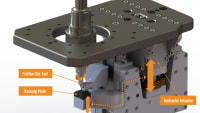
Friction Stir Welding
Once a metal part is made, it often needs to be joined to other components. In the space industry, friction stir-welding is replacing traditional arc welding done by humans or robots. Friction stir welding heats up the metals by simply rotating a pin over the welding area at high speeds, thereby using friction to stir the materials together. This precise welding technique fuses metals allowing for stronger structures, such as those used to make the tanks for Ariane 6.
With new digital monitoring technologies for weld force, temperatures and other machine telemetry, machine learning is now helping setup the machines faster, support documentation efforts and automatically check the shape of the final weld. This automatic evaluation of weld seams has reduced analysis time by 95 percent compared to the traditional process.

Automated Fiber Placement
It’s not all metal though – carbon-fiber reinforced-plastic offers new shapes that are lighter and stronger. Built in layers, the Phoebus project is exploring the use of carbon-fiber tanks for Ariane 6.
Here MT Aerospace is integrating new laser sensor technology that, powered by machine learning models, will detect and classify defects on the fly, which keeps production going and shortens production times significantly.
“Artificial intelligence, such as machine learning, in combination with new digital technologies is transforming launcher manufacturing,” said Daniel Chipping ESA Project Manager for Software-Centered and Digitalization Activities at the Future Launchers Preparatory Program in Space Transportation. “From automating complex analysis tasks to reducing tedious machine stop-starts, we are starting to see the benefits across all materials and shaping processes.”
These projects are part of ESA’s Future Launchers Preparatory Program (FLPP), that helps develop the technology for future for space transportation systems. By conceiving, designing and investing in technology that doesn’t exist yet, this program is reducing the risk entailed in developing untried and unproven projects for space.
More From SAE Media Group
Advanced Manufacturing INSIDER
Space Launch System’s Core Stage Built Piece-by-Piece

NASA Spinoff
Rocket Manufacturing Meets Science Friction
Aerospace Manufacturing and Machining INSIDER
Machine Learning Makes Light Work of AM Aerospace Alloys

Aerospace & Defense Tech Briefs
Metal-Plated, High-Temperature Plastics

Aerospace & Defense Tech Briefs
Scientists Fuse Simulations and Machine Learning to Accelerate Novel Additively Manufactured Materials
Aerospace Manufacturing and Machining INSIDER
How Airbus is Using w-DED to 3D Print Larger Titanium Airplane Parts
Aerospace INSIDER
Breakthroughs in Testing Solid-Fuel Ramjets Advance Research
NASA Spinoff
Printed Polymer Makes Integrated Airplane Parts
Aerospace & Defense Tech Briefs
Researchers Discover New Materials That Could Enhance Fighter Jet Efficiency

Aerospace Manufacturing and Machining INSIDER
3D Printed Rocket Engine Parts Survive 23 Hot-Fire Tests
Aerospace & Defense Tech Briefs
Machining Beryllium
Aerospace INSIDER
Using Ultrabright X-Rays to Test Materials for Ultrafast Aircraft
Aerospace INSIDER
Air Force Wind Tunnel Team Takes 3D Printing Program to Next Dimension


Tech Briefs
Calibration System for Automated Fiber Placement
Tech Briefs
New on the Market
Aerospace & Defense Tech Briefs
Aerospace Aluminum Laser Welding: Advancing Material Performance for the Future of Flight

NASA Spinoff
3D Printed Engines Propel Next Industrial Revolution

Photonics & Imaging Technology
Advanced Laser Cleaning Robotic Work Cells Turbocharge Industrial Processes
Top Stories
INSIDERDefense
 New Raytheon and Lockheed Martin Agreements Expand Missile Defense Production
NewsAutomotive
 Ford Announces 48-Volt Architecture for Future Electric Truck
INSIDERManufacturing & Prototyping
 Active Strake System Cuts Cruise Drag, Boosts Flight Efficiency
ArticlesTransportation
 Accelerating Down the Road to Autonomy
INSIDERMaterials
 How Airbus is Using w-DED to 3D Print Larger Titanium Airplane Parts
Road ReadyTransportation

Webcasts
Electronics & Computers
 Cooling a New Generation of Aerospace and Defense Embedded...
Power
 Battery Abuse Testing: Pushing to Failure
Connectivity
 A FREE Two-Day Event Dedicated to Connected Mobility
Automotive
 Quiet, Please: NVH Improvement Opportunities in the Early Design Cycle
Transportation
 Advantages of Smart Power Distribution Unit Design for Automotive &...
Aerospace
 Sesame Solar's Nanogrid Tech Promises Major Gains in Drone Endurance