




Touch Takes Hold, Switches Lend a Hand
Touch screens are becoming the norm, but knobs and switches are often used to improve operator comfort.

System developers are leaving no technology unturned in their effort to boost performance by improving comfort. Touch screens dominate human-machine interface (HMI) development, but rotary knobs and push buttons remain relevant, as do joysticks, which could replace steering wheels.

The electronic systems in cabs are evolving to meet expectations of operators used to the convenience of handheld electronics. However, evolving control strategies can’t discount user’s familiarity with knobs and buttons.
“Increasingly, the use of the basic smart phone HMI principles with touch screens tends to simplify and reduce the number of commands, making navigation easier,” said Stephan Tarnutzer, Vice President of Electronics at FEV North America. “It’s progressing, but we need to consider that many HMIs designed today represent a compromise and assume the average age of a driver/ user is slightly older than the demographic that makes the most/best use of this technology.”
Machine screens
Flat panel displays are a mainstay in cabs’ evolution. Screens are growing in size and number, and more of them are featuring touch input. This brings benefits and challenges. On the upside, operators get more information with a customizable control technique that’s extremely intuitive.
“One of the key areas that allow for better operator productivity and overall machine productivity is the ability to change screens and operator interfaces depending on the machine operating mode,” said Kirk Lola, Business Development Manager for Parker Hannifin’s Electronic Controls Division. “Touch screens allow the button menus to change along with the screens and allows an intuitive operator interface for each screen. In addition, the languages can also be changed, by the operator to suit their local language preference.”
Design teams get the challenges. Determining how operators will interact with screens is a big challenge. Another is to make sure users can actually see all the information that’s on the screen.

“Users want to see the displays at all times, so sunlight views and things like reflection need to be improved,” said Darren Magner, Product Manager, Electronic Displays at Danfoss. “Many people also want larger displays that show three or four things at once. Some want 10-to-12-inch displays that have modern-looking graphics and are intuitive.”
The rampant advance of touch screens doesn’t necessarily mean users will interact by touching the glass. Displays are often hard to reach, so alternative inputs are needed. Operators can then select the control mode that’s most comfortable at any given time.
“Touch screens are easier to use when vehicles are stopped, it’s not always practical to reach up for inputs. People want things like rotary knobs so they don’t have to reach up to touch screens,” Magner said. “They want something closer to where their hand rests, either with CAN-programmable rotary dial or joystick controls.”
When OEMs implement alternatives to touch input, it’s important to make sure these buttons or knobs are both simple to use and cost effective to implement. Typically, inputs can be programmed to perform different actions in various operating environments.
“These buttons can provide feedback into the control system to change and customize the display screens based on operator inputs, fault or operating conditions,” Lola said. “In addition, the function of the buttons can change based on the operating state to reduce the number of buttons and knobs. This allows for better operator productivity as the button functions can change to fit the requirements of the operating state.”
Joy to the cab
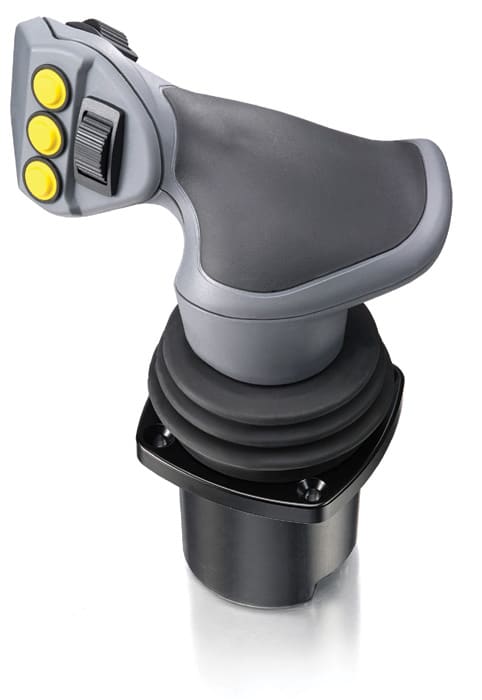
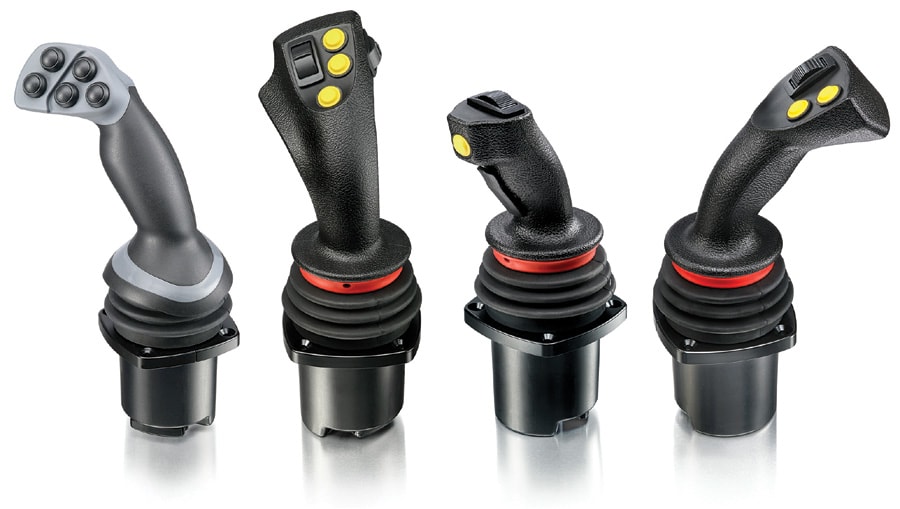
While touch-sensitive displays are a central focus, they’re not displacing the joystick’s central role in vehicle control. Joysticks continue to evolve so operators can do more with less effort. These controls are so critical that design teams are setting extremely high durability parameters for the performance of buttons and rollers on the handles.
“One million cycles has become the minimum, many are asking for more,” said Kyle Peterson, Product Marketing Manager, Americas, at C&K Components. “They also want redundant contacts and sealing to IP68 ratings. At the same time, many companies are looking for turn-key solutions, potted switches with wiring harnesses.”
Ergonomic factors are equally important. HMIs have become a differentiating factor for OEMs, who invest heavily to get a look and feel that exudes comfort and efficiency.
“Joystick grip outlines are very different from customer to customer,” said Rüediger Hüttmann, Product Manager at Danfoss. “Texture, where the buttons are, how the rollers are positioned — they are all elements of brands. It’s easy to discern one company’s grip from another grip.”
Push buttons aren’t as exotic as large screens, but the ancient touch input technology has an important role in the HMI. They can easily be upgraded to provide alerts. These switches can light up to focus the operator’s attention on a control activity that needs attention.

“LEDs can illuminate products independently of the switch circuitry,” Peterson said. “It just requires an extra wire or two to do an LED or a bi-color LED. You can blink them when necessary to help alert operators.”
Joysticks may see an expanded role in the future. Visibility and comfort have become focal points in cab designs, prompting some designers to focus on removing obstacles like steering wheels.
“Someone operating a combine wants an enlarged viewing angle, but the steering wheel can get in the way, so our goal is to let them steer the machine with a joystick,” Hüttmann said. “There may be a scenario where operators can disassemble the steering wheel when they’re working and re-assemble it when they’re driving. That also provides much more flexibility for the operator’s seating position, making it easier to design for ergonomics.”
This strategy highlights the rising complexity that comes when many electrical systems work together. Multiple design teams have to work together to create comprehensive architectures.
“The by-wire project can’t be one business unit; we’ve aligned the groups developing prototype joysticks and steering technologies,” Hüttmann said. “They both have to certify systems to meet safety standards.”
More From SAE Media Group
Automotive Engineering
FEV/DGE System Automates HMI Validation Process
Off-Highway Engineering
Switching to Comfort Mode
Off-Highway Engineering
Looking for a Better Image

Automotive Engineering
Automotive HMIs Aren’t Just for Driving Any More
Automotive Engineering
Connectivity for Comfort
Electronics & Sensors INSIDER
Self-Powered Sensor Automatically Harvests Magnetic Energy
Aerospace & Defense Tech Briefs
Grip Tab Active Controllers
Battery Technology
Advancing Battery Technology: THE 2021 BATTERY SHOW Preview
Tech Briefs
Product of the Month
Automotive Engineering
Airing on the Side of Innovation
Tech Briefs
Essential Control and Visualization, Combined
Off-Highway Engineering
Consumer Electronics Come on Board

Tech Briefs
2025 Award Finalists
Aerospace & Defense Tech Briefs
New Products
Electronics & Sensors INSIDER
Opening Up the Potential of Thin-Film Electronics for Flexible Chip Design

Tech Briefs
Thin-Film Electronics for Flexible Chip Design

Tech Briefs
New on the Market
Off-Highway Engineering
Rethinking Vehicle Controls for On- and Off-Highway Applications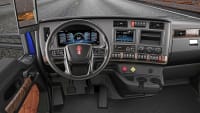
Tech Briefs
Magazine Archives
Tech Briefs
New on the Market: August 2022
Tech Briefs
TE Connectivity's Justin Weigold
Tech Briefs
Products of Tomorrow
Electronics & Sensors INSIDER
Integrating Dimensions to Get More Out of Moore’s Law

Medical Design Briefs
Smart HMIs and Capacitive Touch Technology for Medical Devices
Top Stories
INSIDERManufacturing & Prototyping
 How Airbus is Using w-DED to 3D Print Larger Titanium Airplane Parts
INSIDERManned Systems
 FAA to Replace Aging Network of Ground-Based Radars
NewsTransportation
 CES 2026: Bosch is Ready to Bring AI to Your (Likely ICE-powered) Vehicle
NewsSoftware
 Accelerating Down the Road to Autonomy
EditorialDesign
 DarkSky One Wants to Make the World a Darker Place
INSIDERMaterials
 Can This Self-Healing Composite Make Airplane and Spacecraft Components Last...
Webcasts
Defense
 How Sift's Unified Observability Platform Accelerates Drone Innovation
Automotive
 E/E Architecture Redefined: Building Smarter, Safer, and Scalable...
Power
 Hydrogen Engines Are Heating Up for Heavy Duty
Electronics & Computers
 Advantages of Smart Power Distribution Unit Design for Automotive...
Unmanned Systems
 Quiet, Please: NVH Improvement Opportunities in the Early Design...
