




Connectivity for Comfort
Seat suppliers such as Continental, Johnson Controls, and Faurecia pursue “networked” seats to enhance safety, personalization, and comfort.

Connectivity is a hot topic in the automotive industry, as consumers increasingly expect more in-vehicle integration of mobile devices and linking to the Internet. But seating suppliers are taking connectivity beyond infotainment functions and employing it to make vehicle occupants safer and, importantly, more comfortable.
Continental, for example, is working to develop a link between smartphones and the seat system for further personalization of seating functions. A demonstrator prototype of this technology that Continental revealed last year offers a range of options for greater seating comfort.
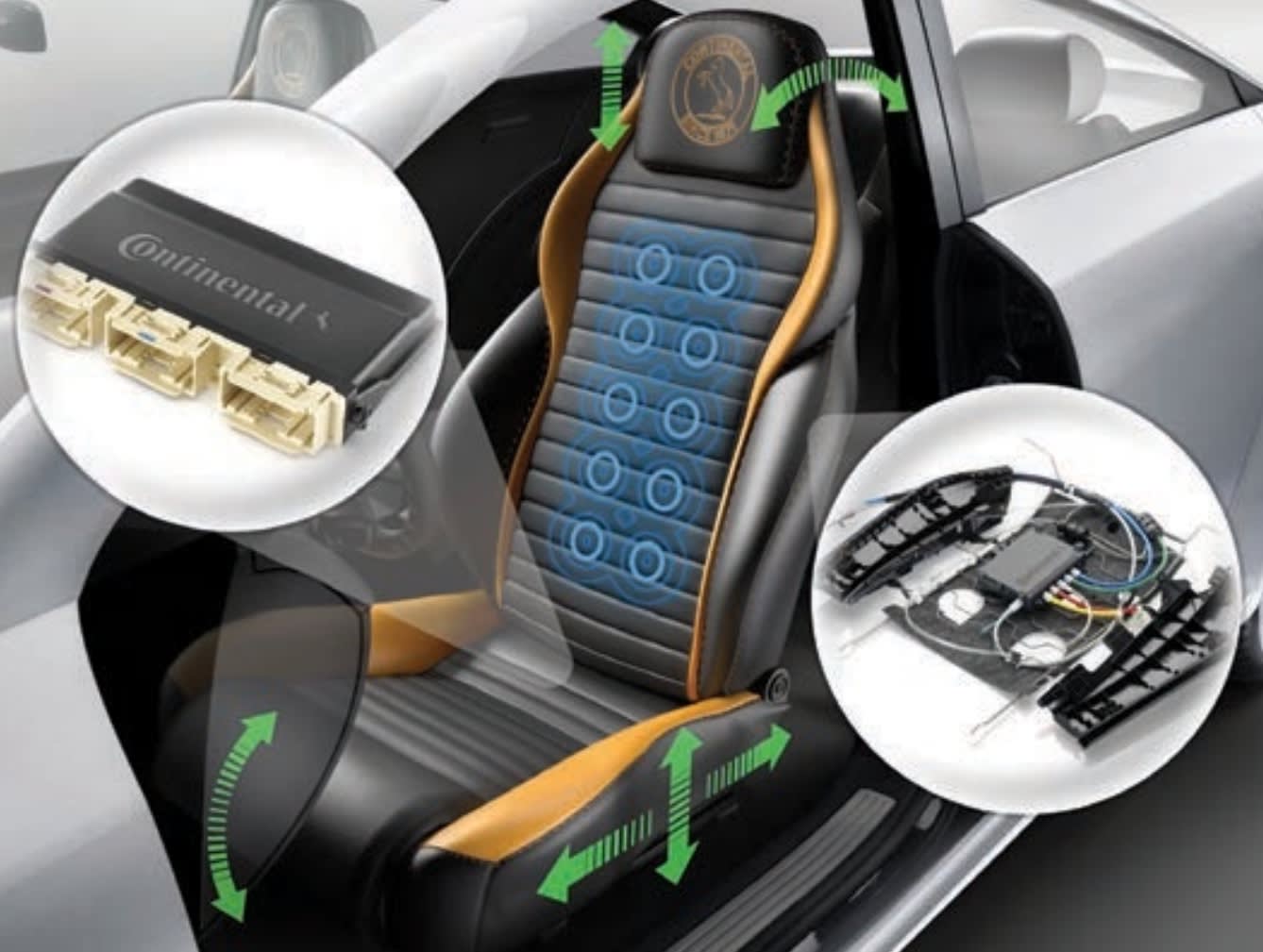
The seat prototype allows drivers to use their home computers or tablet PCs to configure an individual comfort program tailored to their specific needs. This personalization includes seat heating and blower functions as well as individual adjustment of the preferred massage setting.
Another supplier exploring the possibilities of seat connectivity is Johnson Controls, which has developed an automatic seat pre-adjustment system that brings the driver’s seat into a safe, comfortable position based on an individual’s size.
“Connectivity in vehicles means far more than just access to the Internet and email. By networking the vehicles, comfort and safety can also be increased. The automatic seat pre-adjustment is a good example of intelligent interfaces between humans and machines,” said Andreas Eppinger, Group Vice President for Technology Management at Johnson Controls Automotive Seating.
Automatic seat pre-adjustment via smartphone

Developers at Johnson Controls have validated pre-adjustment technology by examining the seat positions of more than 100 test subjects.
“Many people do not position their vehicle seat correctly. This can lead to back pain and stiff legs, particularly during longer journeys,” said Eppinger. “The right seat adjustment is important for safety. This relates not only to the effectiveness of the head restraints, but also to the interaction with the airbags and safety belts. Therefore, we have developed a technology that allows vehicle seats to easily be pre-adjusted automatically.”
The technology is especially useful when more than one person drives the same vehicle — not only vehicles driven by multiple family members but also those in company fleets and from rental companies and car-sharing service providers.

Ergonomics specialists at Johnson Controls developed an algorithm that determines the optimal seat position based on the driver’s size. Based on this algorithm, the adjustment motors automatically move the seat to a position that is both comfortable and safe for that specific individual. In some cases, the driver may still need to fine-tune the seat position to suit his or her personal preferences, the company notes.
“We discovered that correct positioning of the seat track cannot be derived directly from leg length, nor from height adjustment of the seat derived directly from the torso length. Rather, the human body is more like a complex system. If you change one parameter, this has an impact on other variables,” explained Eppinger. “We were able to program the algorithm so that size was sufficient as the decisive adjustment criteria. This enabled very precise default adjustment that was rated as good by the participants in the series of tests we performed. Following minor manual readjustment, they rated the position as very good.”
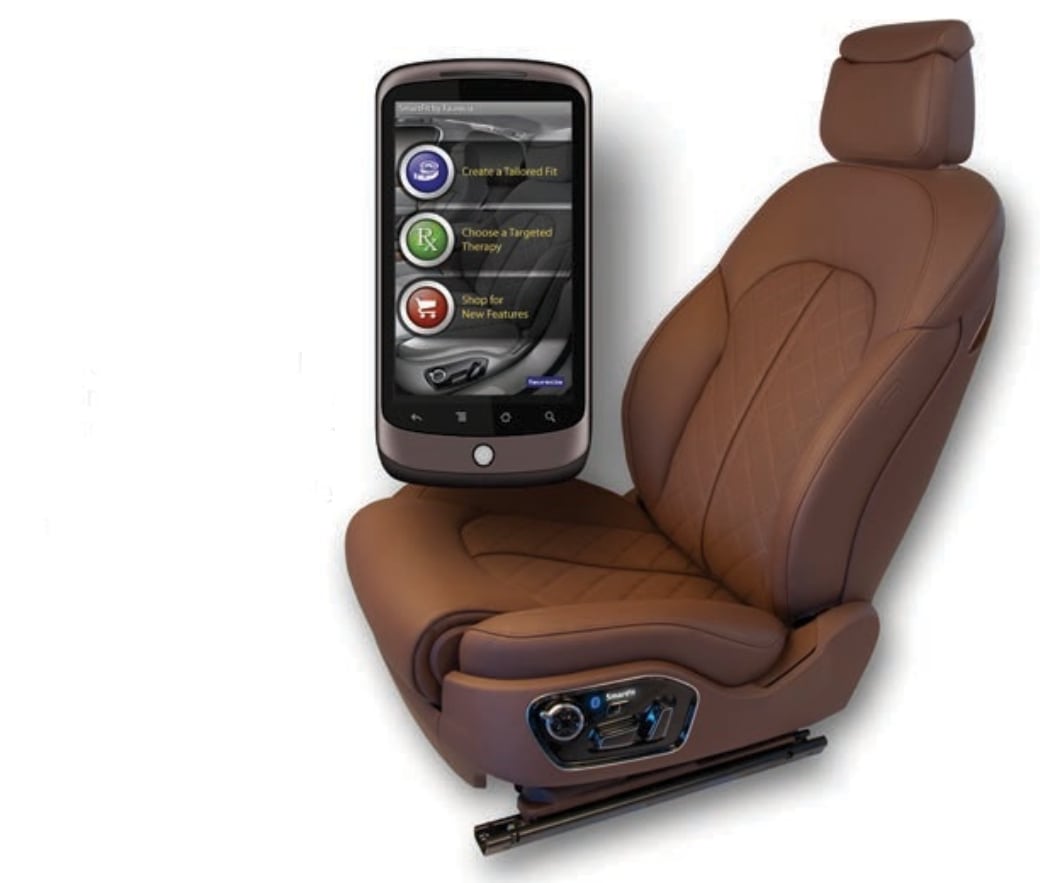
To operate the system, Johnson Controls has developed an app that allows drivers to input their size via a smartphone. This information also can be entered into the vehicle’s digital control console. It is even possible for an onboard camera to automatically measure body size before the driver enters the vehicle and for the seat to adjust accordingly.
For rental cars and car-sharing services, the driver’s size could be stored in a customer profile. This information would be forwarded to the vehicle beforehand, providing a comfortable seating position from the get-go and a nice personal touch.
Controlling comfort
In its attempt to “transform car seats into multifunctional component features,” Continental is employing intelligent electronics. The supplier provides the controls for diverse electric adjustments, HVAC integration, and memory, massage, and safety functions.
“We make a wide range of seat functions possible and use innovative electronic controls to ensure that all passengers can enjoy a comfortable, relaxed, and safe journey,” said Andreas Wolf, head of Continental’s Body & Security business unit.
Position adjustment might be a basic seat function, but it’s also a significant one. Vehicle passengers want to be able to adjust their seats just so for optimum comfort. According to Continental, modern seat systems offer up to 10 different adjustment axes in the seat’s backrest, cushions, and headrests — covering such aspects as the length of the thigh rests, the height of the shoulder pads, and the width of lumbar support. To accommodate this functionality, some seats have up to 11 integrated electric motors, the supplier notes.
So much for the seat being a “simple” automotive system.
Last year, Continental began supplying a massage function for seats in the new Mercedes-Benz S-Class. These pneumatic systems employ air cushions beneath the upholstery to provide additional support and to help reduce strain. More than a dozen cushions can be integrated to provide not only static systems that are manually set, but also dynamic solutions that alter the seat contour and adjust the lateral hold in response to the road — for example, when cornering at high speed.
In addition to air cushions and airlines, the pneumatic seat system from Continental consists of compressors, fast switching valves, and a central control unit.
“This field of technology is gaining in importance,” said Wolf. “Initial massage functions are now already being offered in mid-range vehicles. So, we are making big strides to expand our expertise. We are integrating more and more pneumatic products and functions into seats.”
GPS predicts ‘correct’ positioning
A few years ago, Faurecia developed its SmartFit automated seating adjustment application, which uses a smartphone to take a person’s picture and guide him or her through a process to create a seating profile that’s tailored to that person’s body. Passengers can then pre-adjust their seats via their smartphone.

Faurecia then enhanced the system with GPS Fit, an application that uses data from the vehicle’s GPS to adjust the seat position according to the road configuration and driving conditions (traffic and weather). SmartFit 2.0, as it’s called, was demonstrated in an Audi A8 seat, “which in its high-end version has more than 28 different possible adjustments,” according to Christian Neyrinck, Research & Development Metal Systems Innovation Manager, Faurecia.
“If you want to adjust all those things in sequence — the customer just doesn’t do this,” said Neyrinck. “So the idea was how to make it easy for the customer to use all those features that are in the seat.”
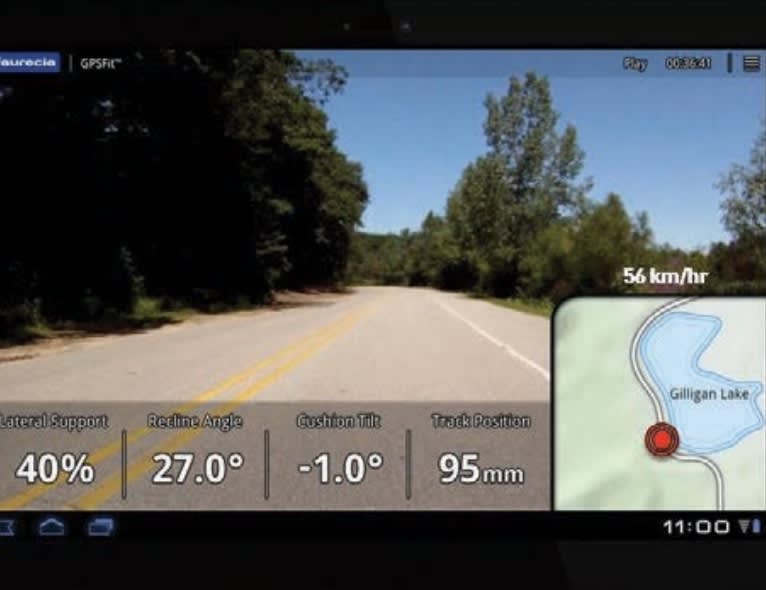
The GPS Fit app combines the information from the original SmartFit “fitting” with the road type, vehicle speed, and other environmental conditions to “predictively adjust” the occupant’s posture. For example, if the driver is about to enter a series of turns, the seat can change to furnish a more performance-oriented posture, according to Faurecia. The backrest angle can adjust to offer a better point of view, and the cushion angle can shift to provide better support during braking and lateral support adjustment to properly hold the driver in the seat.
Bringing the GPS Fit application to production is not without its challenges, Neyrinck noted. “The GPS Fit works well as long as the [navigation information] is correct and up to date. This is a bit of an issue we have,” he shared. “Sometimes you come to a point where the road is new and not yet integrated into the GPS data, so the GPS Fit function is delivering false commands—it doesn’t adjust when it should or it adjusts when it should not, depending on the mistake. We have to rely too much on the GPS material for that.”
Connecting to ‘bio’ data
A second app Faurecia developed for its 2.0 version is MicroFit. SmartFit initially adjusts cushion height, backrest height, reclining position, and tracking; MicroFit then uses the pneumatic system — sensors on five bladders in the backrest and two in the seat cushion — to read the pressure levels of the occupant’s body on the seat surface. MicroFit automatically balances the pneumatic system to provide more support to areas where too little pressure exists or relief where too much pressure is indicated, according to Faurecia.
“Connectedness means now also connecting to bio data of the occupant — monitoring heart rate, respiration frequency, blood oxygenation, things like that,” Neyrinck said. “We can connect this with specific massage applications, for example, but it can even go further: if someone does not feel very well and we detect it, imagine what you can do with all this data.”
The data also can be used more generally to determine how parameters change during a very long ride, for example. “Understanding more about that helps us to make the right [adjustments] with the seat: How can I make sure that the driver feels better at the end of the ride than at the beginning,” he said. “Once you have all those connections, you can always add functions on top.”
The technology is ready to be integrated in vehicles, according to Neyrinck. So when will these applications appear in production vehicles?
“Some of the SmartFit functionality, but probably not all, is expected in vehicles, but we can’t tell which vehicle yet,” said a Faurecia spokesperson.
Added Neyrinck: “When we first developed this in 2011, connectedness was not as much of a key topic as it has become in the last year. I think we were a little bit ahead of our time. What we see now, it’s coming back and all of a sudden customers ask us about SmartFit.
“From our side, it’s fully developed — from the electronics point of view, etc. — and now we will see which pieces the customers will take.”
More From SAE Media Group
Autonomous Vehicle Engineering
Honda Puts Autonomous Vehicles to Work
Automotive Engineering
Honda to Reveal Autonomous Work Vehicle at CONEXPO
Battery Technology
Advancing Battery Technology: THE 2021 BATTERY SHOW Preview
Off-Highway Engineering
Vermeer Concept Targets Autonomous Baling
Automotive Engineering
Two-Wheeled Tech: The Latest in Motorcycle Applications
Automotive Engineering
Airing on the Side of Innovation
Automotive Engineering
AVSC Develops Best Practices for Traceable AV Safety Inspection Protocols
Automotive Engineering
Automotive HMIs Aren’t Just for Driving Any More
Automotive Engineering
Snapdragon Ride Flex Puts Safety, Infotainment onto Single Chip
Off-Highway Engineering
Sensors Evolve to Satisfy CV Demands
Automotive Engineering
Planning for a Digital World
Automotive Engineering
Electronic Stability Control Builds the Foundation for Safer Roads
Off-Highway Engineering
Engine Developers Increase Efforts to Decrease Fuel Usage
Off-Highway Engineering
ABS Ramps up Commercial-Vehicle Battery-Pack Assembly
Tech Briefs
Periodic Wave Disc Brake Rotor
Tech Briefs
SAE WCX™ Digital Summit Preview
Automotive Engineering
MAGNA Say Some Hurdles of Seat-reconfiguration System to Be Addressed by OEMs
Battery & Electrification Technology
Ultracapacitor Solutions to Address Energy-Storage Needs of Vehicles
Off-Highway Engineering
Freightliner’s Medium-Duty Makeover
Off-Highway Engineering
Israeli Startup REE Reinvents the Wheel with a Modular Approach to Future EV Design
Automotive Engineering
Elevate: Hyundai’s New Four-Wheel Drive, Four-Legged Off-Road Vehicle
Off-Highway Engineering
MOBI Rolls out the First Blockchain-Enabled Vehicle Identity (VID) Mobility Standard
Off-Highway Engineering
Autonomous Quarry Haulage in High Demand
Automotive Engineering
Toyota Stretches SUV Line-Up with World Debut of Grand Highlander
Aerospace & Defense Tech Briefs
Personal Air Transport Drives Need for Advanced VTOL Technologies, Standards
Off-Highway Engineering
REE’s P7 Brings Advanced Suspension Control to Medium-Duty Trucks
Off-Highway Engineering
WAVE Inductive Charging Purpose-Built for Large EVs
Aerospace & Defense Tech Briefs
SAE International Extends Call for Abstracts, Seeks Submissions for AeroTech Conference
Top Stories
INSIDERManufacturing & Prototyping
 How Airbus is Using w-DED to 3D Print Larger Titanium Airplane Parts
INSIDERManned Systems
 FAA to Replace Aging Network of Ground-Based Radars
NewsTransportation
 CES 2026: Bosch is Ready to Bring AI to Your (Likely ICE-powered) Vehicle
NewsSoftware
 Accelerating Down the Road to Autonomy
EditorialDesign
 DarkSky One Wants to Make the World a Darker Place
INSIDERMaterials
 Can This Self-Healing Composite Make Airplane and Spacecraft Components Last...
Webcasts
Defense
 How Sift's Unified Observability Platform Accelerates Drone Innovation
Automotive
 E/E Architecture Redefined: Building Smarter, Safer, and Scalable...
Power
 Hydrogen Engines Are Heating Up for Heavy Duty
Electronics & Computers
 Advantages of Smart Power Distribution Unit Design for Automotive...
Unmanned Systems
 Quiet, Please: NVH Improvement Opportunities in the Early Design...
