




Rethinking Vehicle Controls for On- and Off-Highway Applications
Smarter control architectures including CAN- and LIN-based multiplexing can elevate operational efficiency, customization and end-user experience.

From long-haul Class 8 trucks navigating cross-country routes to articulated dump trucks operating deep in a mining pit, the need for smarter, more reliable and more efficient control systems has never been more critical. Across both on- and off-highway commercial vehicle segments, OEMs are re-evaluating how operators interact with machines – and how those systems can be made more robust, flexible and digitally connected.
Suppliers have responded to this industry-wide shift with new solutions that reduce complexity, improve durability and help customers future-proof their vehicle architectures. For example, Eaton’s latest advancement is the E33 Sealed Multiplexed (MUX) Rocker Switch Module (eSM) – a sealed, modular switch solution that replaces traditional electromechanical designs with a multiplexed digital interface. Combined with Eaton’s OMNEX Trusted Wireless mobile control systems, these innovations provide OEMs with a unified ecosystem for both cab-based and remote vehicle control.
Eaton also offers the E34 MUX switch line, which builds on the same multiplexing foundation with newer technology, enhanced functional safety (FuSa), upgraded Controller Area Network Bus (CAN) and Local Interconnect Network (LIN) channels, and expanded customer functionality. The E35 is currently being developed with FuSa on-road (ISO 26262) and off-road (ISO 19014) safety standards.
Common challenges, different conditions

On-highway commercial vehicles such as transit buses, vocational trucks and long-haul tractors face a different set of control-system challenges than their off-highway counterparts in construction, mining or agriculture. Yet, both segments are converging around a similar need: control systems that are digitally intelligent, customizable and tough enough to handle demanding environments.
For example, in the on-highway world, drivers of electric or hybrid trucks need reduced wiring and weight to improve efficiency and range. Meanwhile, off-highway operators — often wearing gloves and working in harsh conditions — need tactile, sealed switchgear that won’t fail under pressure or vibration. Solutions like the E33 eSM are being built with both extremes in mind. The E33, which is Ingress Protection (IP) 68 rated, withstands water, dust, mud and temperature extremes, making it suitable for rugged construction vehicles as well as over-the-road equipment operating in snow, ice or salt-laden conditions. (An IP68 rating means the product is completely dust-tight and can withstand continuous immersion in water beyond one meter.) The module also supports up to 500,000 switch cycles, ensuring long-term reliability whether installed in a mining truck or municipal plow.
Smarter wiring for modern platforms
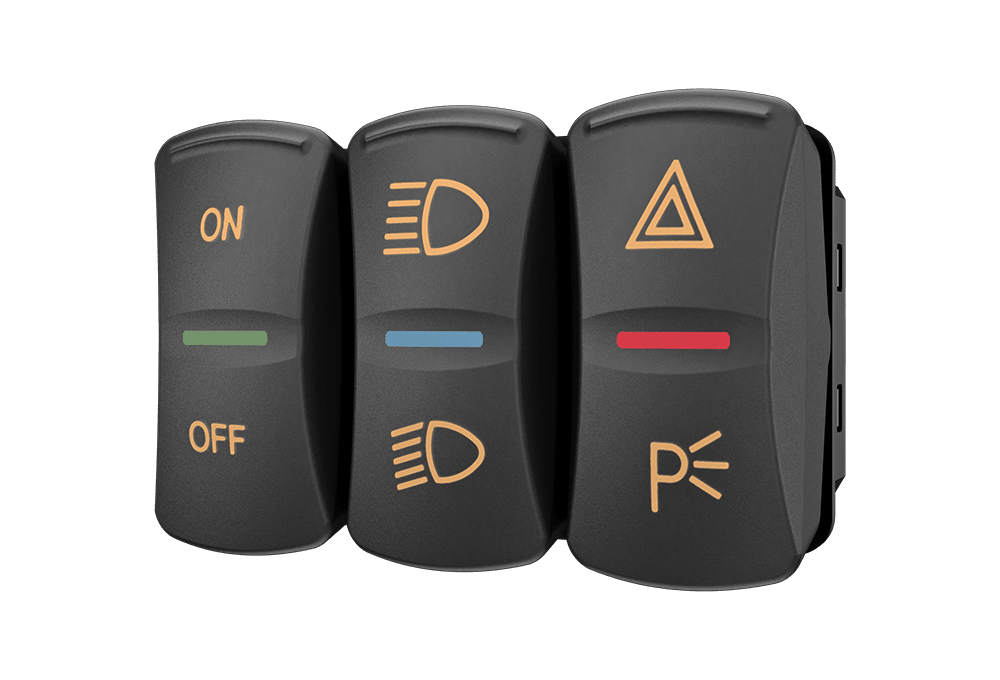
One of the most important innovations of the E33 – and the broader Eaton MUX switch family – is how it simplifies system architecture. Traditional electromechanical switch panels are wiring-intensive – each switch requires its own power and signal path, often resulting in bulky harnesses that are labor-intensive to install, heavy and prone to failure in environments with severe vibrations.
In contrast, MUX switches use a CAN J1939-compliant multiplexed architecture. CAN J1939 is a widely used communications standard in commercial vehicles that allows multiple electronic control units (ECUs) to communicate with each other over a single data bus. By using this protocol, wiring is dramatically reduced. Instead of 20 or more wires for 20 switches, a daisy-chain system allows multiple modules to communicate via just a few lines.
To further enhance efficiency, Eaton also employs LIN as a sub-bus within its multiplexing architecture. LIN is a lower-cost, lower-speed serial network protocol often used to connect smaller devices and sensors to the main CAN bus. This allows:
- A single CAN connection to support up to 64 switches (keypads) or 24 switches (rocker modules)
- Simplified wiring harnesses
- Enhanced diagnostics and operator feedback
- Reduced installation time and cost.
This proprietary LIN implementation is part of a broader electronic control strategy, which shifts from traditional electromechanical systems to MUX-based electronic switch modules. These modules improve reliability, reduce weight and provide late-point definition capabilities for OEMs and integrators.
Flexibility in the field

The E33’s modular, software-driven design also unlocks new field-level configurability. Each switch module can be reprogrammed via an input/output (I/O) flash update to perform a new function. Operators or upfitters can then physically change the rocker cap to reflect that updated function without needing to reroute wiring or replace the switch itself.
This level of flexibility is invaluable in both on- and off-highway applications. Fleet operators, for example, may need to configure trucks differently depending on local regulations, customer preferences or seasonal use. In off-highway markets, the same base machine might be used for different tasks on different jobsites – or even sold across regions with different functional requirements.
Instead of re-engineering the entire electrical system, OEMs can now support these variations with simple software updates and minimal mechanical intervention. That also means lower parts inventories, faster vehicle customization and simpler service down the road.
Meeting functional safety head-on
Whether operating a refuse truck in downtown Chicago or a bulldozer on a remote jobsite, FuSa is becoming a top concern – especially in Europe, where regulations are tightening. By 2027, electronic vehicle controls sold in the Europe, Middle East and Africa (EMEA) region will need to meet SAE-derived functional safety standards, which include built-in redundancies for critical systems like lighting, braking and battery management.
Building rocker switch modules with these requirements in mind is key. For example, Eaton’s architecture supports fault-tolerant communication, safety-rated designs and configurable logic to ensure compliance with evolving standards. For electric vehicles in particular – where a loss of power or control could pose serious risks – controls are designed to manage emergency functions such as battery disconnects and hazard lighting, even during power failures.
Wireless control for hazardous zones

While switches like the E33 represent a step forward in in-cab controls, mobile control systems like OMNEX Trusted Wireless extend that functionality beyond the vehicle, which is especially important for off-highway operations. These wireless remote-control units, operating at 900 MHz or 2.4 GHz, give operators the ability to manage high-value equipment safely and efficiently from up to 1,650 feet (503 m) away.
This capability offers safety and productivity benefits. Whether operating a crane, vacuum truck, concrete mixer or boom lift, remote operation allows personnel to stand in a safer, more advantageous location, eliminating the need for spotters or co-pilots in many cases. It also reduces fatigue and exposure to hazards like dust, noise or moving machinery.
Eaton’s latest wireless models include the TD110 compact handheld, the TD1140 handheld with display and optional emergency stop (E-Stop), the TD2100 with a pistol-grip design, and the TD3100 small belly-pack. All units are IP65/IP67-rated for durability. (IP65 means dust-tight and resistant to low-pressure water jets, while IP67 means dust-tight and protected against immersion in water up to one meter for 30 minutes.)
The units also come equipped with programmable feedback options like haptic alerts, LED sequences, and displays – suitable for showing load weights or arm extension positions in real time. They have also been enhanced with fail-safe logic, and lithium-ion batteries for longer field performance.
A unified control ecosystem
Multiplexed switch modules and wireless mobile control systems are transforming how commercial vehicle OEMs design, build and support both on- and off-highway platforms. From simplified wire harnesses and modular customization to remote control and functional safety, these solutions help customers bridge the gap between rugged performance and digital intelligence.
By investing in smarter control architectures – including CAN- and LIN-based multiplexing – OEMs across the commercial vehicle industry are unlocking new levels of operational efficiency, customization and end-user experience.
Carlos Ortega, Business Unit Director, Vehicle Controls and Wireless, Eaton’s Mobility Group, wrote this article for SAE Media.
More From SAE Media Group
Automotive Engineering
Etching for a Greener Future
Automotive Engineering
SAE WCX 2022: EV Cybersecurity Threats
Off-Highway Engineering
Addressing Electromagnetic Compatibility in the Context of Aircraft Electrification
Tech Briefs
Hyper-Distributed RFID Antenna (HYDRA) System

Tech Briefs
Robust Serial Communications

Sensor Technology
What Will 5G Do for the IoT/IIoT?
Tech Briefs
New on the Market: March 2022
Tech Briefs
Electronics Cooling Using Additive Manufacturing

Off-Highway Engineering
Data Connectivity in Heavy-Duty Vehicle Environments
Battery Technology
Advancing Battery Technology: THE 2021 BATTERY SHOW Preview
Battery & Electrification Technology
Zonal Electrical Architectures Cut Vehicle Wiring-System Cost, Complexity
Aerospace & Defense Tech Briefs
Industry Invited to Participate in AeroTech Aerospace and Defense Technical Program

Tech Briefs
Product of the Month
Off-Highway Engineering
Peloton Develops a Level 4 Automated Platooning System, but Keeps the Driver in Charge
Automotive Engineering
Nvidia Partners with AdaCore to Secure Self-Driving Firmware
Electronics & Sensors INSIDER
Researchers Demonstrate Cutting-Edge Chip Technology for Ultra-Low Power AI Connected Devices
Off-Highway Engineering
WAVE Inductive Charging Purpose-Built for Large EVs
Battery & Electrification Technology
Using Silver Sintering in Traction Inverter Assembly
Aerospace & Defense Tech Briefs
SAE International Extends Call for Abstracts, Seeks Submissions for AeroTech Conference
Aerospace & Defense Tech Briefs
Martin UAV VTOL Unmanned Aircraft Taps Persistent Systems Wave Relay Data Link Technology
Tech Briefs
Magazine Archives
Tech Briefs
New on the Market

Sensor Technology
The Many Uses of Inductive Position Sensors in the IIoT
Top Stories
INSIDERManufacturing & Prototyping
 How Airbus is Using w-DED to 3D Print Larger Titanium Airplane Parts
INSIDERManned Systems
 FAA to Replace Aging Network of Ground-Based Radars
NewsTransportation
 CES 2026: Bosch is Ready to Bring AI to Your (Likely ICE-powered) Vehicle
NewsSoftware
 Accelerating Down the Road to Autonomy
EditorialDesign
 DarkSky One Wants to Make the World a Darker Place
INSIDERMaterials
 Can This Self-Healing Composite Make Airplane and Spacecraft Components Last...
Webcasts
Defense
 How Sift's Unified Observability Platform Accelerates Drone Innovation
Automotive
 E/E Architecture Redefined: Building Smarter, Safer, and Scalable...
Power
 Hydrogen Engines Are Heating Up for Heavy Duty
Electronics & Computers
 Advantages of Smart Power Distribution Unit Design for Automotive...
Unmanned Systems
 Quiet, Please: NVH Improvement Opportunities in the Early Design...
Power

Similar Stories
NewsElectronics & Computers

NewsPower
 Scania Adapts On-Highway Diesel for New Off-Highway Engine Platform
ArticlesDesign
 Redefining Modern US Navy Shipbuilding with Additive Manufacturing
ArticlesUnmanned Systems
 Why Heat Exchanger Manufacturers Need to Rethink Design and Fabrication
Technology ReportPower
 New Four-Chamber Rotary Engine Could Supplant Wankel and Piston Engines for UAV...
