




Steering Mazda’s Unique Course
A chassis engineer at heart, Chairman Kanai challenges his engineers to think differently and embrace the Skyactiv technology that has made Mazda a benchmark.

In 1999 Mazda Motor Corp.’s current Chairman, Seita Kanai, had just taken over as program manager for the first-generation Atenza/ Mazda6. The new car was a top priority and its success was deemed vital to the Hiroshima-based automaker’s survival — this was Mazda’s first new product in 18 months. Considered an “engineer’s engineer” within a company that prides itself on technical creativity, Kanai was under significant pressure from both Mazda management and from Ford Motor Co., which owned a controlling stake, to deliver an exceptional car.

“It was then Kanai-san’s dream — and he strongly believed — that Mazda would someday produce a car that would ‘beat up’ the German premium sedans,” recalled Masahiro Moro, the CEO of Mazda North American Operations and good friend of Kanai, who at the time was the young head of product marketing. But in his first benchmarking drive of the incumbent Mazda sedan on the German autobahn, Kanai was shocked.
“Our car’s speed was less than 180 kph and was shaking a lot,” Moro noted, “while Mercedes and BMWs were passing him by. Because of this experience, Kanai was determined to build Mazdas that would lead the industry in vehicle dynamics and efficiency.”
While the Ford product-development system at the time was focused on delivering middle-of-the-road driving characteristics, Kanai — a long-time fan of the Hiroshima Carp baseball team — preferred to deliver “the high inside fastball — the really surprising stuff,” Moro said.
“I could hardly qualify myself as a ‘car guy’ in my youth,” Kanai told Automotive Engineering. But he was energetic and a natural problem-solver. Not long after he joined Mazda’s chassis design department in 1974, fresh out of university, he developed a passion for the mechanics and physics of vehicle dynamics. Kanai played a role in several chassis innovations, including the TTL (twin-trapezoidal link) rear suspension of the 1980 front-drive 323 and the 1982 626 — two cars that greatly contributed to Mazda’s rebound and growth.
He then gained further acclaim for his team’s patented “E-link” rear suspension of the 929 large sedan, a clever reactive multi-link type endowing the car with a combination of agility and stability.
Finding unique value
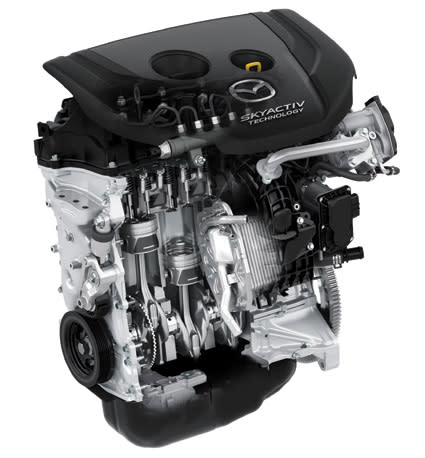
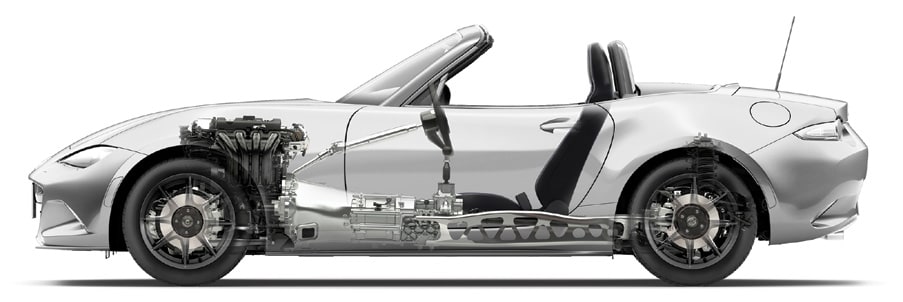
Nearly two decades later, the chassis engineer and Carp fan is at the helm of Mazda, perhaps best known for its purist MX-5 sports car and a brand built on being agile, flexible and delivering a high fun-to-drive quotient across the product segments in which it plays. His influence is apparent. Superior steering, handling and agility enabled by stiffer, lighter-weight structures and components has indeed made Mazda a clear alternative to the Germans on multiple fronts, including its latest line of CX-3, China-exclusive CX-4, CX-5 and CX-9 sport-utilities. Such engineering attributes including advanced powertrains are part of Mazda’s holistic vehicle-efficiency strategy known as Skyactiv, which Kanai helped spearhead.
Industry analysts traditionally have viewed Mazda as lacking scale and financial muscle but driven by a strong “overdog” spirit that enables it to innovate and power forward against much larger rivals. U.S. boss Moro agrees: “We always ‘punch above our weight class!’” he quipped. This was particularly true in 2008 when Ford control ended and Mazda was again left alone with a paltry R&D budget.
As one of Japan’s most export-dependent automakers, Mazda is especially sensitive to exchange rate swings. Unfavorable exchange rates typically hit Mazda hard and a more expensive yen reduces the profit the company can book on the vehicles sold overseas. About 63% of its global output comes from Japan and 80% of that is exported. The Japanese yen’s appreciation took ¥34 billion off the company’s operating profit in second quarter 2016.
Mazda’s strategy is to grow unit sales volume and profit by: investing more in and expanding deployment of its Skyactiv platform and powertrain technologies; introducing more crossovers; and establishing a broader overseas production footprint.
“When we copied the strategy of the big players and fought under their rules and on their battle-ground, we lost,” Moro noted. “When we competed only on price and discount, we disappointed people. So Kanai-san challenged us to change our mindset — to find Mazda’s unique value: Vehicle development technology, vehicle dynamics and fun-to-drive. Engineering excellence and vehicle efficiency are the focus.”
Hybrids and hydrogen
Mazda has yet to make a major commitment to vehicle electrification, with only a few Japan-only hybrids and battery-electric vehicles in the field thus far. A Mazda twist on hybrid technology is the “E-Loop” regenerative brake system, now in production, that stores electric energy in a capacitor and supplies it to power vehicle accessories. Talk of a diesel-hybrid surfaced within the diesel program and leveraged a works-supported endurance racing effort to promote the (stillborn) Skyactiv-D models in the U.S. This was quietly swapped for the Skyactiv-G (gasoline) power unit.
Mazda powertrain engineers realized that the cost of full urea-based aftertreatment for light-duty diesel was too burdensome — for North America.
But in Japan, the Skyactiv-D is outselling the G, an extraordinary phenomenon in a market where diesels have not been popular. The CX-3 in the home market is exclusively diesel. At this time, Mazda is the only Japanese OEM that offers diesel cars — albeit with vastly different emissions-control suites than in the U.S.
But Kanai realizes that Mazda may need to incorporate electrification to meet at least some U.S. regulations. Mazda is among a group of OEMs that must comply with California’s zero-emission vehicle mandate beginning in 2018. Along with other smaller carmakers it successfully lobbied to change the regulations so that plug-in hybrids can count toward the sales totals. While Mazda continues its hydrogen-fuel R&D, supplying a fleet of H2-fueled rotary RX-8s to be evaluated in Scandinavia, Kanai is pragmatic. He considers fuel cell vehicles a variation of the EV.
Hybrids are mostly and primarily ICE-propelled, Kanai reasons, so Mazda should concentrate its resources on ICE optimization that would enable reducing the degree of electrification that involves cost, mass and complication. However, the company has joined with Toyota in a “long term” technology-sharing deal that is expected to provide Mazda with components and know-how for future Mazda HEVs and PHEVs.
While Mazda may have fallen behind in the hybrid race, it is widely acknowledged as a benchmark in further optimizing internal-combustion engines. The Skyactiv program is well along in marrying Otto and Diesel cycle characteristics as development progresses through G1, G2, and G3 stages.
At the 2015 SAE High-Efficiency Engine Symposium, Mazda ICE Technical Center Research Manager Hiroyki Yamashita noted that “Our target with the G3 is 18:1 compression ratio at lambda 2.5 — and up to a 40% improvement in thermal efficiency by setting the ideal pressure and temperature for HCCI combustion.” He said the G3 program focuses on heat transfer from the combustion chamber and employs a special sprayed-on thermal insulation coating on the piston crown and chamber walls.
Mazda also is in the vanguard of reducing internal friction across its ICEs, noted Marc Sens, IAV Automotive’s Head of Department Thermodynamics/Boost Systems. “We’ve tested their [G1] Skyactiv engines and their claim of 30% friction reduction over the previous generation is real — very impressive,” he told Automotive Engineering.
Learnings from Ford
The period under Ford’s 34% majority stake included many joint engineering programs and is seen as a “difficult time” by some in Mazda management. But Kanai said he “learned hugely from Ford’s logical and painstakingly exacting marketing and product planning, and analytical methods, versus what we at Mazda had been doing.”
The product planners in Hiroshima had been used to putting passion at the top of their proposals. “Surely we calculated target cost but invariably preceded by ideals, relegating such ‘earthly’ issues as sales volume, retail prices, marketing and sundry expenditures to their respective executives and specialists,” Kanai noted.
Today he lavishes praise on “the young lions Dearborn dispatched to Mazda” including current Ford CEO Mark Fields (then president) and the successive Senior Managing Directors for R&D, Martin Leach, Phil Martens and Joe Bakaj. In late 1999, Fields gathered all managers in the company’s auditorium and delivered an impassioned speech that Kanai remembers as a call to battle: “Firmly establish and strengthen the Mazda brand, or else!”
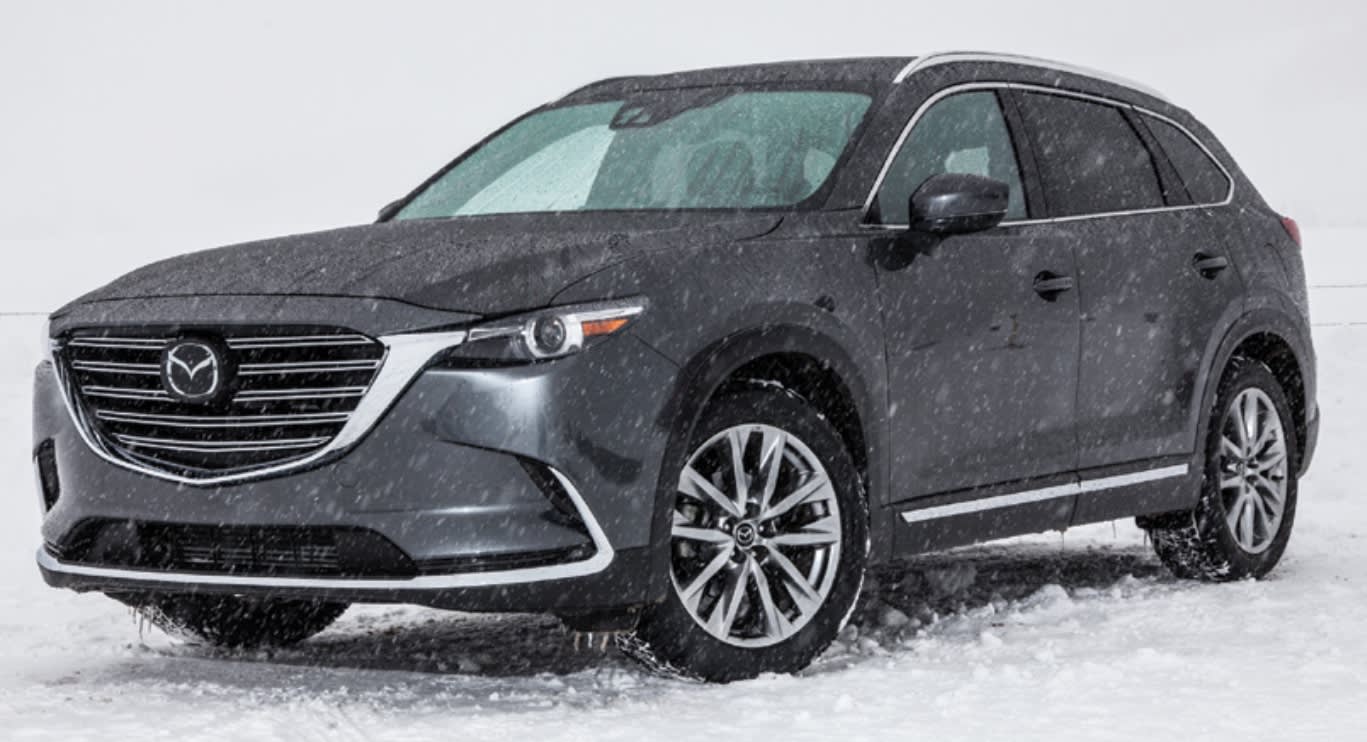
The now familiar “Zoom-Zoom” strategy and brand identity that followed was in perfect synch with Kanai’s own development concept that focused on vehicle agility and dynamic precision. “I am hugely grateful and owe to the Zoom-Zoom movement. The whole company and our suppliers responded to the dynamic cause represented by the strategy,” he said.
Autonomy and rotary future?
Having revealed the full Skyactiv technologies in September 2011, Mazda’s powertrain engineers continue to push the combustion frontiers (and help rationalize gasoline and diesel engine production). Kanai is particularly proud of the latest offering, the CX-9, calling the mass-efficient SUV “the best premium vehicle we have ever produced.” Its Skyactiv turbocharged 2.5-L inline four replaces the previous-generation CX-9’s Ford Cyclone-based 3.7-L V6 with a much smaller, lighter and more powerful package.
Mazda has been researching autonomous vehicle operation for many years, like other major OEMs. “Self-driving is not in our planning scope,” Kanai asserted. “People—maybe excepting professional transport drivers — derive pleasure when they could drive to their satisfaction, taking corners, bends, up and down hill, etc. Our neuroscientists conform that driving invigorates brain functions. We are not taking that pleasure away by driverless operation,” he said while noting that Mazda is incorporating the latest driver-assist technologies.
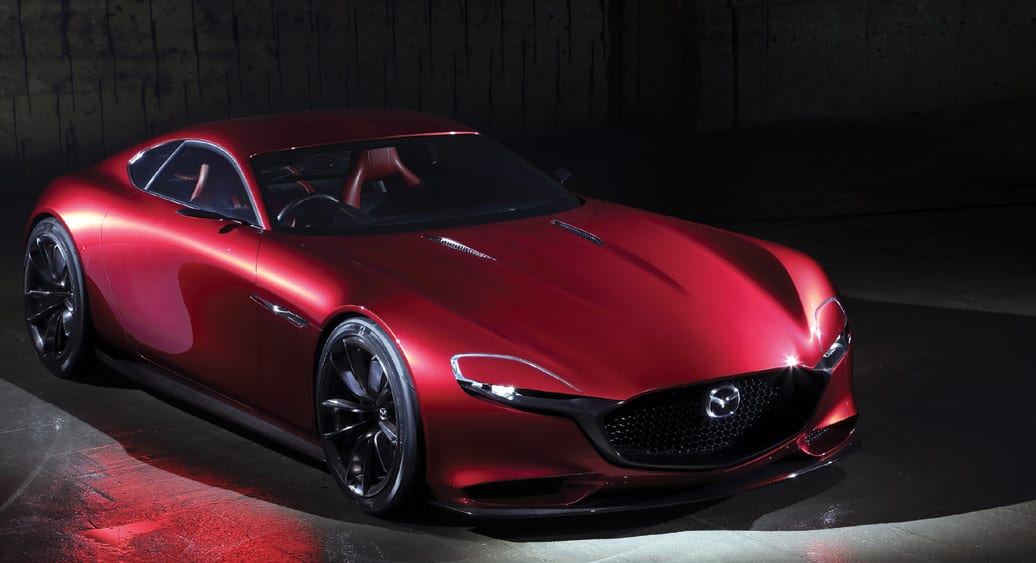
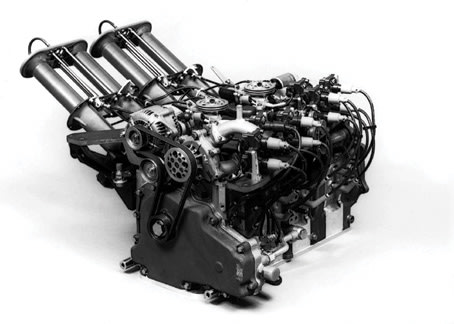
An inevitable question regards the future, if any, of the rotary engine at Mazda. Does the recent RX-Vision concept herald a production car? Rumors and speculation are rampant in Hiroshima. Kanai recognizes the biggest challenge still ahead is the rotary’s inherent shortcoming, fuel consumption. His engine teams are working on the issue and may have some promising measures for a solution.
“It [a rotary] would have to be [in] a sports car that could match if not exceed the best of the world,” said Kanai. Mazda has already hinted the number “16,” signifying single chamber volume of 800 cm3.
Mazda also has demonstrated a range-extender EV based on the Demio/Mazda2 hatchback. It’s a single-rotor engine with 330-cm3 chamber capacity mounted with its eccentric shaft (crankshaft equivalent) vertically driving a generator. The whole system fit neatly under the luggage compartment. Chairman Kanai said the rotary could fill the bill for such applications.
Stay tuned.
More From SAE Media Group
Automotive Engineering
New Dawn at Honda R&D
Off-Highway Engineering
ZM Trucks Starts Production in Fontana, California
Off-Highway Engineering
Electrification’s Impact on Commercial-Vehicle Chassis Design
Automotive Engineering
Toyota Stretches SUV Line-Up with World Debut of Grand Highlander
Automotive Engineering
Packaging Honda’s all-new Insight
Off-Highway Engineering
A Bevy of Battery and Fuel-Cell Electric Truck Reveals
Automotive Engineering
2026 Nissan Sentra Review: Putting the Pieces Together
Automotive Engineering
Tension and the Electric Takeover
Automotive Engineering
Mazda Plots Wankel-powered Range Extenders, HCCI Mild Hybrids
Automotive Engineering
The Man From APPA-E
Battery & Electrification Technology
Ultracapacitor Solutions to Address Energy-Storage Needs of Vehicles
Autonomous Vehicle Engineering
Autonomy: the New Age of Automobility
Off-Highway Engineering
ZF Premieres AxTrax 2 Electric Axle Platform at ACT Expo
Automotive Engineering
Engineering ‘Electron Guzzlers’
Tech Briefs
Making Diesel Engines Nearly Emission-Free
Automotive Engineering
Suppliers Struggling to Keep Pace with Faster Product Cycles, Says IHS
Automotive Engineering
2024 Lexus GX Ready for Off-Road Adventure with New Platform, E-KDSS
Autonomous Vehicle Engineering
AV Powers Bring May Flowers
Automotive Engineering
Preparing for a 48-volt Revival
Automotive Engineering
Volvo's New Plug-In XC90 Is Really a Tri-Motor
Automotive Engineering
2015 Mondeo Launch Shows Flexibility, Challenges of One Ford Strategy
Off-Highway Engineering
Digital Tech a Las Vegas Headliner
Off-Highway Engineering
Hyundai’s Fuel-Cell Dreams Remain Xcient

Automotive Engineering
Time with the Teardown Titan
Automotive Engineering
Hau Thai-Tang Is Engineering a New Ford
Automotive Engineering
CES 2019: Blueprint for Future Auto Shows?
Automotive Engineering
Ford Approved for Hands-Off Driving on German Autobahn
Automotive Engineering
2026 Nissan Leaf First Drive: Fun and More Efficient
Top Stories
INSIDERManufacturing & Prototyping
 How Airbus is Using w-DED to 3D Print Larger Titanium Airplane Parts
INSIDERManned Systems
 FAA to Replace Aging Network of Ground-Based Radars
NewsTransportation
 CES 2026: Bosch is Ready to Bring AI to Your (Likely ICE-powered) Vehicle
NewsSoftware
 Accelerating Down the Road to Autonomy
EditorialDesign
 DarkSky One Wants to Make the World a Darker Place
INSIDERMaterials
 Can This Self-Healing Composite Make Airplane and Spacecraft Components Last...
Webcasts
Defense
 How Sift's Unified Observability Platform Accelerates Drone Innovation
Automotive
 E/E Architecture Redefined: Building Smarter, Safer, and Scalable...
Power
 Hydrogen Engines Are Heating Up for Heavy Duty
Electronics & Computers
 Advantages of Smart Power Distribution Unit Design for Automotive...
Unmanned Systems
 Quiet, Please: NVH Improvement Opportunities in the Early Design...
