




Supplier Technologies Could Nix the Steering Wheel and Unleash 360-Degree Stereo Camera Views
Hitachi Astemo is developing 360-degree stereo camera sensing and steer-by-wire operation via a palm-sized input device.
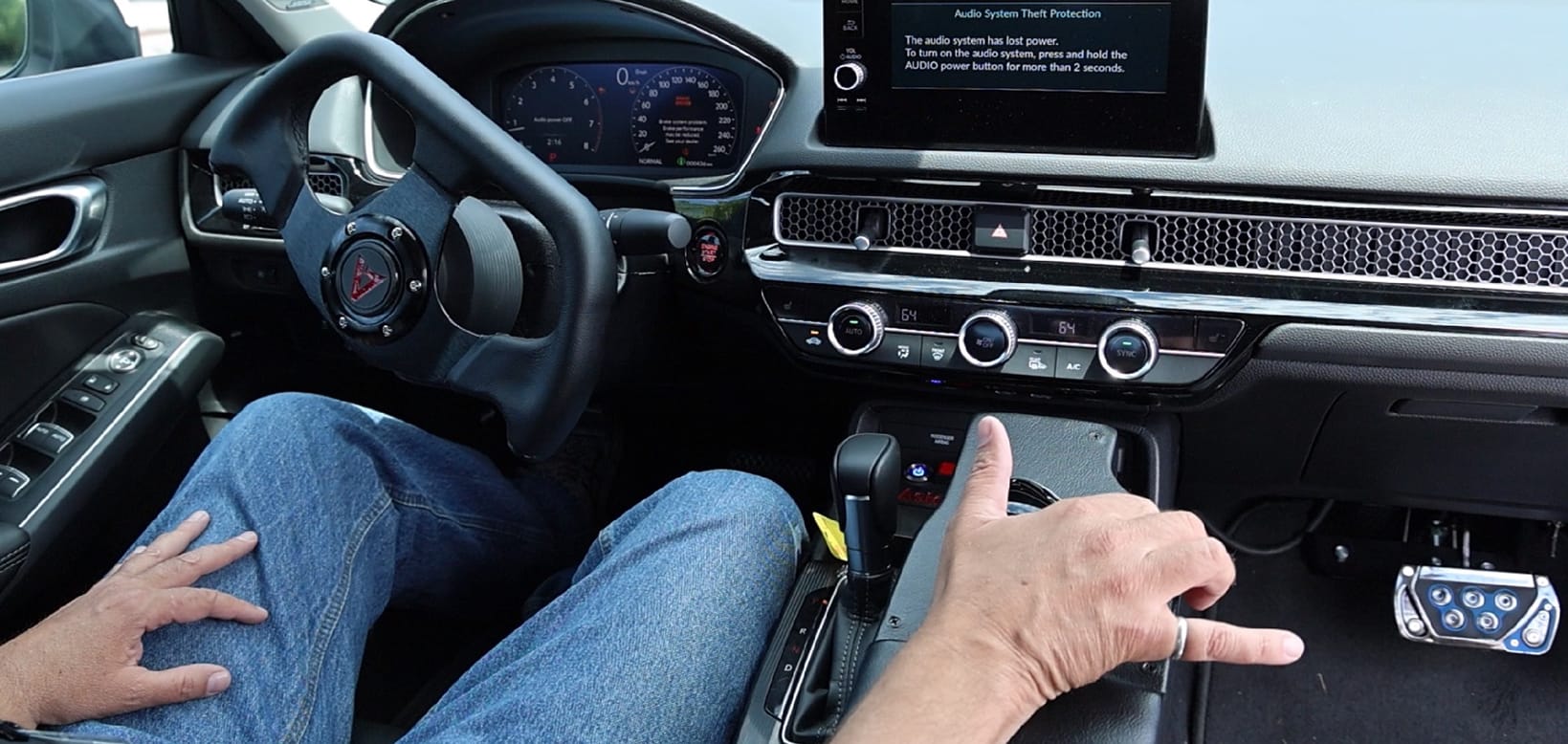
A driver’s finger movements engage with a mouse-like device to steer a demonstration vehicle. Eleven stereo cameras on another demonstrator enable detection and prediction of the distance from vehicles navigating a roundabout.

“When we develop technology, our vision is to have everyone in society benefit from the innovation,” said Harsha Badarinarayan, Hitachi Astemo’s vice president of advanced engineering. Badarinarayan spoke with SAE Media during a June press briefing at the company’s headquarters for the Americas in Farmington Hills, Michigan.

Hitachi Astemo’s in-development steer-by-wire system’s palm-size device, located on a demo vehicle’s center floor console, responds to finger glide movements with virtually no lag time from input to the front wheels’ response. “The idea is to make this input device, which especially caters to people who need an alternative steering interface, as intuitive to use as a steering wheel,” said Badarinarayan.
SAE Media test drove Hitachi Astemo’s steer-by-wire system on a Honda Civic with a steering wheel and another Civic sedan equipped with the finger-operated device. Both technology demonstration cars were easy-to-steer through a parking lot dotted with orange cones to replicate slalom curves, a tight U-turn, and a three-point Y-turn.

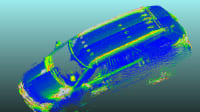
In another demonstration vehicle, 360-degree object recognition and three-dimensional point cloud generation was facilitated by 11 fifth-generation Hitachi Astemo stereo cameras fitted on a Cadillac XT6 SUV. In a replicated parking lot roundabout, the technology demonstrator SUV detected other vehicles and their distance from the demonstration vehicle.
“Stereoscopic vision provides accurate information versus a mono-camera system that gives you distance estimation,” Badarinarayan said. Precise vision information is crucial for SAE Level 3 driving automation technology development. “For example, in a roundabout driving scenario, the vision system needs to determine when it’s safe to enter the roundabout, how to maneuver around the roundabout, and how to exit the roundabout,” said Badarinarayan. The vision system also needs to detect lanes, curb height, and other obstacles.
Hitachi Astemo’s stereo camera system provides automatic calibration during driving to maintain measurement accuracy as well as high-density 3D point cloud generation from disparity information (via artificial intelligence) of each camera pair. “We offer the stereo cameras and the IP (intellectual property) for the perception stack,” said Badarinarayan.
More From SAE Media Group
Autonomous Vehicle Engineering
The ‘Buzz’ in Driverless Shuttling
Automotive Engineering
Volvo’s Electric High-Wire Act
Automotive Engineering
Snapdragon Ride Flex Puts Safety, Infotainment onto Single Chip
Automotive Engineering
Inside Tesla's Cybercab Future
ADAS & Autonomous Vehicle Engineering
AV Life After Argo AI
Autonomous Vehicle Engineering
Hopeful but Closer Scrutiny for SAE Level 4 Automation
Automotive Engineering
Valeo Debuts New Lidars, EV Tech at CES 2022
Automotive Engineering
Nexteer Readies Steering Technologies for Autonomous and Mixed-Mode Driving
Autonomous Vehicle Engineering
GM Announces Door-To-Door Ultra Cruise ADAS
Autonomous Vehicle Engineering
New Roles for Lidar in Autonomy’s Lower Levels
ADAS & Autonomous Vehicle Engineering
Automated Driving’s Journey: One Step Forward…
Automotive Engineering
CES 2020: Mercedes VISION AVTR Concept a Beacon for Sustainability
Automotive Engineering
Nvidia’s New Level 2+ Autonomy Platform Is Making Cars Safer Today
Autonomous Vehicle Engineering
Amending the Automated-Driving ‘Constitution’
Off-Highway Engineering
Autonomous Trucking Hits Rocky Road
Automotive Engineering
Taking ‘Eyes-Off’ the ADAS Future
ADAS & Autonomous Vehicle Engineering
The Subscriptions Are Coming for Your Wallet
ADAS & Autonomous Vehicle Engineering
Lidar Vs. Everybody in the Onboard Sensor Race
Aerospace & Defense Tech Briefs
Adapting US Army Acquisition to Ensure the Reliability and Safety of Autonomous Vehicles
Automotive Engineering
Provizio Eyes Safety with Radar, Not LiDAR
Automotive Engineering
Engineers Balance Today’s Programs with Tomorrow’s Mobility Future
Automotive Engineering
Talking SDVs and Zonal Architecture with TE Connectivity
Automotive Engineering
Integrating Sensor Data: Selecting an ADAS Decision-Making Process
Motion Design INSIDER
Autonomous Vehicles Could Understand Their Passengers Better With ChatGPT
Automotive Engineering
BEV-Agnostic’ Systems Require Attention
ADAS & Autonomous Vehicle Engineering
Tesla’s FSD Recall Impacts AV Industry
ADAS & Autonomous Vehicle Engineering
Inner Visions
Top Stories
NewsSensors/Data Acquisition
 Microvision Aquires Luminar, Plans Relationship Restoration, Multi-industry Push
INSIDERRF & Microwave Electronics
 A Next Generation Helmet System for Navy Pilots
INSIDERWeapons Systems
 New Raytheon and Lockheed Martin Agreements Expand Missile Defense Production
NewsAutomotive
 Ford Announces 48-Volt Architecture for Future Electric Truck
INSIDERAerospace
 Active Strake System Cuts Cruise Drag, Boosts Flight Efficiency
ArticlesTransportation

Webcasts
Aerospace
 Cooling a New Generation of Aerospace and Defense Embedded...
Energy
 Battery Abuse Testing: Pushing to Failure
Power
 A FREE Two-Day Event Dedicated to Connected Mobility
Automotive
 Quiet, Please: NVH Improvement Opportunities in the Early Design Cycle
Electronics & Computers
 Advantages of Smart Power Distribution Unit Design for Automotive &...
Unmanned Systems
 Sesame Solar's Nanogrid Tech Promises Major Gains in Drone Endurance