




Infrastructure for Development of Secure, Reliable Software
Complex software systems are made secure and correct by construction.
The Verification and Automated Reasoning research group at Cornell University has been building an infrastructure, comprising human expertise and computational resources, for the development of secure, reliable software for critical military applications. Such software includes distributed real-time embedded software systems, which are inherently complex and difficult to understand and specify. The infrastructure includes both efficient means of constructing the software and mathematically rigorous means of ensuring that the software will be secure and correct by construction.
The continuing work of the Verification and Automated Reasoning research group includes the development of formal methods and software tools for design, implementation, verification, and optimization of software systems. To provide a basis for efficient and practical correct-by-construction and secure-by-construction distributed programming, the group has developed a prototype logical programming environment (LPE) that includes an extensive collection of automated reasoning software tools.
A key component of the LPE is a digital library of formal algorithmic knowledge. The library contains vast amounts of highly structured mathematical knowledge and enables researchers and programmers to search for knowledge that is relevant to the development of specific software systems. The information in the library is organized logically in such a way as to make it useable and to enable sharing of the information among researchers and programmers involved in creating hardware and software that are more reliable than they otherwise would be. The library also includes logical accounting mechanisms to enforce the highest standards of correctness and accuracy while enabling researchers to contribute new formal algorithmic knowledge to the library.
The infrastructure also includes computing hardware. Because of the huge search spaces and high processing demands of the formal reasoning software tools of the LPE, many processors and large amounts of memory are necessary for using these tools efficiently in state-of-the-art applications. Processors are also needed to make the LPE accessible to remote users via the Internet. The hardware portion of the infrastructure includes the following:
- An internal cluster of 32 processors having a total of 68GB of random-access memory (RAM) and a file-system capacity of 1,200GB;
- A Web cluster of 12 dual-core processors having a total of 44GB of RAM and a file-system capacity of 900GB;
- More than a dozen assorted computer workstations and associated equipment that includes a projector and several printers.
This assortment of hardware enables several researchers to perform heavy-duty theorem-proving tasks simultaneously while enabling remote users to browse, search, combine, and add formal material to the knowledge base.
This work was done by Robert Constable, Christoph Kreitz, Bart Selman, Stuart Allen, Richard Eaton, Lori Lorigo, Wojciech Moczydlowski, Evan Moran, and Radhika Lakshmanan of Cornell University for the Air Force Research Laboratory.
AFRL-0096
This Brief includes a Technical Support Package (TSP).
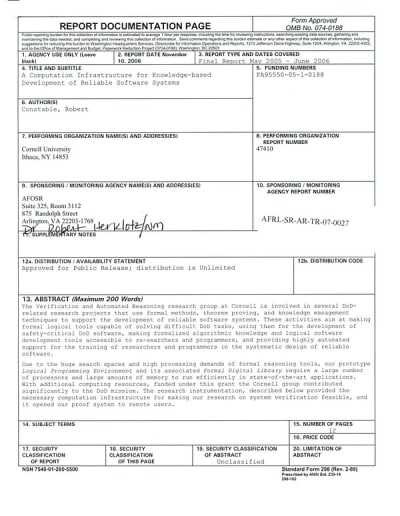
Infrastructure for Development of Secure, Reliable Software
(reference AFRL-0096) is currently available for download from the TSP library.
Don't have an account?
More From SAE Media Group
Aerospace & Defense Tech Briefs
Deterministic and Modular Architecture for Embedded Vehicle Systems
Tech Briefs
Open Software Options for Automation
Tech Briefs
Software for Managing Distributed Real-Time Data

Tech Briefs
Designing Application Software for DSP Chips

Aerospace & Defense Tech Briefs
Future-Proofing the Tactical Edge: Converging AI, Edge Processing, and Hybrid Cloud for Modern Battlefield Operations
Sensor Technology
The Industrial Nervous System: IIoT and PLCs
Aerospace & Defense Tech Briefs
Overcoming Obstacles to DoD Software Technology Transition
Aerospace & Defense Tech Briefs
Adamant: A Soon-to-be Open Source, Mission-Critical Flight Software Framework Written in Ada
NASA Spinoff
NASA-Born Software Keeps Cloud Traffic Moving
Aerospace & Defense Tech Briefs
5G OSIRIS Testing
Tech Briefs
Robust Software Architecture for Robots
Photonics & Imaging Technology
Total Versatility: Flexible Test Station With a Cobot and Camera

Medical Manufacturing and Fabrication
Open Core Engineering: New Freedom for Machine Automation Programming

Aerospace & Defense Tech Briefs
New Products
Aerospace & Defense Tech Briefs
Thwarting Code-Injection Attacks Using SDT-Based ISR

Aerospace & Defense Tech Briefs
FACE Technical Standard Offers MOSA Lessons for Safety-Critical Software in Any Sector


Photonics & Imaging Technology
The New Industrial Edge Ecosystem for Machine Vision

Tech Briefs
My Opinion: Who Was Grace Hopper?

Tech Briefs
PLCs Directly Access Internet Information
Air Force Research Laboratory Technology Horizons
A Concept for Information Extraction From Remote Wireless Sensor Networks
Overview
The document titled "A Computation Infrastructure for Knowledge-based Development of Reliable Software Systems" presents a final report by Robert Constable and Christoph Kreitz from Cornell University, detailing their research efforts in enhancing the reliability of software systems, particularly for Department of Defense (DoD) applications. The report emphasizes the challenges associated with developing reliable and secure distributed real-time embedded software systems, which are crucial for military capabilities. These systems are inherently complex, making them difficult to specify and understand, often leading to costly design flaws that are discovered late in the development process.
To address these challenges, the research group employs formal methods, theorem proving, and knowledge management techniques. Their goal is to create formal logical tools that can effectively tackle complex DoD tasks and support the development of safety-critical software. The report outlines the development of a prototype Logical Programming Environment and a Formal Digital Library, which are designed to facilitate formal reasoning and verification of software systems.
The infrastructure funded by the Air Force Office of Scientific Research (AFOSR) grant has enabled the team to conduct heavy-duty theorem proving tasks with multiple proof engines, model checkers, and SAT solvers operating simultaneously. This capability requires substantial computational resources, including a large number of processors and significant memory, to run efficiently in state-of-the-art applications.
The report highlights the importance of making formalized algorithmic knowledge and logical software development tools accessible to researchers and programmers. It also discusses the automated support provided for training individuals in the systematic design of reliable software. The research instrumentation described in the report has significantly contributed to the DoD mission by making system verification research feasible and opening the proof system to remote users.
In summary, the document outlines a comprehensive approach to improving the reliability of software systems through advanced computational infrastructure and formal methods, addressing the critical needs of the DoD while also providing a framework for training and knowledge dissemination in the field of software development.
Top Stories
INSIDERDesign
 How Airbus is Using w-DED to 3D Print Larger Titanium Airplane Parts
NewsSensors/Data Acquisition
 Microvision Aquires Luminar, Plans Relationship Restoration, Multi-industry Push
INSIDERManned Systems
 A Next Generation Helmet System for Navy Pilots
NewsAR/AI
 Accelerating Down the Road to Autonomy
INSIDERDefense
 New Raytheon and Lockheed Martin Agreements Expand Missile Defense Production
ArticlesAR/AI
 CES 2026: Bosch is Ready to Bring AI to Your (Likely ICE-powered) Vehicle
Webcasts
Semiconductors & ICs
 Advantages of Smart Power Distribution Unit Design for Automotive...
Unmanned Systems
 Quiet, Please: NVH Improvement Opportunities in the Early Design...
Electronics & Computers
 Cooling a New Generation of Aerospace and Defense Embedded...
Automotive
 Battery Abuse Testing: Pushing to Failure
Transportation
 A FREE Two-Day Event Dedicated to Connected Mobility
