




Overcoming Obstacles to DoD Software Technology Transition
A proposed institution would provide infrastructure for systematic collaboration.
The term "Software Wind Tunnel" (SWiT) denotes an institution proposed to be established as a means of overcoming obstacles that, heretofore, have impeded technology transition in connection with research on, and development and utilization of, software needed for software- intensive systems of the Department of Defense (DoD). The term "technology transition" should not be confused with the term "technology transfer," which denotes a process in which an item of technology developed by or for the government is transferred to industry (usually) or vice versa. Instead, "technology transition" denotes a process in which an item of technology is made to evolve from its developmental form into a mature form and in which that item is adopted by its intended end users.
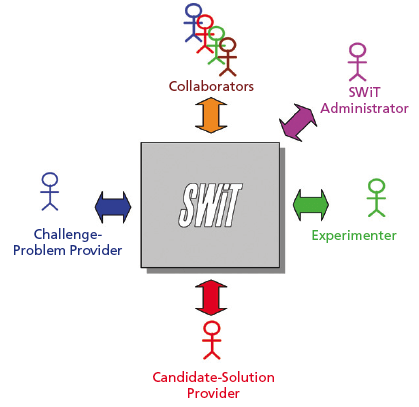
The SWiT would provide hardware, software, and other infrastructure of an open environment for collaborative research and development to demonstrate, evaluate, and document the ability of novel software tools and methods to enable affordable and more predictable production of software- intensive systems. The SWiT hardware may be an aggregation of centralized resources, distributed resources connected via the Internet, and local (standalone) resources. The unifying element of SWiT would be its software suite. The software would enable distributed, interactive collaboration among users; integration of software tools; and measurement of, and collection of data on, performance.
There could be multiple instances of the SWiT, each dedicated to enabling collaboration within a specific community, which would typically be dedicated to a technological specialty (e.g., distributed real-time embedded weapons software systems). Given the distributed nature of users in such a community, the SWiT would be made remotely accessible via textual and other visual interfaces. The SWiT would be hosted and operated by the DoD or a designated contractor, but would be publicly accessible via the Internet, though only unclassified data would be available to the general public. Inasmuch as classified evaluations would be parts of technology-transition processes, users of SWiT could download its software tools to perform these evaluations within their classified program environments. Likewise, users could set up classified SWiT instances within their classified program environments.
This work was done by Richard W. Buskens, Patrick J. Lardieri, Bennett C. Watson, Jennifer Lautenschlager, and Douglas C. Schmidt of Lockheed Martin Corp. for the Air Force Research Laboratory.
AFRL-0071
This Brief includes a Technical Support Package (TSP).
Overcoming Obstacles to DoD Software Technology Transition
(reference AFRL-0071) is currently available for download from the TSP library.
Don't have an account?
More From SAE Media Group
Photonics & Imaging Technology
Total Versatility: Flexible Test Station With a Cobot and Camera


Tech Briefs
Fused Analytic Desktop Environment (FADE)
Tech Briefs
A ‘Smarter’ Way to Protect an Electric Grid
Aerospace & Defense Tech Briefs
USSOCOM’s New Generative AI Tool
Tech Briefs
Who Knows How Much AI Knows? This Tech Does
Tech Briefs
Ontology-Driven Information Integration
Aerospace & Defense Tech Briefs
Developing and Validating Statistical Cyber Defenses
Tech Briefs
5G, AI Team Up to Optimize Military Fueling
NASA Spinoff
Equalizing Internet Access
Aerospace & Defense Tech Briefs
Web Service and Interface for Remote Electronic Device Characterization


Tech Briefs
Open Software Options for Automation
Software Tech Briefs
Mobile Multi-System Overview
Software Tech Briefs
Policy-Based Negotiation Engine for Cross-Domain Interoperability
Software Tech Briefs
Space Images for NASA JPL Android Version

Aerospace & Defense Tech Briefs
FPGA-Based System for Tracking Digital Information Transmitted Via Peer-to-Peer Protocols
Tech Briefs
Software for Managing Distributed Real-Time Data
Tech Briefs
PLCs Directly Access Internet Information
Aerospace & Defense Tech Briefs
One Person Can Supervise a Swarm of 100 Unmanned Autonomous Vehicles
Tech Briefs
AI Advances Heart Research

Aerospace & Defense Tech Briefs
Digital Twinning and Protecting Controlled Unclassified Information
Overview
The document is a final technical report prepared by the Lockheed Martin Advanced Technology Laboratories for the Air Force Research Laboratories (AFRL) under contract FA8750-06-C-0205. It details the implementation of the Software Wind Tunnel (SWiT), a project aimed at enhancing the development and testing of software-intensive systems for the Department of Defense (DoD).
The report outlines the objectives of SWiT, which include providing a collaborative environment for DoD program teams, researchers, and program managers to accelerate technology transition and improve the reliability and cost-effectiveness of large-scale software systems. It emphasizes the importance of experimental collaborations between emerging advanced technology solutions and open development program challenges.
Key sections of the report discuss the operational policies and constraints associated with SWiT. The intent is for SWiT to serve as an open resource, but it must navigate several constraints, including intellectual property protection, DoD program classification, and International Traffic in Arms Regulations (ITAR) restrictions. These factors are crucial for ensuring that the system can be utilized effectively while adhering to legal and security requirements.
The document also highlights the challenges faced in system design, development, testing, and certification. It provides insights into the tools, methods, and services necessary for producing reliable software systems that meet the functional and quality of service properties required by the DoD. The report underscores the need for integration and testing tools that can assure the performance and reliability of these systems.
In addition to technical details, the report includes a notice regarding the use of government data and the implications of its publication. It clarifies that the report has been reviewed and approved for public release, making it accessible to the general public, including foreign nationals.
Overall, the report serves as a comprehensive overview of the SWiT project, its objectives, operational constraints, and the methodologies employed to enhance software development and testing within the DoD. It aims to facilitate knowledge exchange and promote advancements in software-intensive systems, ultimately contributing to the effectiveness of defense operations.
Top Stories
INSIDERDefense
 New Raytheon and Lockheed Martin Agreements Expand Missile Defense Production
NewsAutomotive
 Ford Announces 48-Volt Architecture for Future Electric Truck
INSIDERManufacturing & Prototyping
 Active Strake System Cuts Cruise Drag, Boosts Flight Efficiency
ArticlesTransportation
 Accelerating Down the Road to Autonomy
INSIDERMaterials
 How Airbus is Using w-DED to 3D Print Larger Titanium Airplane Parts
Road ReadyTransportation

Webcasts
Electronics & Computers
 Cooling a New Generation of Aerospace and Defense Embedded...
Power
 Battery Abuse Testing: Pushing to Failure
Connectivity
 A FREE Two-Day Event Dedicated to Connected Mobility
Automotive
 Quiet, Please: NVH Improvement Opportunities in the Early Design Cycle
Transportation
 Advantages of Smart Power Distribution Unit Design for Automotive &...
Aerospace
 Sesame Solar's Nanogrid Tech Promises Major Gains in Drone Endurance