




5G OSIRIS Testing
Lockheed Martin
Annapolis, MD
301-214-3030
www.lockheedmartin.com
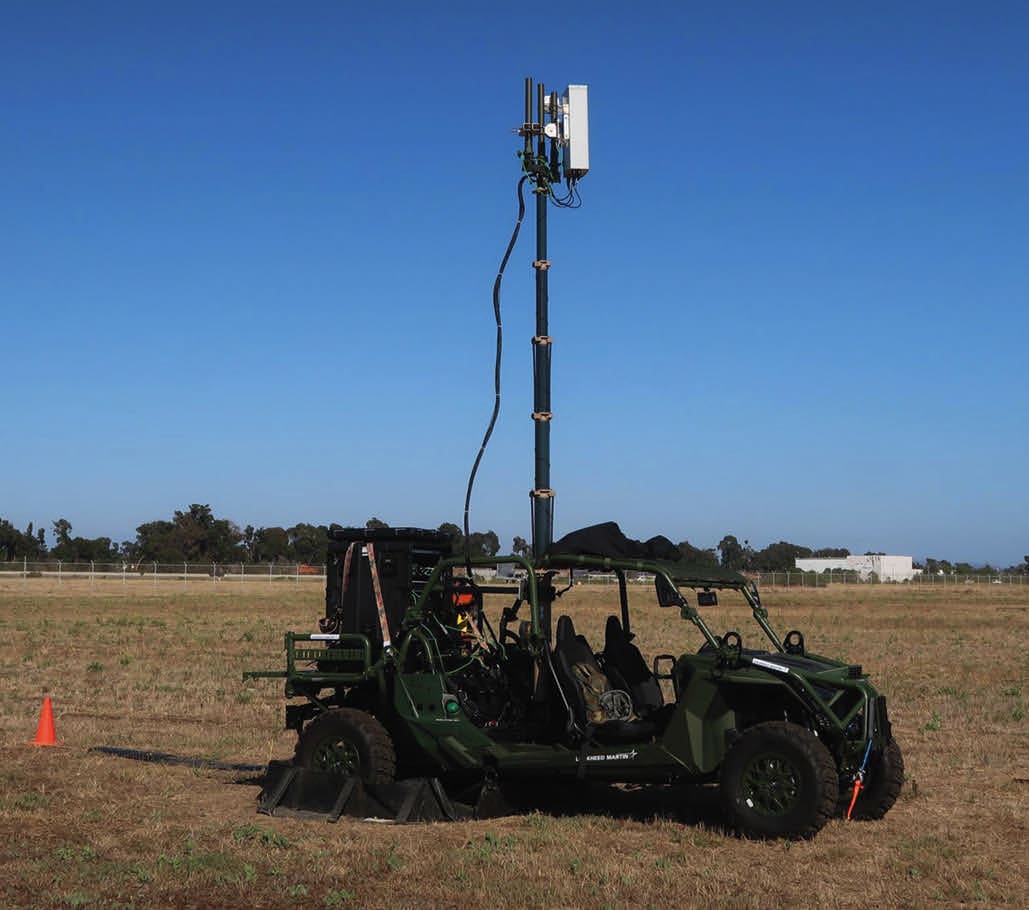
Lockheed Martin delivered the final Phase 1 Initial Prototype 5G testbed variant for the Open Systems Interoperable and Reconfigurable Infrastructure Solution (OSIRIS) to the Marine Corps program management team aboard Marine Corps (USMC) Base Camp Pendleton, California to begin mobile network experimentation. OSIRIS is a 5G communications network infrastructure testbed for expeditionary operations experimentation for the Office of the Under Secretary of Defense for Research and Engineering’s (OUSD R&E) FutureG & 5G Office that was awarded to Lockheed Martin in 2021.
Phase 2, experimentation, continues Lockheed Martin’s partnership with the USMC to integrate specific mission applications onto the OSIRIS 5G testbed for evaluation. In parallel, emerging wireless technology will be assessed and selected for use as part of the continued build out of the OSIRIS 5G testbed concluding with three distinct 5G standalone network configurations. These configurations include a trailer mounted nomadic tower, an ATV mounted mobile relay and transit case deployable 5G operational facility.
The Lockheed Martin-led team, with subcontractors Intel Corporation, Radisys Corporation and Rampart Communications, Inc., has worked closely with the PM team aboard Camp Pendleton, and the team will continue their close collaboration with the USMC and OUSD R&E over the next 15 months to test, evaluate and ultimately demonstrate the technology as part of a Fleet Marine Force (FMF) event in the Southern California region.
To progress from phase 1 to the experimentation phase, the team successfully integrated an Open Radio Unit (O-RU) with Lockheed Martin’s hybrid base station running Intel’s FlexRAN reference software and hardware technology including Intel Xeon processors, ethernet adapters and accelerators. This integration makes the OSIRIS system one of the first tactical 5G standalone small cell systems compliant with the Open-Radio Access Network (O-RAN) 7.2 split architecture.
O-RAN 7.2 split architecture compliance optimizes the OSIRIS system to oversee increases in bandwidth while also maximizing virtualization of shared resources like radios. This is crucial to supporting the USMC’s Expeditionary Advanced Base Operations (EABO) goals, which involve Marines operating in contested environments with increased bandwidth requirements. Additionally, the OSIRIS system aims to reduce overall set-up time.
Visit Here
More From SAE Media Group

Tech Briefs
6G: Will It Trigger a Manufacturing Revolution?
Sensor Technology
O-RAN Redefining the Future of Wireless Connectivity

Sensor Technology
Product Showcase

Tech Briefs
Modern Software Links Legacy Systems
Sensing Technology
NIST Tackles Wireless Industrial Systems
Aerospace & Defense Tech Briefs
New Products

Off-Highway Engineering
Connecting Off-Highway Vehicles in Remote Locations

Sensor Technology
Wireless Networking Expanding the Reach of Healthcare


Aerospace & Defense Tech Briefs
How Will TSN Ethernet Impact the Future of Embedded Computing?
Aerospace & Defense Tech Briefs
Future-Proofing the Tactical Edge: Converging AI, Edge Processing, and Hybrid Cloud for Modern Battlefield Operations
Tech Briefs
New on the Market: October 2020
Aerospace & Defense Tech Briefs
Deterministic and Modular Architecture for Embedded Vehicle Systems
Tech Briefs
My Opinion: The IIoT Gave Birth to the IoT
Tech Briefs
How Much Do You Know About 6G?
Tech Briefs
Hyper-Distributed RFID Antenna (HYDRA) System

Tech Briefs
New on the Market: October 2021
Autonomous Vehicle Engineering
TCU Testing at the Heart of Vehicle Connectivity
Tech Briefs
How Much Do You Know About Wi-Fi 6?
Tech Briefs
Product of The Month

Off-Highway Engineering
Protecting a Cyber-Physical Remote Diagnostic Communication System Against Cyberattacks

Top Stories
INSIDERManufacturing & Prototyping
 How Airbus is Using w-DED to 3D Print Larger Titanium Airplane Parts
INSIDERManned Systems
 FAA to Replace Aging Network of Ground-Based Radars
NewsTransportation
 CES 2026: Bosch is Ready to Bring AI to Your (Likely ICE-powered) Vehicle
NewsSoftware
 Accelerating Down the Road to Autonomy
EditorialDesign
 DarkSky One Wants to Make the World a Darker Place
INSIDERMaterials
 Can This Self-Healing Composite Make Airplane and Spacecraft Components Last...
Webcasts
Defense
 How Sift's Unified Observability Platform Accelerates Drone Innovation
Automotive
 E/E Architecture Redefined: Building Smarter, Safer, and Scalable...
Power
 Hydrogen Engines Are Heating Up for Heavy Duty
Electronics & Computers
 Advantages of Smart Power Distribution Unit Design for Automotive...
Unmanned Systems
 Quiet, Please: NVH Improvement Opportunities in the Early Design...
