




Learning Defects From Aircraft NDT Data
Non-destructive evaluation of aircraft production is optimized and digitalized with Industry 4.0. The aircraft structures produced using fiber metal laminate are traditionally inspected using water-coupled ultrasound scans and manually evaluated.
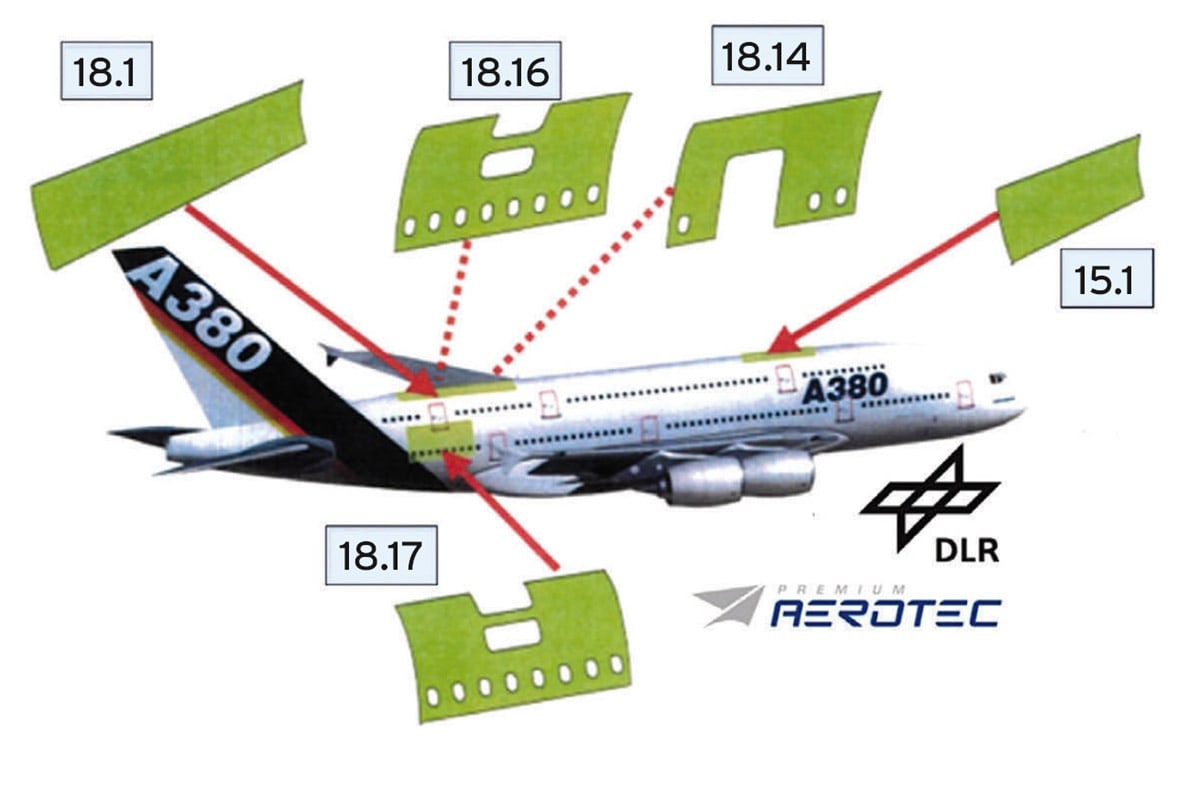
Ultrasonic Testing (UT) is a typical Non-destructive testing (NDT) method for examining the structural components for aircraft production. Manufacturing aircraft made of fiber metal laminates (FML) includes cascaded steps such as placement of aluminum, glass prepreg, adhesive, doublers, stringers, vacuum bagging and curing in an autoclave. Quality control (QC) is performed first at the layup of the component (without stringers) after curing and the quality assessment is visually evaluated. The manually performed examination of anomalies is very time-consuming. In addition, conducted NDT inspection using a manual UT phased array for Glass Reinforced (GLARE®) FML of A380, it lacked the high capacity of data and additionally an evaluation software.
So, non-destructive evaluation (NDE) 4.0 helps streamline processes, increase quality and lower costs in aircraft production with an automated quality assurance (QA). Traditionally, the quality control of FML is performed by an experienced examiner after the final production of an aircraft structure. But, with the implementation of machine learning (ML) techniques, defects can be identified instantaneously to help the examiner. So, the primary motivation was to develop an automated QA in aircraft production by implementing a machine learning algorithm. The quality analysis process in the proposed method consists of pre analyzing the sensor data acquisition to classify the features according to the defects and good qualities. The proposed approach reduces the examiner’s workload, expensive repairs and manufacturing waste.
The proposed work can be vital in the automated offline-QA to scrutinize FML aircraft production and adapt to other aircraft materials like aluminum, thermoplastic fiber and carbon fiber reinforced plastic (CFRP). The proposed research aims: to understand and prepare ultrasonic scans of aircraft FML (raw data) provided by the aircraft industry and pre-process data (convert raw data to images) to gain feasibility for the proposed method. Additionally, implement embedded machine learning classifiers with image feature extraction techniques to achieve the best defect detection rate and further interpret industry-based certification process to evaluate this approach.
Machine learning is a subset of artificial intelligence (AI), dealing with data acquired from sensors for learning the data-generating distribution. There are three primary techniques: supervised learning - data needs to be labelled (each data point tagged to belong to a particular class) for training, mainly used for classification (predicts discrete labels) and regression (predicts a continuous quantity). Next, unsupervised learning - requires no data labels for training; dimensionality reduction and clustering are the two significant methodologies. Following is reinforcement learning - the agent (training) sends an action (a move causing change) to the environment (real or virtual world) and in-return environment sends the state and its reward (evaluation of the action, either positive or negative) for the agent; real-time decisions and gaming models are its prototypes. Additionally, semi supervised learning is a combination of supervised and unsupervised learning methodologies.
Supervised learning examples include support vector machine (SVM), Decision Trees, Random Forest (RF), κ-Nearest Neighbor (κ-NN), Naïve Bayes, Linear Discriminant Analysis (LDA) and Logistic Regression. The Fuzzy C-means (FCM) κ-means and principal component analysis (PCA) are a few state-of-the-art unsupervised learning techniques. SVM predicts classes based on an optimal hyperplane creating margins to find similar features from each class and classifies them together. Decision Trees predict a class by learning the decision rules from the data features of that class. Random Forest combines the outcome of multiple Decision Trees into a prediction. κ-Nearest Neighbor predicts using the proximity of κ nearest data points for classification.
Naïve Bayes classifies based on the probability of data points applying Bayes’ theorem. Using Fisher’s algorithm, LDA finds a linear combination of data features to characterize different classes. Logistic regression finds the probability of an event occurring, such as voted or no vote, based on the data variables. Fuzzy C-means is similar to κ-means but is a soft clustering where a data point can belong to one or more clusters. κ-means is a hard clustering that partitions data points into κ clusters, each belonging to one cluster with the nearest mean value. PCA reduces data dimensionality and increases its interpretability with less information loss.
This work was performed by Navya Prakash, Dorothea Nieberl, Monika Mayer and Alfons Schuster for the German Aerospace Center. For more information, download the Technical Support Package (free white paper) below.
This Brief includes a Technical Support Package (TSP).
Learning Defects From Aircraft NDT Data
(reference ADT-10231) is currently available for download from the TSP library.
Don't have an account?
More From SAE Media Group
Aerospace & Defense Tech Briefs
AI Co-Pilot Enhances Human Precision for Safer Aviation
Aerospace & Defense Tech Briefs
SAE International Extends Call for Abstracts, Seeks Submissions for AeroTech Conference
Aerospace & Defense Tech Briefs
AIA Predicts Flying Air Taxis, Supersonic Air Travel, and Space Industry for 2050
Aerospace & Defense Tech Briefs
Industry Invited to Participate in AeroTech Aerospace and Defense Technical Program
Aerospace & Defense Tech Briefs
3D Data Acquisition Platform for Human Activity Understanding
Motion Design
Liquid Metal Sensors and AI Help Prosthetic Hands “Feel”
Aerospace & Defense Tech Briefs
Quality Management Experts Provide Guidance on AS9100 Standard, Equipment Calibration

Aerospace & Defense Tech Briefs
Implementing an Aerospace Factory of the Future
Tech Briefs
Drones Use Machine Learning to Detect Landmines
Aerospace INSIDER
Northrop Grumman to Develop Prototype Artificial Intelligence Assistant
Automotive Engineering
Tuning-Up AI’s ‘Understanding’ to Make Safer ADAS, AVs
Motion Design INSIDER
A Low-Cost Robot Ready for Any Obstacle

Motion Design INSIDER
AI Helps Robots Manipulate Objects with Their Whole Bodies

Motion Design INSIDER
Teaching a Robot to Hang a T-shirt Starts with Data

Tech Briefs
AI Helps UAVs Predict Oncoming Turbulence
Aerospace INSIDER
Germany's New Military Surveillance Jet Completes First Flight
Aerospace & Defense Tech Briefs
Adapting US Army Acquisition to Ensure the Reliability and Safety of Autonomous Vehicles
Aerospace INSIDER
Technology Companies Work to Combat Pilot Fatigue

Tech Briefs
5G, AI Team Up to Optimize Military Fueling

Robotics & Automation INSIDER
AI Yields ‘Athletically Intelligent’ Robotic Dog
Aerospace & Defense Tech Briefs
Autonomous Surveillance Technologies Relating to Dismounted Soldiers
Aerospace & Defense Tech Briefs
Development of a Secure Private Neural Network Capability
Aerospace & Defense Tech Briefs
NRL Research Physicists Explore Fiber Optic Computing Using Distributed Feedback
Overview
The document discusses advancements in non-destructive testing (NDT) techniques, specifically focusing on the application of machine learning to analyze ultrasonic inspection data of fiber metal laminates (FML) used in aircraft production, particularly the Airbus A380. The research aims to enhance the quality assurance processes in the manufacturing of aircraft components by utilizing automated methods for defect detection.
The study begins by outlining the context of NDT in the aerospace industry, emphasizing the importance of reliable inspection methods to ensure the safety and integrity of aircraft structures. The authors describe the ultrasonic inspection reports generated for various aircraft components, which include C-scans that visualize internal defects. These scans are processed using specialized software, ULTIS®-TESTIA, which helps in identifying and categorizing defects such as porosity, folds, twists, overlaps, gaps, and foreign bodies.
A significant portion of the document is dedicated to the methodology employed in the research. The authors detail the process of extracting features from the ultrasonic images using custom feature extractors, including KAZE and SURF methods. These features are then used to construct a Bag-of-Visual-Words model, which serves as the basis for training machine learning classifiers. The study highlights the challenges faced due to the limited number of data samples available, as the production rate of aircraft components restricts the volume of data that can be collected.
The results of the study indicate that the proposed machine learning model effectively categorizes defects in the ultrasonic scans, demonstrating improved accuracy in defect detection compared to traditional methods. The authors also discuss the implications of their findings for the future of NDT, suggesting that integrating machine learning approaches can lead to more efficient and reliable inspection processes in the aerospace industry.
In conclusion, the document presents a comprehensive overview of the integration of machine learning in NDT for aircraft manufacturing. It underscores the potential of these technologies to revolutionize quality assurance practices, ultimately contributing to safer and more efficient aircraft production. The authors acknowledge the support received during the research and declare no competing interests, while also noting the confidentiality of the data used in the study.
Top Stories
NewsRF & Microwave Electronics
 Microvision Aquires Luminar, Plans Relationship Restoration, Multi-industry Push
INSIDERAerospace
 A Next Generation Helmet System for Navy Pilots
INSIDERDesign
 New Raytheon and Lockheed Martin Agreements Expand Missile Defense Production
INSIDERMaterials
 How Airbus is Using w-DED to 3D Print Larger Titanium Airplane Parts
NewsPower
 Ford Announces 48-Volt Architecture for Future Electric Truck
ArticlesAR/AI

Webcasts
Electronics & Computers
 Cooling a New Generation of Aerospace and Defense Embedded...
Automotive
 Battery Abuse Testing: Pushing to Failure
Power
 A FREE Two-Day Event Dedicated to Connected Mobility
Unmanned Systems
 Quiet, Please: NVH Improvement Opportunities in the Early Design Cycle
Automotive
 Advantages of Smart Power Distribution Unit Design for Automotive &...
Energy
 Sesame Solar's Nanogrid Tech Promises Major Gains in Drone Endurance