




Some Advances in Understanding of Environmental Fatigue
These advances may enable development of improved aerospace aluminum alloys.
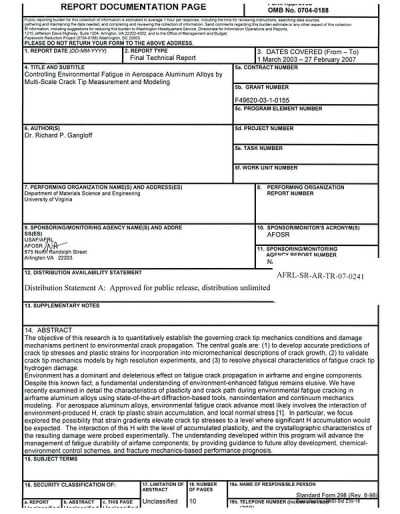
A research program has yielded advances in understanding of numerous aspects of environmental crack propagation in aerospace aluminum alloys. From one perspective, the objective of this program was to quantitatively establish governing crack-tip-mechanics conditions and damage mechanisms pertinent to environmental crack propagation, using a combination of (1) high-spatial-resolution experimentation and (2) computational simulation based on continuum-mechanics mathematical models employing multiple length scales. From a slightly different perspective, the central goals of this research were to (1) develop means of accurate prediction of crack-tip stresses and plastic strains for incorporation into micromechanical descriptions of crack growth, (2) validate crack-tip-mechanics models by means of high-spatial-resolution experiments, and (3) resolve physical characteristics of damage attributable to accumulation of hydrogen at fatigue-crack tips.
It is well known that with respect to fatigue, environment exerts a dominant and generally deleterious effect in that some environmental conditions (especially humidity) stimulate propagation of fatigue cracks in airframe and engine components. However, fundamental understanding of environmental fatigue remains elusive, making it necessary to engage in this and other related research in order to provide guidance for development of alloys, control of chemical and other environmental conditions, and fracture-mechanics-based prognosis of performance, all directed toward increasing the fatigue durability of engine and airframe components.
This research was guided and prompted partly by the observation that the level of stress that triggers decohesion or even significant bulk hydrogen trapping that could ultimately lower the required decohesion stress is higher than the levels of crack-tip stress predicted by conventional crack-tip-analysis methods. Therefore, the central question to be addressed in this research became the following: What mechanism is responsible for elevated crack-tip stresses large enough to trigger decohesion associated with lattice planes or microstructure interfaces? Prior to this research, it had been observed that materials can exhibit higher flow stresses in the presence of strong gradients in plastic strain, which gradients are accommodated by geometrically necessary dislocations. To address the issue of cracking enhanced by hydrogen, this research included examination of applicability of phenomenological strain-gradient plasticity (SGP) continuum-mechanics models, variously involving single or multiple length scales, implemented within a finite-element computational-simulation framework. Concomitantly, the interaction of hydrogen with accumulated plasticity and the crystallographic nature of the resulting damage were examined experimentally.
The crystallographic nature of plastic deformation makes it particularly amenable to experimental characterization by diffraction-based techniques. Two state-of-the-art diffraction-based techniques — electron backscattered diffraction (EBSD) [which can be regarded as an extension of scanning electron microscopy] and micro-Laue diffraction — were used in this program. EBSD affords sufficient resolution (< 200 nm) yet also offers potential for performing statistically significant investigations of crack-wake plasticity by examining large sample areas. EBSD was used in this program to assess the environmental effect on crack-wake plasticity. Micro-Laue diffraction is an x-ray-diffraction technique that is the basis of a three-dimensional x-ray microscope. A Laue-diffraction indexing procedure developed in this research, with help from collaborators at the Oak Ridge National Laboratory, is amenable to application to heavily dislocated and/or multiphase materials. It holds promise to afford spatial resolution comparable to that of EBSD, plus other capabilities that may contribute significantly to future research involving characterization of plastic damage. Another high-spatial-resolution experimental technique used in this research is nanoindentation, which is useful for characterizing a length that constitutes the parameter in a single-parameter phenomenological SGP continuum-mechanics model.
The findings made in this research are too numerous and too diverse to summarize here. However, one main idea has been abstracted from the findings: For aerospace aluminum alloys, propagation of environmental fatigue cracks most likely involves the interaction of environmentally produced hydrogen, accumulation of plastic strain at cracks, and local normal stress.
This work was done by Richard P. Gangloff, Sean R. Agnew, and Matthew R. Begley of the University of Virginia for the Air Force Research Laboratory.
AFRL-0088
This Brief includes a Technical Support Package (TSP).
Some Advances in Understanding of Environmental Fatigue
(reference AFRL-0088) is currently available for download from the TSP library.
Don't have an account?
More From SAE Media Group


Aerospace & Defense Tech Briefs
Cracking of Aluminum Panels Repaired With Composite Patches

Photonics & Imaging Technology
Deformation Fingerprints Will Help Researchers Identify, Design Better Metallic Materials
Aerospace & Defense Tech Briefs
Thermal Mechanical Fatigue Crack Growth Testing
Aerospace & Defense Tech Briefs
Microcompression Tests of a BMG and a Tungsten/BMG Composite
Aerospace & Defense Tech Briefs
Portable Data Recorder for Measuring Sand Grain Fracture After Blasts
Aerospace & Defense Tech Briefs
Fatigue Crack Detection Via Load-Differential Guided Wave Methods

Tech Briefs
Creating 2D All-Organic Perovskites
Photonics & Imaging Technology
New Upgrade Will Supercharge Atomic Vision of the World’s Most Powerful X-Ray Laser
Aerospace & Defense Tech Briefs
Testing Mechanical Properties of Polymer-Based Multi- Phase Particulate Composites

Power Electronics INSIDER
New Material To Make Next Generation of High-Power Electronics Faster and More Efficient
Tech Briefs
Micro Electron MicroProbe and Sample Analyzer


Motion Design INSIDER
Autonomous Structures Can Be Programmed to Jump Days in Advance
Tech Briefs
Using AI to Perfect the 3D Printing of Metals

Battery & Electrification Technology
Next-Generation Binder for Lithium-ion Batteries
Battery & Electrification Technology
Enhancing the Performance of All-Solid-State Batteries
Battery & Electrification Technology
Designing Safer, Higher-Performance Lithium Batteries
Photonics & Imaging Technology
The Latest Advancements in Optics
Overview
The document titled "Controlling Environmental Fatigue in Aerospace Aluminum Alloys by Multi-Scale Crack Tip Measurements and Modeling" is a final report detailing research conducted by Dr. Richard P. Gangloff and his team at the University of Virginia. The primary objective of the research was to quantitatively establish the mechanisms governing crack propagation in aerospace aluminum alloys under environmental conditions, which are known to significantly affect fatigue crack behavior.
The report emphasizes the detrimental impact of environmental factors on fatigue crack propagation in airframe and engine components. Despite the recognized influence of the environment, a comprehensive understanding of how these factors enhance fatigue remains elusive. The research team employed advanced techniques, including diffraction-based tools, nanoindentation, and continuum mechanics modeling, to investigate the characteristics of plasticity and crack paths during environmental fatigue cracking.
Key findings indicate that environmental fatigue crack advancement is likely influenced by the interaction of hydrogen produced by the environment, accumulated plastic strain at the crack tip, and local normal stress. The study explored how strain gradients can elevate crack tip stresses, potentially leading to significant hydrogen accumulation. Experimental investigations were conducted to probe the relationship between hydrogen interaction, plasticity levels, and the crystallographic characteristics of the resulting damage.
The report also highlights the educational impact of the research program, noting the contributions of graduate students who explored various aspects of environmental exposure and microstructural interactions in aluminum alloys. Notably, Yunjo Ro's thesis focused on the crystallography of fatigue crack surfaces in precipitation-hardened aluminum alloys, while Uday Komaragiri developed finite element codes for simulating elasto-plastic behavior.
The research culminated in the submission of a journal paper that measures the effect of the environment on fatigue crack-wake plasticity in Aluminum Alloy 2024. The insights gained from this study are expected to advance the management of fatigue durability in aerospace components, guiding future alloy development, chemical-environment control strategies, and performance prognosis based on fracture mechanics.
Overall, this report provides a significant contribution to the understanding of environmental fatigue in aerospace materials, with implications for improving the safety and longevity of critical components in the aerospace industry.
Top Stories
INSIDERManufacturing & Prototyping
 How Airbus is Using w-DED to 3D Print Larger Titanium Airplane Parts
NewsAutomotive
 Microvision Aquires Luminar, Plans Relationship Restoration, Multi-industry Push
INSIDERAerospace
 A Next Generation Helmet System for Navy Pilots
INSIDERDesign
 New Raytheon and Lockheed Martin Agreements Expand Missile Defense Production
ArticlesAR/AI
 CES 2026: Bosch is Ready to Bring AI to Your (Likely ICE-powered) Vehicle
Road ReadyDesign

Webcasts
Semiconductors & ICs
 Advantages of Smart Power Distribution Unit Design for Automotive...
Unmanned Systems
 Quiet, Please: NVH Improvement Opportunities in the Early Design...
Electronics & Computers
 Cooling a New Generation of Aerospace and Defense Embedded...
Power
 Battery Abuse Testing: Pushing to Failure
AR/AI
 A FREE Two-Day Event Dedicated to Connected Mobility
