




Methodologies and Equipment for Measuring High Temperature Tensile Properties of Subscale Specimen Geometries for Additively Manufactured Metallic Materials (Continued)
Editorial Note: With the growth in adoption of addititively manufactured materials across aerospace and defense manufacturing, we decided to include two parts of this Air Force Research Lab report.
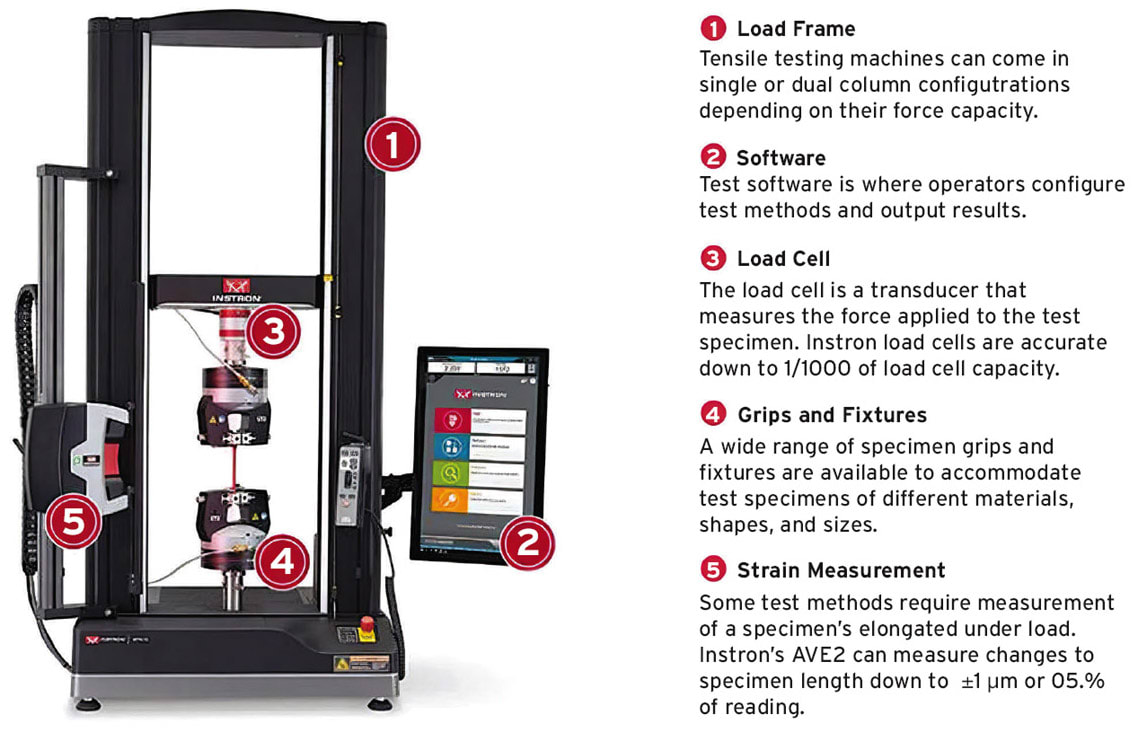
Universal test frames are generally either screw-driven or servohydraulic, which are both perfectly suited for uniaxial tensile testing experiments. A uniaxial test frame is comprised of several basic fixture components: loading device, a load cell, and a specimen gripping apparatus.
An example of a commercially available tensile testing frame is shown below. Load cells are available in a wide range of load limits to accommodate the sensitivity needs for a wide range of materials and specimen geometries. ASTM E74 outlines the calibration procedure for load cells and must be followed to ensure proper measurement during testing, regardless of specimen size. Further details about alignment and gripping will be provided given their overall importance to testing accuracy. Standardized testing procedures have been established to assist in test frame and specimen alignment through the quantification of bending strains and their acceptable limits during testing.
Test frames may be configured with some type of universal joint that allows for concentricity and angularity adjustments for alignment. The largest contributor to bending strains originates from the test specimen-grip interface. ASTM E1012, established to address adequate alignment under tensile and compressive loading, outlines the usage of strain-gaged specimens to verify test equipment alignment through a series of loading-unloading and re-gripping cycles.
Specific to high temperature tension testing of metallic materials, standards mandate maximum bending strains do not exceed 10% of the axial strain.
Despite the existence of these standards, the issue persists where, in general, equipment is unavailable to measure maximum bending strains at elevated test temperatures. As a result, often, the only viable option is to qualify the alignment at room temperature using the intended machine setup for elevating temperature testing.
Notably, alignment requirements are designed for standard specimen sizes. Alignment procedures for test setup of subscale specimens are rarely reported in detail and seem to be generally considered a “best effort” based upon experimental expertise of the user.
This is somewhat troublesome because as specimen size and gauge lengths decrease, concentric and angular misalignments become more pronounced, i.e., larger bending strains. The subscale specimens may also require higher machining tolerance for more precise alignment in the specimen-grip interface. Furthermore, subscale specimen sizes frequently make it impractical to manufacture a strain-gaged specimen for proper test frame alignment due to physical constraints.
As a result, custom grips and alignment fixtures often are engineered to accommodate specifically designed subscale test specimen geometries and to ensure uniaxiality throughout testing. Self-aligning grips have also been used at room temperature and elevated temperatures.
This work was performed by Thomas Gallmeyer for the Air Force Research Laboratory Materials and Manufacturing Directorate. For more information, download the Technical Support Package (free white paper) below. AFRL-08232
This Brief includes a Technical Support Package (TSP).
Methodologies and Equipment for Measuring High Temperature Tensile Properties of Subscale Specimen Geometries for Additively Manufactured Metallic Materials
(reference AFRL-08232) is currently available for download from the TSP library.
Don't have an account?
More From SAE Media Group


Aerospace & Defense Tech Briefs
SAE International Issues First Technical Standards for Aerospace Additive Manufacturing
Aerospace & Defense Tech Briefs
Unlocking the Potential of 3D-Printed Polymers in Aerospace and Defense
Aerospace & Defense Tech Briefs
Thermal Simulation and Testing of Expanded Metal Foils for Lightning Protection
Tech Briefs
Calibration System for Automated Fiber Placement

Aerospace & Defense Tech Briefs
Testing Military-Grade Adhesive in Extreme Loading Conditions
Automotive Engineering
Lyten Says 3D Graphene Could Disrupt Racing, Automotive and Space
Aerospace & Defense Tech Briefs
Physics-Guided Neural Network for Regularization and Learning Unbalanced Data Sets
Aerospace & Defense Tech Briefs
Evaluation of Additively Manufactured Ultrahard Steels
Tech Briefs
Nano/Micro Mechanical Environmental Test Cell
Aerospace & Defense Tech Briefs
Additive Manufacturing Adoption Up, Growing Rapidly in Aerospace
Tech Briefs
Crack Image Quality Indicator
Tech Briefs
Automated Tow/Tape Placement System
Tech Briefs
3D Printing with an Unknown Material
Tech Briefs
Copper Strengthens 3D-Printed Titanium
Aerospace & Defense Tech Briefs
Streamlining Post-Processing in Additive Manufacturing
Aerospace & Defense Tech Briefs
More Bang for the Buck: A New Design and Manufacturing Method for Deep Penetrating Bomb Cases
Tech Briefs
Microtesting Rig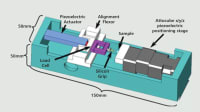
Aerospace & Defense Tech Briefs
Metal-Plated, High-Temperature Plastics
Aerospace & Defense Tech Briefs
Ruggedizing Coaxial and Fiber Optic Cable Assemblies from Mechanical Strain
Aerospace & Defense Tech Briefs
Spectrum Fatigue of 7075-T651 Aluminum Alloy Under Overloading and Underloading
Power Management INSIDER
Technology Enables First Test of Actual Turbine Engine Conditions
Automotive Engineering
Virtual and Physical Testing of Third-Generation High Strength Steel
Off-Highway Engineering
Additive Manufacturing Is Transforming Mobility Engineering, Driving the Factory of the Future
Overview
The document titled "Assessment of Test Methods for Measuring High Temperature Tensile Properties of Subscale Specimen Geometries for Additively Manufactured Metallic Materials" is an interim report published by the Air Force Research Laboratory on May 15, 2023. It covers the evaluation of methodologies and equipment used to assess the tensile properties of subscale specimens, particularly focusing on materials produced through additive manufacturing (AM).
The report begins with an executive summary that outlines the objectives and significance of the research. It emphasizes the need for reliable testing methods to understand the mechanical properties of AM metallic materials, especially at high temperatures, which are critical for various aerospace and defense applications.
The introduction sets the context for the study, highlighting the growing use of AM technologies and the challenges associated with characterizing the mechanical properties of subscale specimens. The document then details current methodologies, equipment, and instrumentation used in tensile testing. This includes discussions on standard and non-standard specimen geometries, uniaxial test frame setups, and various heating sources such as radiant, resistance, and induction heating.
Instrumentation and measurement techniques are also covered, focusing on temperature and strain measurement, which are crucial for accurate tensile testing. The report identifies gaps in the current methodologies, particularly in subscale high-temperature tensile testing, and discusses the effects of specimen size on tensile properties.
A significant portion of the document is dedicated to considerations for additive manufacturing, including the impact of as-built surface finishes on performance assessment and the intrinsic versus extrinsic performance of AM metallic materials. It also explores the current utilization of subscale tensile geometries in AM, providing insights into how these factors influence material performance.
The conclusions summarize the findings and underscore the importance of developing standardized testing methods to ensure the reliability of tensile property measurements for AM materials. Finally, the report offers recommendations for future research and testing protocols to address the identified gaps and improve the understanding of high-temperature tensile properties in additively manufactured metallic materials.
Overall, this interim report serves as a comprehensive resource for researchers and engineers involved in the testing and evaluation of AM materials, providing a foundation for further advancements in the field.
Top Stories
NewsSensors/Data Acquisition
 Microvision Aquires Luminar, Plans Relationship Restoration, Multi-industry Push
INSIDERRF & Microwave Electronics
 A Next Generation Helmet System for Navy Pilots
INSIDERWeapons Systems
 New Raytheon and Lockheed Martin Agreements Expand Missile Defense Production
NewsAutomotive
 Ford Announces 48-Volt Architecture for Future Electric Truck
INSIDERAerospace
 Active Strake System Cuts Cruise Drag, Boosts Flight Efficiency
ArticlesTransportation

Webcasts
Aerospace
 Cooling a New Generation of Aerospace and Defense Embedded...
Energy
 Battery Abuse Testing: Pushing to Failure
Power
 A FREE Two-Day Event Dedicated to Connected Mobility
Automotive
 Quiet, Please: NVH Improvement Opportunities in the Early Design Cycle
Electronics & Computers
 Advantages of Smart Power Distribution Unit Design for Automotive &...
Unmanned Systems
 Sesame Solar's Nanogrid Tech Promises Major Gains in Drone Endurance