




MIL-DTL-32628/01-X Reusable EMI Shield Termination Band on MIL-DTL-38999 Electrical Connector Accessory Braid Termination/Tensile Qualification Test
Reusable constant force spring force bands (CFSB), employed on shielded wire harness constructions to secure the shield onto the connector accessory/backshell banding platform in order to protect the wires in the bundle from electromagnetic interference (EMI), were evaluated for tensile strength performance as described in SAE AS85049™ and AS85049/128™.
Reusable constant force spring force bands (CFSB) M32628/ 01-10 thru 13 (ISOTDS1 thru 4) shield termination bands were evaluated for tensile strength performance as described in SAE AS85049™ and AS85049/128™. The M32628/01 shield termination bands are employed on shielded wire harness constructions to secure the shield on to the connector accessory/back-shell banding platform in order to protect the wires in the bundle from electromagnetic interference (EMI).
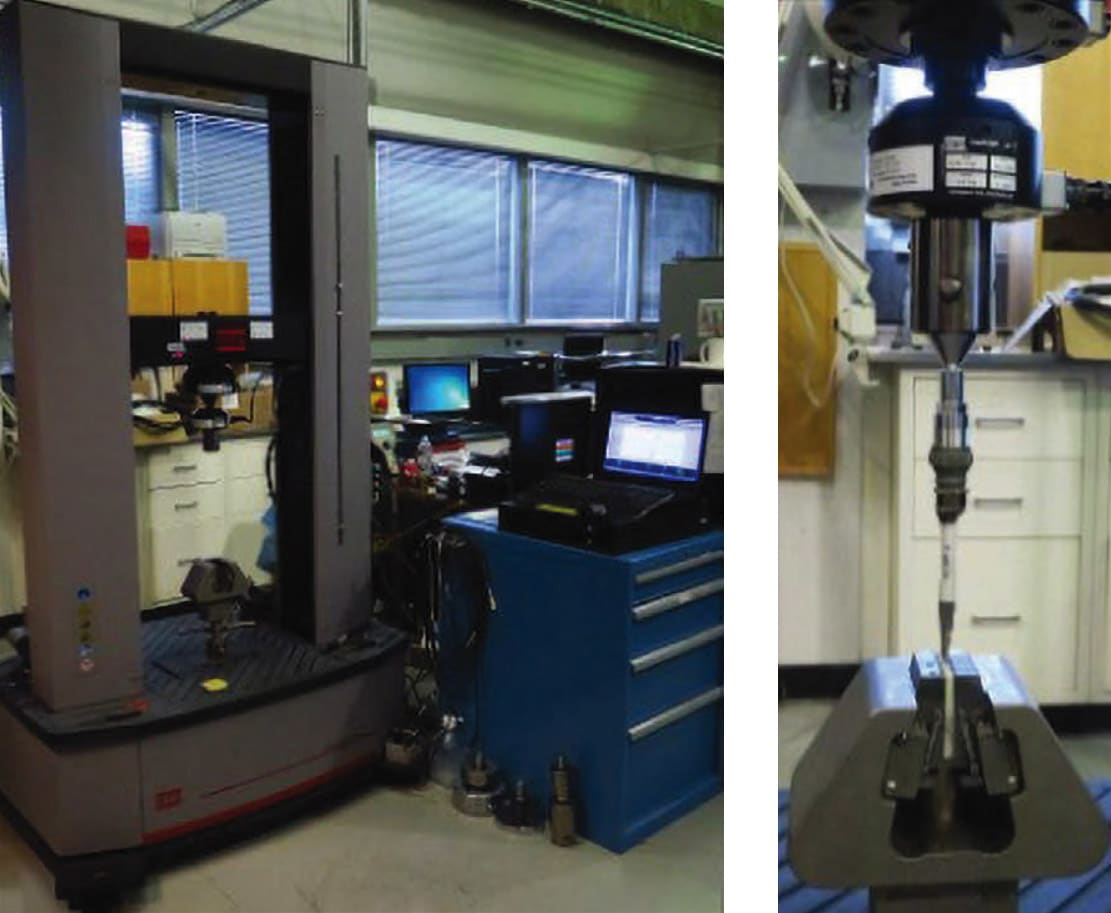
Four sizes of constant force spring bands were tested applied to eight shell sizes of connector accessories/backshells. The CFSBs were installed on A-A-59569 shield braid of suitable width, on shell size A- H of M85049/88™ backshells, mated to interface connector fixtures. The M85049/ 88™ backshells mate to the Mil-Dtl-38999 Series 3 connectors. The braid retention/tensile test requirements are per AS85049/ 128F™, para 2a. To pass the test, the M32628/01-10 thru -13 constant force spring band test articles may not shift, loosen, break or slip after exposure to the prescribed linear force.
For the band termination test, a 6-inch braid was clamped by each specimen to the accessory. The braid shell was tin coated copper in accordance with a-a-59569 with a 90% coverage. Two specimens each were clamped to an m85049/82-10*03, m85049/82-18*03, and m85049/82-28*03 accessory respectively.
For the braid retention test, the braid was pulled at a rate of 1 inch per minute to a force of 100 pounds minimum for braid .50 inch and under and 150 pounds minimum for braid over .50 inch. The braid could not pull out, and band slippage could not exceed .025 inch when measured from a fixed point on the adapter. Braid breakage due to tensile load was not viewed as a failure.
The AS85049/128F™ para 2a test was performed to assess the tensile strength performance characteristics of the M32628/10-10 thru -13 (ISOTDS1 thru 4) reusable constant force shield bands when installed on the legacy Mil-Dtl-38999 Series III compatible M85049/ 88™ EMI accessory. All shell sizes were tested, versus only the three called out in the AS85049/128F™ para 2.

All backshells tested were M85049/ 88™, size -9 thru -23 (A-H). They were aluminum base metal, with W=Cadmium plating per AS85049™ with the suitable cable entry sizes.
Specimens were tested using an electromechanical 100 KN MTS load frame. A smaller 10 KN load cell was utilized to minimize error in the test data. Specimens were fixtured using a mechanical wedge grip and fittings that were manufactured to interface with the different connector assemblies.
The tensile test setup was programmed to apply a tensile load by increasing the displacement between fixed ends of the assembly using a rate of 1 inch per minute until the desired load was reached. For accessory shell sizes 9 thru 19 connectors, a minimum force of 100 pounds was the required load while using .50 inch or less width braid. For the shell sizes 21 and 23, the minimum force applied was 150 pounds as the braid was wider than .50 inches (one inch). Once the maximum force requirement was reached, the applied force dwell/hold was one minute on average.
This work was done by Oliviu (Ollie) Muja and Matthew Stanley for the Naval Air Warfare Center Aircraft Division. For more information, download the Technical Support Package (free white paper) below. NAWC-0004
This Brief includes a Technical Support Package (TSP).
MIL-DTL-32628/01-X Reusable EMI Shield Termination Band on MIL-DTL-38999 Electrical Connector Accessory Braid Termination/Tensile Qualification Test
(reference NAWC-0004) is currently available for download from the TSP library.
Don't have an account?
More From SAE Media Group
Aerospace & Defense Tech Briefs
Hydraulic Testing of Polymer Matrix Composite 102mm Tube Section
Medical Design Briefs
Winter 2022 Resource Guide

Aerospace & Defense Tech Briefs
Specifying Components for Space Applications
Tech Briefs
Miniature Spring Performance Tester
Tech Briefs
Polyimide Wire Insulation Repair System

Tech Briefs
Reusable Hot-Wire Cable Cutter
Medical Design Briefs
Summer 2022 Resource Guide
Aerospace & Defense Tech Briefs
Ruggedizing Coaxial and Fiber Optic Cable Assemblies from Mechanical Strain
Medical Design Briefs
Winter 2021 Resource Guide
Tech Briefs
5 Ws of Puncture-Proof Soft Electronics
Medical Design Briefs
New Products & Services
Tech Briefs
Nano/Micro Mechanical Environmental Test Cell
Aerospace & Defense Tech Briefs
Testing Services
Aerospace & Defense Tech Briefs
Testing EMI Materials for Battlefield Applications
Medical Design Briefs
New Products and Services
Tech Briefs
Dust Tolerant Connectors
Medical Design Briefs
Medical Design Briefs: 2019 Technology Leaders

Tech Briefs
Products of Tomorrow
Off-Highway Engineering
Accumulator Design and Assembly Process
Motion Design
Calculating the Estimated Fatigue Life of a Disc Spring
Aerospace & Defense Tech Briefs
Plasma Electrolytic Oxidation: The Future of Lightweight Designs in Aerospace and Defense

Aerospace & Defense Tech Briefs
Shielding Aerospace Systems from Electromagnetic Interference
Overview
The document is a technical report (NAWCADPAX/TR-2020/01) detailing the qualification testing of the MIL-DTL-32628/01-X Reusable EMI Shield Termination Band, which is designed for use with MIL-DTL-38999 electrical connectors. Conducted by the Naval Air Warfare Center Aircraft Division, the tests took place on August 15-16, 2019, and the report was authored by Oliviu Muja and Matthew Stanley.
The primary objective of the testing was to evaluate the tensile strength performance of the constant force spring force bands (CFSBs) designated M32628/01-10 through -13 (ISOTDS1 through 4). These shield termination bands are critical components in shielded wire harness constructions, as they secure the metallic shield braid to the connector accessory/backshell banding platform, thereby protecting the wires from electromagnetic interference (EMI).
The testing involved four sizes of CFSBs, which were installed on shield braid conforming to specification A-A-59569. The bands were tested on eight different shell sizes (9 through 23) of M85049/88™ backshells, which are commonly used in aerospace applications. The evaluation followed the guidelines set forth in SAE AS85049™ and AS85049/128™, specifically focusing on the tensile test requirements outlined in paragraph 2a.
Results from the tests indicated that all configurations and sizes of the CFSBs passed the tensile strength requirements. Notably, none of the test articles exhibited any shifting, loosening, or damage after being subjected to the prescribed linear force during testing. This demonstrates the reliability and effectiveness of the shield termination bands in maintaining their integrity under operational conditions.
The report concludes that the reusable M32628/01-10 through -13 constant force spring bands are suitable for use in aerospace applications, providing robust protection against EMI while ensuring secure connections in wire harness assemblies. The findings contribute valuable insights into the performance of these components, supporting their continued use in critical electrical systems within the aerospace industry.
Overall, the document serves as a comprehensive evaluation of the CFSBs, affirming their compliance with industry standards and their role in enhancing the reliability of electrical connections in aerospace applications.
Top Stories
NewsRF & Microwave Electronics
 Microvision Aquires Luminar, Plans Relationship Restoration, Multi-industry Push
INSIDERAerospace
 A Next Generation Helmet System for Navy Pilots
INSIDERDesign
 New Raytheon and Lockheed Martin Agreements Expand Missile Defense Production
INSIDERMaterials
 How Airbus is Using w-DED to 3D Print Larger Titanium Airplane Parts
NewsPower
 Ford Announces 48-Volt Architecture for Future Electric Truck
ArticlesAR/AI

Webcasts
Electronics & Computers
 Cooling a New Generation of Aerospace and Defense Embedded...
Automotive
 Battery Abuse Testing: Pushing to Failure
Power
 A FREE Two-Day Event Dedicated to Connected Mobility
Unmanned Systems
 Quiet, Please: NVH Improvement Opportunities in the Early Design Cycle
Automotive
 Advantages of Smart Power Distribution Unit Design for Automotive &...
Energy
 Sesame Solar's Nanogrid Tech Promises Major Gains in Drone Endurance