




A Comparison of SiC-Based Devices for Use as Power Switches
A report details a survey of the state of technological development and commercial availability of SiC-based electronic devices that has been performed to evaluate the suitability of such devices as power switches in present and future applications in which high reliability and/or capability for high-temperature operation are or will be required. Examples of such applications include high-temperature motor drives, switch modules, and DC-to- DC power converters, and DC-to-AC power inverters. The survey consisted primarily of a comparative study of the relative advantages and disadvantages of SiCbased vertical-junction field-effect transistors (VJFETs) and SiC-based metal oxide/semiconductor field-effect transistors (MOSFETs). Other devices, including conventional Si-based MOSFETs and SiCbased bipolar junction transistors (BJTs) were considered, but only in passing, because it was assumed, at the beginning of the study, that the superiority of SiCbased VJFETs and SiC-based MOSFETs over other devices for power-switching applications had already been established.
Overall, it was found that fundamental properties of SiC-based JFETs are more closely matched to design requirements for power electronic circuits than are the fundamental properties of SiC-based MOSFETs. It was concluded that SiCbased MOSFETs could be regarded as stopgap design components in that their performances do not exceed those of Sibased MOSFETs but designers might feel compelled to use them if SiC-based VJFETs were not available. It was further concluded that first-generation SiC-based VJFETs are so superior to both Si-based and SiC-based MOSFETs that there may not be a need for stopgap components.
This work was done by Michael S. Mazzola and Jeffrey B. Casady of Mississippi State University for the Air Force Research Laboratory.
This Brief includes a Technical Support Package (TSP).
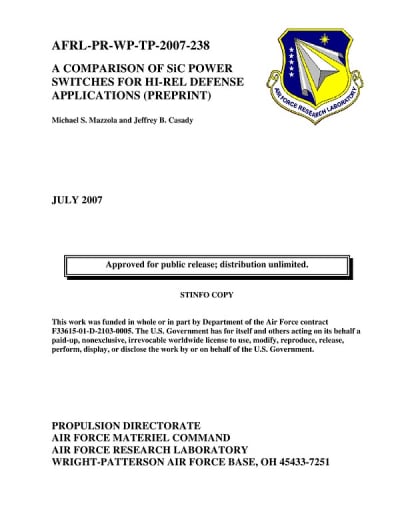
A Comparison of SiC-Based Devices for Use as Power Switches
(reference AFRL-0069) is currently available for download from the TSP library.
Don't have an account?
More From SAE Media Group

Tech Briefs
Silicon Carbide High-Voltage Switch

Aerospace & Defense Tech Briefs
Procedure to Determine and Correct for Transmission Line Resistances for Direct-Current, On-Wafer Measurements
Tech Briefs
G⁴FET Implementations of Some Logic Circuits
Aerospace & Defense Tech Briefs
Silicon Carbide Junction Field-Effect Transistor Devices for Scalable Solid-State Circuit Breakers


Tech Briefs
A Two-in-One Storage and Computing Device


Embedded Computing INSIDER
High-Efficiency Power Amplifier Could Bring 5G Cell Phones
Electronics & Sensors INSIDER
Organic Bipolar Transistor Developed at the Tu Dresden
Tech Briefs
Nanotransistors Stay Cool at High Voltages
Aerospace & Defense Tech Briefs
Content Addressable Memory (CAM) Technologies for Big Data and Intelligent Electronics Enabled By Magneto-Electric Ternary CAM
Tech Briefs
SOI CMOS Imager With Suppression of Cross-Talk
Aerospace & Defense Tech Briefs
DC Power Converter for 200°C Containing SiC Transistors


Tech Briefs
T-Shaped Emitter Metal Structures for HBTs
Tech Briefs
Graphene “Nano-Origami” Creates Tiny Microchips
Embedded Technology INSIDER
Could Black Phosphorus be the Next Silicon?

Aerospace & Defense Tech Briefs
Prognostic Health Management for Avionics System Power Supplies


Overview
The document titled "A Comparison of SiC Power Switches for Hi-Rel Defense Applications" is a conference paper authored by Michael S. Mazzola and Jeffrey B. Casady, published in July 2007. It focuses on the evaluation of Silicon Carbide (SiC) power switches, particularly the Vertical Junction Field Effect Transistor (VJFET) and the Metal-Oxide-Semiconductor Field Effect Transistor (MOSFET), for high-reliability defense applications.
The paper highlights the advantages of SiC VJFETs, which combine the high switching speed of Silicon MOSFETs with the voltage and current handling capabilities of Insulated Gate Bipolar Transistors (IGBTs), along with superior thermal properties due to the SiC material. These characteristics make SiC VJFETs suitable for various power electronics applications, including high-temperature motor drives, switch modules, and inverters/converters used in military systems such as shipboard power systems and more electric vehicles.
A key aspect of the paper is the comparison of the performance metrics of SiC VJFETs and SiC MOSFETs, particularly focusing on the figure of merit (FOM) defined by the product of on-resistance (R_on) and total gate charge (Q_g). This FOM is crucial for evaluating the efficiency of FET technologies in switch mode power supply (SMPS) applications. The authors argue that while SiC MOSFETs are often considered the leading technology, the SiC VJFET presents compelling advantages that challenge this conventional wisdom.
The document also discusses the challenges associated with the commercialization of both SiC VJFETs and MOSFETs, noting that preproduction samples are becoming available, which allows for a more informed comparison based on recent literature. The authors emphasize the importance of understanding the true properties of SiC devices and the economic factors that influence their adoption in various applications.
In addition to the technical analysis, the paper provides insights into the backgrounds of the authors, both of whom have extensive experience in SiC device development and power electronics. Dr. Mazzola and Dr. Casady have contributed significantly to the field through numerous publications and patents.
Overall, the document serves as a comprehensive resource for understanding the potential of SiC power switches in high-reliability defense applications, offering a critical perspective on their performance and commercialization challenges.
Top Stories
INSIDERMaterials
 How Airbus is Using w-DED to 3D Print Larger Titanium Airplane Parts
NewsSensors/Data Acquisition
 Microvision Aquires Luminar, Plans Relationship Restoration, Multi-industry Push
INSIDERDesign
 A Next Generation Helmet System for Navy Pilots
NewsManned Systems
 Accelerating Down the Road to Autonomy
INSIDERWeapons Systems
 New Raytheon and Lockheed Martin Agreements Expand Missile Defense Production
ArticlesDesign
 CES 2026: Bosch is Ready to Bring AI to Your (Likely ICE-powered) Vehicle
Webcasts
Transportation
 Advantages of Smart Power Distribution Unit Design for Automotive...
Automotive
 Quiet, Please: NVH Improvement Opportunities in the Early Design...
Electronics & Computers
 Cooling a New Generation of Aerospace and Defense Embedded...
Power
 Battery Abuse Testing: Pushing to Failure
AR/AI
 A FREE Two-Day Event Dedicated to Connected Mobility
