




Prognostic Health Management for Avionics System Power Supplies
An integrated approach to prediction tools enables faults to be diagnosed accurately.
Electronic systems such as electronic controls, onboard computers, communications, navigation, and radar perform many critical functions onboard military and commercial aircraft. All of these systems depend on electrical power supplies for direct current (DC) power at a constant (regulated) voltage to drive solid-state electronics. With these power supplies playing an important role in the operation of aircraft systems and subsystems, flight and ground crews need health state awareness and prediction tools that diagnose faults accurately, predict failures, and project life remaining of these components.

Switch-mode power supplies (SMPSs) are commonly used aboard aircraft where their weight, size, and efficiency make them preferable to conventional transformer-based power supplies. In addition to regulating the voltage of DC power, these novel circuits can also serve as DC-to-DC converters that can step down (“bucking” design) voltage like conventional supplies or step up (“boost” or “flyback” design) voltage. However, early SMPS designs suffered from sudden and catastrophic failures or generated excessive electromagnetic interference (EMI). More recent SMPS designs employ protective circuits to isolate sensitive components from damaging events.
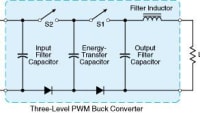
The DC-DC converter at the heart of SMPSs uses a switching element, along with capacitors and inductors, to step up or step down voltage and current accordingly. High-speed switching enables the transfer of energy packets from the input filter capacitor to the output filter capacitor. The last stage filters out any high-frequency components from the DC output. Finally, the output is feedback into a control circuit that stabilizes the DC/DC converter.
Reliability studies of switching mode power supplies have shown that the majority of failures may be attributed to a small number of components. The relative frequency of specific component failures may vary based on SMPS topology, type of component used, derating factors, and location in the system. The components that commonly fail are classified into three different categories: switching transistors, filtering capacitors, and rectifying diodes.
Three types of switching transistors are commonly used in SMPS applications: bipolar junction transistors (BJTs), metal-oxide semiconductor field-effect transistors (MOSFETs), and insulatedgate biplolar transistors (IGBTs). Each type of transistor exhibits unique failure modes and rates, but switching transistors are generally the leading cause of SMPS failures. Bipolar junction transistors are widely used in SMPS designs where low priorities for weight and efficiency allow lower switching frequencies. MOSFETs and IGBTs are more common in applications where weight and efficiency requirements mandate higher switching frequencies.
Physics of failure models are used as the basis for incipient fault detection, fault to failure progression, and remaining useful life predictions. Critical transistor failure modes include thermal runaway, gate-oxide breakdown, contact migration, and thermal fatigue. Thermal runaway and thermal fatigue can affect all types of transistors, while gate-oxide breakdown only affects MOSFETs and contact migration only affects BJTs. Thermal runaway, contact migration, and thermal fatigue also affect diodes. Critical capacitor failure modes include dielectric breakdown and thermal fatigue.
Gate-oxide breakdown is one of the major concerns regarding MOSFET devices. Damage to the gate oxide (see figure) can result in excessive leakage current, increased standby power, and a decrease in response time. Eventually, the damage will cause a MOSFET to short-circuit.
The SMPS fault to failure progression models and diagnostic features for incipient fault detection were verified through accelerated failure tests of commercially available computer power supplies. To generate failures quickly, a load emulator was designed and built to subject the test specimens to extreme electrical and thermal stress.
The load emulator successfully generated multiple switching transistor and diode failures over the course of three months of testing. While tests designed to generate capacitor failures were performed, no catastrophic capacitor failures occurred.
This work was done by Thomas Dabney and Andrew Hess of the Joint Strike Fighter Program Office; and Rolf Orsagh, Douglas Brown, and Michael Roemer of Impact Technologies, LLC. JSF-0001
This Brief includes a Technical Support Package (TSP).
Prognostic Health Management for Avionics System Power Supplies
(reference JSF-0001) is currently available for download from the TSP library.
Don't have an account?
More From SAE Media Group
Aerospace & Defense Tech Briefs
DC Power Converter for 200°C Containing SiC Transistors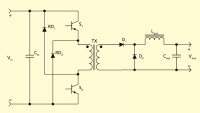
Tech Briefs
Ultra-Wide-Bandgap Power Electronics
Aerospace & Defense Tech Briefs
Silicon Carbide Junction Field-Effect Transistor Devices for Scalable Solid-State Circuit Breakers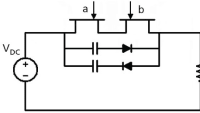
Tech Briefs
Nanotransistors Stay Cool at High Voltages
Aerospace & Defense Tech Briefs
Procedure to Determine and Correct for Transmission Line Resistances for Direct-Current, On-Wafer Measurements

Power Electronics INSIDER
Superconducting Diode Bridge Efficiently Converts AC to DC for Quantum Circuits
Tech Briefs
Silicon Carbide High-Voltage Switch
Tech Briefs
Solid-State Thermal Transistor
Tech Briefs
Series-Connected Buck Boost Regulators

Sensor Technology
Near-Zero-Power Temperature Sensor
Battery Technology
New Products

Aerospace & Defense Tech Briefs
How High-Reliability Capacitors Support Electrical Power in Military Vehicles
Tech Briefs
OMRON’s G9KB PCB Relay
Tech Briefs
X-Band, 17-Watt Solid-State Power Amplifier
Electronics Tech Briefs
High-Power-Density DC-to-DC Power-Converter Modules
Battery Technology
Charge Control Methods for Supercapacitors
Tech Briefs
New on the Market
Aerospace & Defense Tech Briefs
Protection Schemes for Advanced Shipboard Electrical Systems

Medical Design Briefs
New Isolated Power Supply Chip Design Improves Efficiency
Tech Briefs
Product of the Month


Overview
The document titled "Prognostic Health Management for Avionics System Power Supplies" presents an integrated approach to managing the health of switching mode power supplies (SMPS) used in avionics systems. Authored by Rolf Orsagh, Douglas Brown, Michael Roemer, Thomas Dabney, and Andrew Hess, the paper emphasizes the critical role of reliable power supplies in the operation of various electronic systems on military and commercial aircraft, including controls, computers, communications, navigation, and radar.
The authors outline the necessity for health state awareness and predictive tools that can accurately diagnose faults, predict failures, and estimate the remaining life of power supply components. The paper highlights the advancements in SMPS technology, which, while offering advantages such as reduced weight and size, have historically faced issues like catastrophic failures and electromagnetic interference. Recent designs have incorporated protective circuits to mitigate these risks.
The document details the methodologies employed in the health management of SMPS, which include statistical reliability modeling, damage accumulation models, and physics of failure modeling. These techniques are complemented by sensor-based condition monitoring that utilizes automated reasoning algorithms to analyze parameters such as temperature, power quality, and efficiency. The integration of model-based assessments with real-time sensor data enhances the accuracy of health state awareness.
The authors discuss the importance of intelligent fusion of diagnostic information with historical reliability statistics to create robust prognostic models. These models are developed through accelerated failure testing of SMPS, allowing for empirical analysis of projected operating conditions and failure progression.
The paper concludes by emphasizing the potential safety and cost benefits of implementing effective diagnostic and prognostic techniques in avionics systems. By achieving optimal health management of power supplies, the authors argue that significant improvements in operational reliability and efficiency can be realized, ultimately contributing to safer aviation operations.
In summary, this document serves as a comprehensive exploration of the methodologies and technologies involved in the prognostic health management of avionics system power supplies, highlighting the importance of reliability in critical electronic systems aboard aircraft.
Top Stories
INSIDERDefense
 New Raytheon and Lockheed Martin Agreements Expand Missile Defense Production
NewsAutomotive
 Ford Announces 48-Volt Architecture for Future Electric Truck
INSIDERManufacturing & Prototyping
 Active Strake System Cuts Cruise Drag, Boosts Flight Efficiency
ArticlesTransportation
 Accelerating Down the Road to Autonomy
INSIDERMaterials
 How Airbus is Using w-DED to 3D Print Larger Titanium Airplane Parts
Road ReadyTransportation

Webcasts
Electronics & Computers
 Cooling a New Generation of Aerospace and Defense Embedded...
Power
 Battery Abuse Testing: Pushing to Failure
Connectivity
 A FREE Two-Day Event Dedicated to Connected Mobility
Automotive
 Quiet, Please: NVH Improvement Opportunities in the Early Design Cycle
Transportation
 Advantages of Smart Power Distribution Unit Design for Automotive &...
Aerospace
 Sesame Solar's Nanogrid Tech Promises Major Gains in Drone Endurance