




Procedure to Determine and Correct for Transmission Line Resistances for Direct-Current, On-Wafer Measurements
This procedure takes into account the effects from measuring instruments in order to accurately model devices.
Resistances of tenths of ohms to several ohms in transmission lines have been measured in laboratory systems from the power supply to the device under test (DUT). High-current semiconductor devices may draw currents of several amps. In cases such as these, the voltage drop in the transmission lines may rise up to several volts. In order to properly characterize the DUT, the losses in the transmission line and the voltage drop across the line must be measured and accounted for. A procedure for measuring the transmission line resistances is described. Once these values are known, it is necessary to apply a transform to the raw measured data in order to determine the actual voltages on the device of interest. A simple MATLAB code for determining the DUT current and voltage behavior is presented when the raw IV data and the transmission line resistances are known.

The first measurement is made by shorting the probe on Port 1. The second measurement is made by shorting the probe on Port 2. The third measurement is made by landing the probes on a through standard, like the kind typically used in a thru-reflect-line (TRL) s-parameter calibration. The final measurement is made by landing both probes on a solid metallic standard.
There is a non-trivial difference between the measured IV characteristics and the actual IV characteristics of the DUT. This is especially true in the linear (ohmic) region of device operation.
This work was done by Benjamin D. Huebschman of the Army Research Laboratory. For more information, download the Technical Support Package (free white paper) at www.defensetechbriefs.com/tsp under the Electronics/Computers category. ARL-0104
This Brief includes a Technical Support Package (TSP).
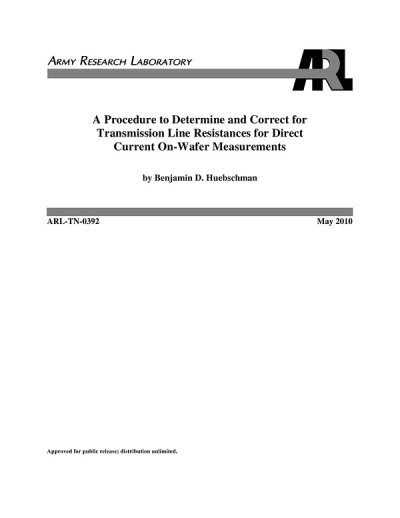
Procedure to Determine and Correct for Transmission Line Resistances for Direct-Current, On-Wafer Me
(reference ARL-0104) is currently available for download from the TSP library.
Don't have an account?
More From SAE Media Group
Aerospace & Defense Tech Briefs
Silicon Carbide Junction Field-Effect Transistor Devices for Scalable Solid-State Circuit Breakers

Tech Briefs
Ultra-Wide-Bandgap Power Electronics
Tech Briefs
Silicon Carbide High-Voltage Switch
Tech Briefs
Nanotransistors Stay Cool at High Voltages
Tech Briefs
A Two-in-One Storage and Computing Device


Aerospace & Defense Tech Briefs
Prognostic Health Management for Avionics System Power Supplies

Electronics & Sensors INSIDER
Organic Bipolar Transistor Developed at the Tu Dresden
Electronics & Sensors INSIDER
A New Magnetic Transistor for More Energy-Efficient Electronics


Aerospace & Defense Tech Briefs
Energy-Filtered Tunnel Transistor: A New Device Concept Toward Extremely Low Energy Consumption Electronics
Electronics & Sensors INSIDER
Leading Experts Suggest Guidelines for Assessing Emerging Transistor Performance


Electronics & Sensors INSIDER
Tiny But Mighty: Next-Gen Transistors Hold Great Promise
Tech Briefs
Graphene “Nano-Origami” Creates Tiny Microchips
Tech Briefs
High-Efficiency Microwave Power Amplifier

Electronics & Sensors INSIDER
Integrating Dimensions to Get More Out of Moore’s Law

Embedded Technology INSIDER
Quantum Tunneling Produces Record Transistor Performance


Overview
The document titled "A Procedure to Determine and Correct for Transmission Line Resistances for Direct Current On-Wafer Measurements" by Benjamin D. Huebschman, published by the U.S. Army Research Laboratory in May 2010, presents a systematic approach to accurately measure and correct for the resistances encountered in transmission lines during direct current (DC) on-wafer measurements.
The introduction outlines the significance of precise resistance measurements in semiconductor testing, where inaccuracies can lead to erroneous conclusions about device performance. The report emphasizes the need for a reliable methodology to account for the resistances of the test setup, which can significantly affect the results.
The document is structured into several key sections. It begins with a detailed explanation of the measurement techniques used to assess the resistances in transmission lines. This includes the setup of the device under test (DUT) and the necessary equipment for conducting the measurements. The methodology section elaborates on the calculation of resistances, providing formulas and examples to illustrate the process.
A critical part of the report is the procedure for determining DUT voltages, which is essential for ensuring that the measurements reflect the true performance of the device. The results section presents findings from the application of the proposed methodology, demonstrating its effectiveness in improving measurement accuracy.
The conclusion summarizes the importance of the developed procedure, highlighting its potential to enhance the reliability of DC measurements in semiconductor testing. The report also includes appendices that provide additional technical details and a list of symbols, abbreviations, and acronyms used throughout the document.
Overall, this report serves as a valuable resource for researchers and engineers involved in semiconductor testing, offering a clear and practical approach to addressing the challenges posed by transmission line resistances. By following the outlined procedures, users can achieve more accurate and reliable measurements, ultimately leading to better device characterization and performance evaluation.
Top Stories
INSIDERManufacturing & Prototyping
 How Airbus is Using w-DED to 3D Print Larger Titanium Airplane Parts
INSIDERManned Systems
 FAA to Replace Aging Network of Ground-Based Radars
NewsTransportation
 CES 2026: Bosch is Ready to Bring AI to Your (Likely ICE-powered) Vehicle
NewsSoftware
 Accelerating Down the Road to Autonomy
EditorialDesign
 DarkSky One Wants to Make the World a Darker Place
INSIDERMaterials
 Can This Self-Healing Composite Make Airplane and Spacecraft Components Last...
Webcasts
Defense
 How Sift's Unified Observability Platform Accelerates Drone Innovation
Automotive
 E/E Architecture Redefined: Building Smarter, Safer, and Scalable...
Power
 Hydrogen Engines Are Heating Up for Heavy Duty
Electronics & Computers
 Advantages of Smart Power Distribution Unit Design for Automotive...
Unmanned Systems
 Quiet, Please: NVH Improvement Opportunities in the Early Design...
