




DC Power Converter for 200°C Containing SiC Transistors
This is a prototype of power converters for high-temperature applications such as automobile and aircraft engines.
A DC-to-DC power converter, nominally rated for a power of 180 W, an input potential of 28 V, an output potential of 270 V, and a maximum operating temperature of 200°C has been designed, built, and tested. This power converter serves as a prototype for further development of power converters required to be capable of operating in high-temperature environments in diverse settings, including automobile, aircraft, and spacecraft engines, and oil and gas wells.
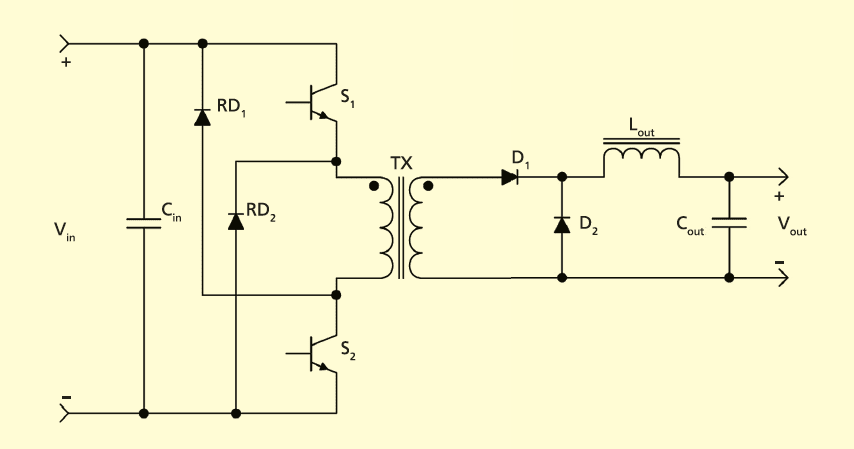
During each switching cycle, the power converter proceeds through three successive modes of operation:
- An energy-transfer mode in which S1 and S2 are on and D1 conducts;
- A transformer-reset mode in which (1) RD1 and RD2 conduct, applying reverse input potential to the primary winding of the transformer and (2) the output inductor current freewheels through D2; and
- A dead-time mode in which S1 and S2 are off and RD1 and RD2 are not conducting while the output inductor current is freewheeling through D2.
Because of the manner in which the magnetic flux in the transformer core is reset in this switching cycle, the duty cycle is limited, in principle, to no more than 1⁄2. In the design of this power converter, a practical duty-cycle value of 0.45 is used. One key advantage of the design is that the transformer leakage-inductance energy is fed back to the input capacitor via RD1 and RD2. Another advantage is that the maximum voltage stress on S1, S2, RD1, and RD2 is limited to the input voltage, so that primary side snubber circuits are not needed. Yet another advantage is that voltage shootthrough is absent because S1 and S2 are turned on and off simultaneously.
In tests, this power converter was found to be capable of operating, as intended, at temperatures up to 200°C. In a contemplated update of the design, the input capacitor would be replaced by one rated for higher temperature in the hope of enabling operation up to at least 250°C. Also under consideration are implementation of a higherpower version using a full bridge topology and the replacement of the SiC bipolar junction transistors with SiC junction fieldeffect transistors or metal oxide/semiconductor field-effect transistors.
This work was done by James D. Scofield and Brett Jordan of the Air Force Research Laboratory, Biswajit Ray of Bloomsburg University of Pennsylvania, and Hiroyuki Kosai of UES, Inc.
More From SAE Media Group

Sensor Technology
Near-Zero-Power Temperature Sensor
Aerospace & Defense Tech Briefs
Prognostic Health Management for Avionics System Power Supplies

Tech Briefs
X-Band, 17-Watt Solid-State Power Amplifier
Aerospace & Defense Tech Briefs
How High-Reliability Capacitors Support Electrical Power in Military Vehicles
Tech Briefs
Improved Q-Switch Drivers
Tech Briefs
Low-Inductance DC Power Bus
Electronics Tech Briefs
High-Power-Density DC-to-DC Power-Converter Modules
Aerospace & Defense Tech Briefs
Energy-Filtered Tunnel Transistor: A New Device Concept Toward Extremely Low Energy Consumption Electronics

Aerospace & Defense Tech Briefs
Silicon Carbide Junction Field-Effect Transistor Devices for Scalable Solid-State Circuit Breakers
Battery Technology
Charge Control Methods for Supercapacitors
Power Electronics INSIDER
Superconducting Diode Bridge Efficiently Converts AC to DC for Quantum Circuits
Tech Briefs
Silicon Carbide High-Voltage Switch


Tech Briefs
High-Voltage Droplet Dispenser
Aerospace & Defense Tech Briefs
Improved Magnetic Sensor Based on Giant Magneto-Impedance


Tech Briefs
Ultra-Wide-Bandgap Power Electronics

Tech Briefs
Series-Connected Buck Boost Regulators

Tech Briefs
New on the Market


Top Stories
INSIDERManufacturing & Prototyping
 How Airbus is Using w-DED to 3D Print Larger Titanium Airplane Parts
INSIDERManned Systems
 FAA to Replace Aging Network of Ground-Based Radars
NewsTransportation
 CES 2026: Bosch is Ready to Bring AI to Your (Likely ICE-powered) Vehicle
NewsSoftware
 Accelerating Down the Road to Autonomy
EditorialDesign
 DarkSky One Wants to Make the World a Darker Place
INSIDERMaterials
 Can This Self-Healing Composite Make Airplane and Spacecraft Components Last...
Webcasts
Defense
 How Sift's Unified Observability Platform Accelerates Drone Innovation
Automotive
 E/E Architecture Redefined: Building Smarter, Safer, and Scalable...
Power
 Hydrogen Engines Are Heating Up for Heavy Duty
Electronics & Computers
 Advantages of Smart Power Distribution Unit Design for Automotive...
Unmanned Systems
 Quiet, Please: NVH Improvement Opportunities in the Early Design...
