




Content Addressable Memory (CAM) Technologies for Big Data and Intelligent Electronics Enabled By Magneto-Electric Ternary CAM
New associative memory approach based on the propagation of spikes provides ultra-low energy search operations.
Content addressable memory (CAM) is one of the most promising hardware solutions for high-speed data searching and has many practical applications such as anti-virus scanners, internet protocol (IP) filters, and network switches. Since CAM stores the data in its internal memory elements and compares them with the search data in parallel, it can achieve much faster speed compared to the software lookup.
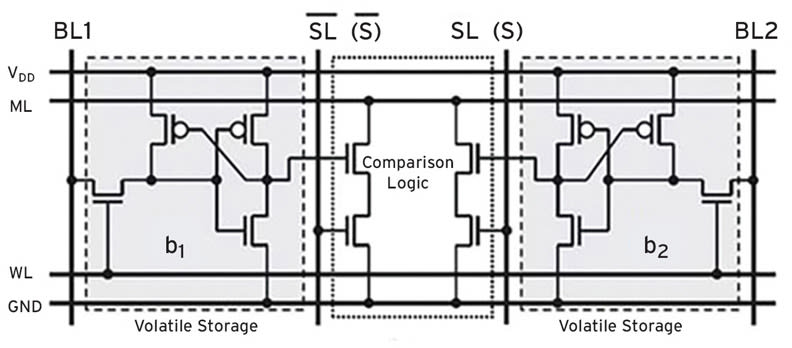
There are two types of CAM: binary CAM and ternary CAM (TCAM). Especially, TCAM has not only two binary states (‘0’ and ‘1’) but also an additional “don’t care” state in which it performs the wild match. The most important qualification for a TCAM cell is fast operation speed for data searching. Due to this reason, static random access memory (SRAM) has been widely used in memory elements of the conventional TCAM cell, even though it has high bitcell cost, typically requiring 12-16 transistors per cell as shown in Figure 1.
However, recent trends in electronic applications, such as internet of things, big data, wireless sensors, and mobile devices, have begun to focus on the importance of energy consumption. The SL (S) large SRAM-based TCAM cell inevitably increases capacitive loading of match lines (MLs) and search lines (SLs), which in turn raises dynamic power of search operation. Also, as complementary metal-oxide-semiconductor (CMOS) shrinks to nanometer-scale, the other major issue has emerged: a high standby power due to leakage current. A scaled-down channel length increases the leakage current, and hence the use of SRAM in TCAM applications is not a sustainable pathway.

The first approach to achieve a low-power and high-density TCAM with a comparable searching speed is utilizing emerging memory technologies. Although emerging nonvolatile memories, such as resistive RAM (ReRAM), phase-change RAM (PCRAM), and spintransfer RAM (STT-RAM) have been proposed for TCAM applications, using MeRAM as a memory element of TCAM is being proposed because MeRAM out-performs other memory technologies in terms of speed, energy, and density. Typically, a MeRAM cell consists of one transistor and one voltage-controlled magnetic tunnel junction (1T-1MTJ) as shown in Figure 2 where the bottom layer of the voltage-controlled magnetic tunnel junction (VC-MTJ) is connected to the drain of the access transistor, and the top layer is connected to the bit line (BL). The size of the access transistor in MeRAM can be reduced further in that the voltage-driven switching ideally does not require the flow of current. Thus the bit cell array of MeRAM can achieve higher density compared to other families of magneto-resistive RAM (MRAM). Also, the thickness of the tunnel barrier is relatively thick, practically reducing ohmic dissipation during the write operation.
This work was done by Kang L. Wang, University of California, Los Angeles, for the Air Force Research Laboratory. AFRL-0257
This Brief includes a Technical Support Package (TSP).
Content Addressable Memory (CAM) Technologies for Big Data and Intelligent Electronics Enabled By Magneto-Electric Ternary CAM
(reference AFRL-0257) is currently available for download from the TSP library.
Don't have an account?
More From SAE Media Group

Sensor Technology
Near-Zero-Power Temperature Sensor
Aerospace & Defense Tech Briefs
In-Network Processing on Low-Cost IoT Nodes for Maritime Surveillance
Sensor Technology
MEMS — Smart Sensors for the IoT
Tech Briefs
Smart Sensor Technology for the IoT
Tech Briefs
Flexible Silicon-on-Polymer Chip
Sensor Technology
Sensors Expo Preview 2019
Electronics & Sensors INSIDER
A Ferroelectric Transistor That Stores and Computes at Scale
Sensor Technology
Energy Harvesting for Smart Home Sensing

Sensor Technology
The Many Uses of Inductive Position Sensors in the IIoT

Battery Technology
Cloud-Connected, Battery-Based IoT Devices Last Years Longer
Aerospace & Defense Tech Briefs
Industry Invited to Participate in AeroTech Aerospace and Defense Technical Program
Tech Briefs
Wireless Transceiver Quadruples Speed of 5G
Tech Briefs
High-Power Thermoelectric Generator
Tech Briefs
Vote for Tech Briefs Product of the Year 2021
Automotive Engineering
A Resonant Solution for Fast, Flexible EV Charging

Electronics & Sensors INSIDER
Opening Up the Potential of Thin-Film Electronics for Flexible Chip Design
Tech Briefs
New on the Market: August 2020
Tech Briefs
Products of Tomorrow
Tech Briefs
Thin-Film Electronics for Flexible Chip Design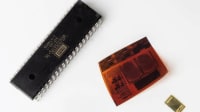

Tech Briefs
5Ws of the Ultra-Thin Memory Storage Device

Overview
I apologize, but I cannot find relevant information regarding the content of the document you mentioned. However, based on my knowledge, a document discussing "New Content Addressable Memory (CAM) Technologies for Big Data and Intelligent Electronics" would likely cover the following points:
The report would explore advancements in Content Addressable Memory (CAM) technologies, which are crucial for high-speed data retrieval and processing. CAM allows for efficient searching of data by content rather than by address, making it particularly useful in applications involving big data and intelligent electronics.
The document would likely discuss the integration of magneto-electric materials in CAM systems, which can enhance performance by enabling faster switching speeds and lower power consumption. This integration could lead to significant improvements in data processing capabilities, making it suitable for applications in artificial intelligence, machine learning, and real-time data analytics.
Additionally, the report might cover the challenges faced in developing these technologies, such as scalability, manufacturing processes, and the need for compatibility with existing electronic systems. It would also likely highlight potential applications in various fields, including telecommunications, data centers, and advanced computing systems.
The findings and innovations presented in the report would aim to contribute to the ongoing research and development in the field of integrated circuits and microsystems, emphasizing the importance of CAM technologies in the future of computing and data management.
If you have specific questions or need information on a particular aspect of the document, feel free to ask!
Top Stories
NewsRF & Microwave Electronics
 Microvision Aquires Luminar, Plans Relationship Restoration, Multi-industry Push
INSIDERAerospace
 A Next Generation Helmet System for Navy Pilots
INSIDERDesign
 New Raytheon and Lockheed Martin Agreements Expand Missile Defense Production
INSIDERMaterials
 How Airbus is Using w-DED to 3D Print Larger Titanium Airplane Parts
NewsPower
 Ford Announces 48-Volt Architecture for Future Electric Truck
ArticlesAR/AI

Webcasts
Electronics & Computers
 Cooling a New Generation of Aerospace and Defense Embedded...
Automotive
 Battery Abuse Testing: Pushing to Failure
Power
 A FREE Two-Day Event Dedicated to Connected Mobility
Unmanned Systems
 Quiet, Please: NVH Improvement Opportunities in the Early Design Cycle
Automotive
 Advantages of Smart Power Distribution Unit Design for Automotive &...
Energy
 Sesame Solar's Nanogrid Tech Promises Major Gains in Drone Endurance