




Upgrade Transonic Compressor Test Rig Data Acquisition System
New software programming using commercial off-the-shelf software for acquiring data, processing data, displaying results, and generating reports is implemented to improve the performance of a legacy system.
The Naval Postgraduate School (NPS) has frequently used the transonic compressor test rig (TCR) to test new axial transonic compressor rotors and casings for design and performance improvements. Technology has improved the ability to create more detailed designs and has led to an increase in testing at NPS. While the rotors and casings produced are becoming more advanced, the data acquisition system (DAS) used to measure the performance of these products became slow and outdated in comparison to currently available DAS products.
Consequently, this work involves the procurement, design, and implementation of upgrades to the current DAS.
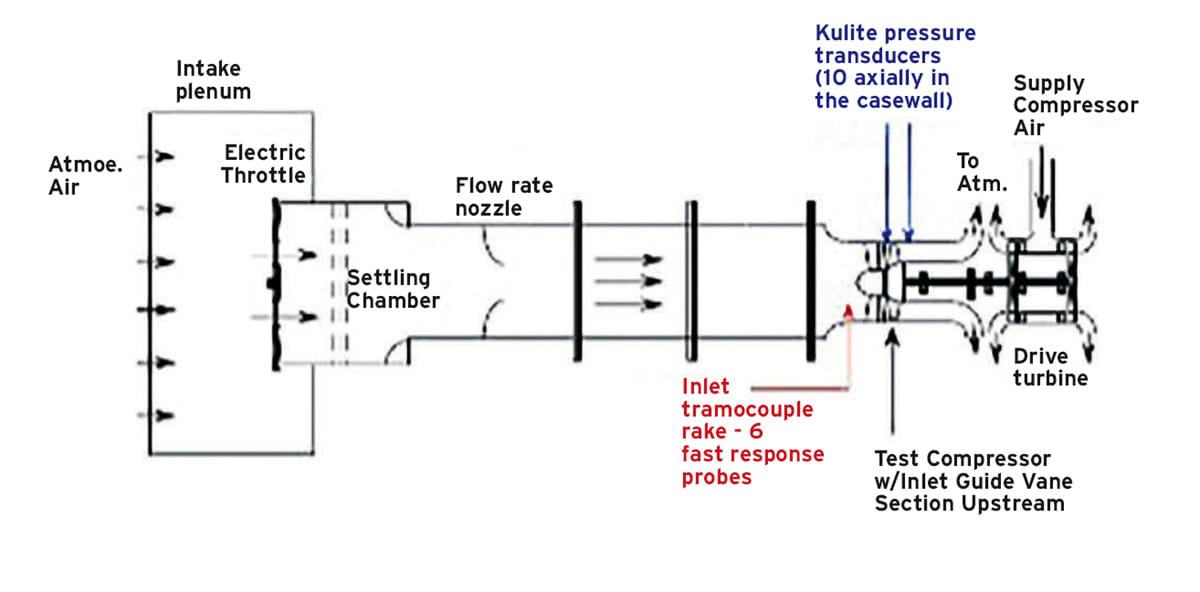
The TCR diagram in Figure 1 consists of a transonic axial rotor mounted on a single shaft with two opposed rotor, single stage air-operated drive turbines. The turbines are powered by supply air from an Allis Chalmers compressor. Atmospheric air is drawn into the inlet plenum and throttled via an electrically actuated butterfly valve; it then passes through the settling chamber, flow rate nozzle and finally to the transonic axial rotor where it is expelled back to the atmosphere.
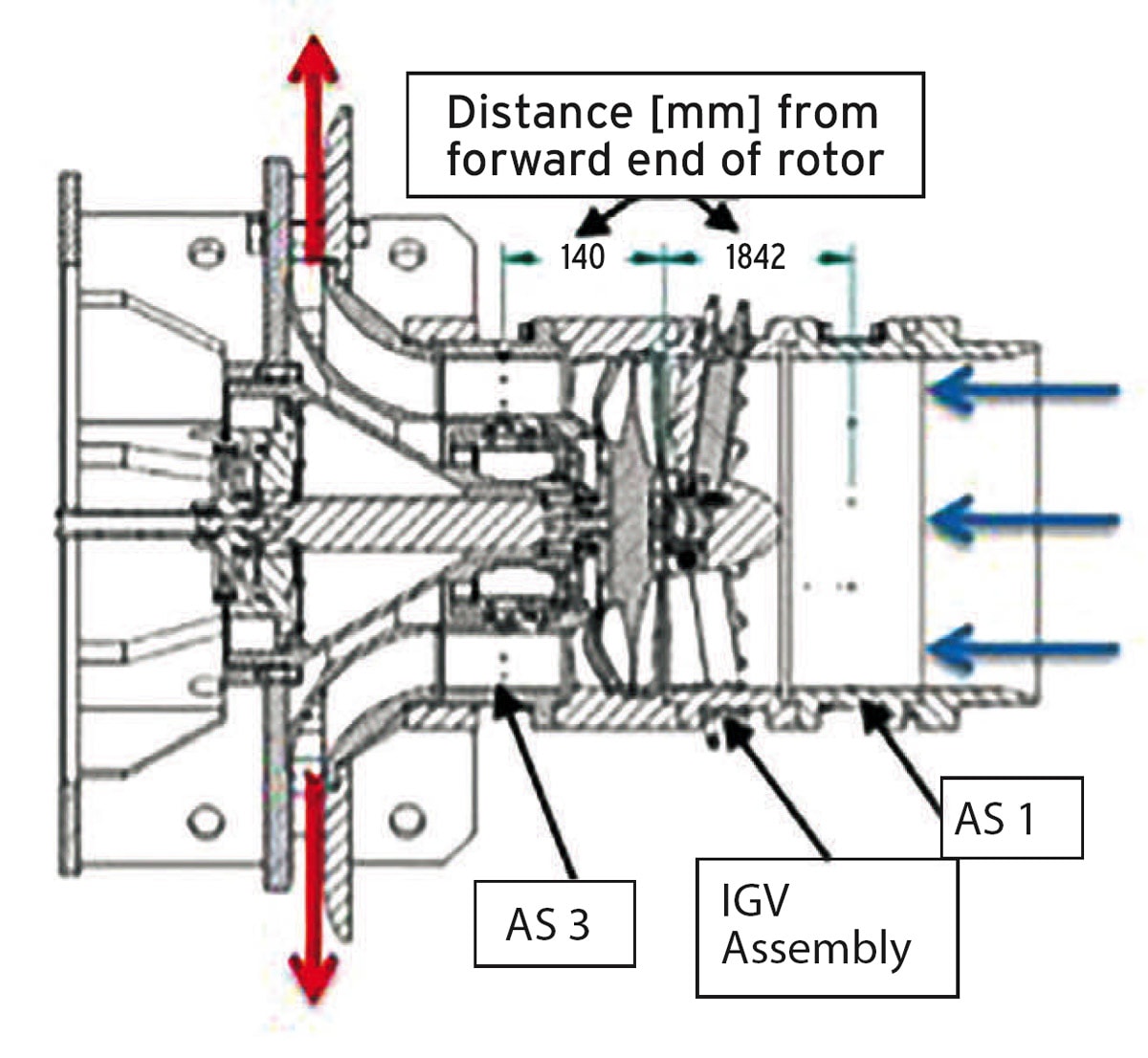
Mass flow is measured by a flow rate nozzle placed just aft of the settling chamber depicted in Figure 1. Inlet stagnation pressure and stagnation temperature are measured with two combination-probes. A static pressure port measures inlet static pressure. Outlet stagnation pressure is measured with eleven Kiel pressure probes and nine combination-probes. Outlet stagnation temperature is measured by the nine combination probes. Static pressure is measured with four static pressure ports in the hub, and two static pressure ports in the casing. Inlet measurements are taken at AS1 and outlet measurements are taken at AS3, as shown in Figure 2.
Throughflow analysis of the TCR utilizes the stream-tube method. Probes measure streamlines of the stream-tube at stations AS1 and AS3. The probes are placed at various radial placements to create inlet and outlet pressure profiles. The stage or rotor performance is calculated using the mass flow rate and circumferentially mass averaged pressures and temperatures. The throughflow analysis provides the stagnation pressure ratio, isentropic efficiency, and power. The experimental results were compared to the isentropic, or idealized, results as a useful measure of the compressor’s performance.
This work was done by Thomas D. Belna for the Naval Postgraduate School. For more information, download the Technical Support Package (free white paper) at mobilityengineeringtech.com/tsp under the Test & Measurement category. NPS-0025
This Brief includes a Technical Support Package (TSP).
Upgrade Transonic Compressor Test Rig Data Acquisition System
(reference NPS-0025) is currently available for download from the TSP library.
Don't have an account?
More From SAE Media Group
Tech Briefs
Film Cooled Surface
Aerospace INSIDER
NASA Studies How Volcanic Ash Affects Airplane Engines

Aerospace & Defense Tech Briefs
Simulations of Stall and Stall Control in Turbocompressors
Aerospace INSIDER
Purdue Strengthens National Security Focus with New Propulsion Lab
Aerospace & Defense Tech Briefs
Using Turbine Flow Meters for Aerospace Test and Measurement Applications
Aerospace & Defense Tech Briefs
Designing for the Connected Battlespace
Off-Highway Engineering
Developing a NEXT-GEN VGT
Aerospace & Defense Tech Briefs
High-Speed Data Cables for Fighter Aircraft
Off-Highway Engineering
Cummins Spools up New Turbo Tech
Aerospace INSIDER
Engineers Assess Flow Quality in Wind Tunnel Test Facility
Aerospace & Defense Tech Briefs
Adding Context to Full-Motion Video for Improved Surveillance and Situational Awareness
Aerospace & Defense Tech Briefs
Development and Verification of Body Armor Target Geometry Created Using Computed Tomography Scans
Aerospace & Defense Tech Briefs
Drone Swarms: A Transformational Technology

Tech Briefs
Robust, Optimal Subsonic Airfoil Shapes
Tech Briefs
Extrans Permeation Measurement System
Aerospace & Defense Tech Briefs
Investigation of Requirements and Capabilities of Next-Generation Mine Warfare Unmanned Underwater Vehicles
Tech Briefs
Miniature Turbomolecular Pump for High Vacuum
Aerospace & Defense Tech Briefs
Instrumentation for Fabrication and Testing of High-Speed Single-Rotor and Compound-Rotor Systems
Aerospace & Defense Tech Briefs
Exploring the Impact of Fuel Data Acquisition Technology on the USMC Expeditionary Energy Command and Control System
Aerospace & Defense Tech Briefs
Information Warfare: Staying Protected at the Edge
Aerospace & Defense Tech Briefs
WMD Detection Technology
Tech Briefs
Reverse Vortex Ring
Off-Highway Engineering
Garrett Two-Stage Turbos Ramp up Off-Highway
Aerospace & Defense Tech Briefs
Inter-Laboratory Combat Helmet Blunt Impact Test Method Comparison
Aerospace INSIDER
Research Could Lead to Noise Reduction in Aircraft Engines
Aerospace & Defense Tech Briefs
Hydraulic Thermal Bypass Valve
Aerospace INSIDER
Stall Warning Monitor Keeps Turbine Engines Healthy
Overview
The document is a master's thesis titled "Upgrade Transonic Compressor Test Rig Data Acquisition System," authored by Thomas D. Belna and submitted to the Naval Postgraduate School in June 2018. The thesis addresses the need for improved data acquisition systems in transonic compressor testing, which is critical for aerospace and defense applications.
The primary focus of the thesis is to present an upgraded data acquisition system designed to enhance the collection and analysis of performance data from a transonic compressor test rig. The author discusses the limitations of the existing legacy system, which may include issues related to data accuracy, processing speed, and overall efficiency. The upgrade aims to overcome these challenges by implementing modern technology and methodologies.
The document outlines the technical specifications of the new data acquisition system, detailing the hardware and software components involved. It emphasizes the importance of accurate measurements of key parameters such as pressure, temperature, and rotational speed, which are essential for evaluating compressor performance. The thesis also includes a comparative analysis between the upgraded system and the legacy system, highlighting improvements in data fidelity, processing capabilities, and user interface.
Additionally, the thesis discusses the implications of these upgrades for future research and development in the field of aerodynamics and propulsion systems. By providing a more robust and efficient data acquisition system, the research contributes to the advancement of compressor testing methodologies, ultimately benefiting the design and optimization of aerospace engines.
The document concludes with reflections on the significance of the research findings and their potential impact on the broader field of aerospace engineering. The author notes that the views expressed in the thesis are personal and do not necessarily reflect the official policy or position of the Department of Defense or the U.S. Government.
Overall, this thesis serves as a valuable resource for engineers and researchers involved in compressor testing and data acquisition, offering insights into the latest advancements in technology and their application in real-world scenarios.
Top Stories
NewsSensors/Data Acquisition
 Microvision Aquires Luminar, Plans Relationship Restoration, Multi-industry Push
INSIDERRF & Microwave Electronics
 A Next Generation Helmet System for Navy Pilots
INSIDERWeapons Systems
 New Raytheon and Lockheed Martin Agreements Expand Missile Defense Production
NewsAutomotive
 Ford Announces 48-Volt Architecture for Future Electric Truck
INSIDERAerospace
 Active Strake System Cuts Cruise Drag, Boosts Flight Efficiency
ArticlesTransportation

Webcasts
Aerospace
 Cooling a New Generation of Aerospace and Defense Embedded...
Energy
 Battery Abuse Testing: Pushing to Failure
Power
 A FREE Two-Day Event Dedicated to Connected Mobility
Automotive
 Quiet, Please: NVH Improvement Opportunities in the Early Design Cycle
Electronics & Computers
 Advantages of Smart Power Distribution Unit Design for Automotive &...
Unmanned Systems
 Sesame Solar's Nanogrid Tech Promises Major Gains in Drone Endurance