




NASA Studies How Volcanic Ash Affects Airplane Engines
NASA researchers are poring over data from a recent test that involved sending volcanic ash through an airplane engine. The primary issue, according to NASA, is that volcanic ash forms glass in the hot sections of some engines that clogs cooling holes and chokes off flow within the engine, which can eventually lead to an engine power loss.
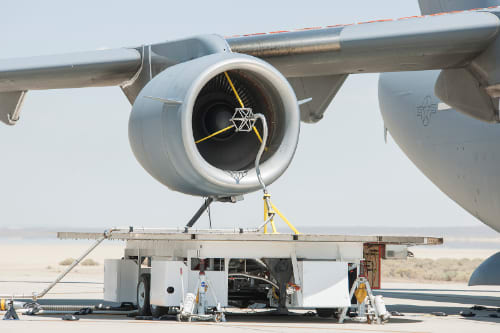
NASA partnered with the Federal Aviation Administration, the U.S. Air Force Research Laboratory, Pratt & Whitney, Rolls Royce Liberty Works, General Electric Aviation, and Boeing Research & Technology to conduct engine tests. Researchers introduced simulated volcanic ash into the engines at low and high flow rates.
The researchers found erosion on the inside of the blades - a cleaning of the blades. As the ash comes through the hot section, it turns into very small volcanic glass droplets that accumulate on the inside of the engine. The result was erosion in the compressor, and “glassification” in the turbine. Results are expected to be publicly released next summer.
More From SAE Media Group
Aerospace INSIDER
NASA, US Industry Advance Small Core Aircraft Engines
Aerospace Manufacturing and Machining INSIDER
GE Aviation Breaks Ground for New Manufacturing Facility in Ohio
Aerospace & Defense Tech Briefs
Upgrade Transonic Compressor Test Rig Data Acquisition System

Aerospace INSIDER
Engineers Assess Flow Quality in Wind Tunnel Test Facility
Aerospace & Defense Tech Briefs
New CFM56 High Pressure Turbine Blades

Aerospace INSIDER
New Probe Could Improve Sonic Boom Investigation
Aerospace INSIDER
Purdue Strengthens National Security Focus with New Propulsion Lab

Aerospace & Defense Tech Briefs
Boeing’s 777X Finally Gets Its Engines

Aerospace & Defense Tech Briefs
Ground Testing Begins on the GE9X
Tech Briefs
Smarter Parachutes Tested for Mars Landings




Tech Briefs
Facility Focus: NASA Goddard Space Flight Center


NASA Spinoff
Flying in the Fast Lane with Air Traffic Software
NASA Spinoff
Eagle Eyes in Treacherous Skies


Aerospace INSIDER
Crash Test Helps Improve Emergency Response
Aerospace INSIDER
NASA Tests Green Aviation Technology

Top Stories
INSIDERManufacturing & Prototyping
 How Airbus is Using w-DED to 3D Print Larger Titanium Airplane Parts
INSIDERManned Systems
 FAA to Replace Aging Network of Ground-Based Radars
NewsTransportation
 CES 2026: Bosch is Ready to Bring AI to Your (Likely ICE-powered) Vehicle
NewsSoftware
 Accelerating Down the Road to Autonomy
EditorialDesign
 DarkSky One Wants to Make the World a Darker Place
INSIDERMaterials
 Can This Self-Healing Composite Make Airplane and Spacecraft Components Last...
Webcasts
Defense
 How Sift's Unified Observability Platform Accelerates Drone Innovation
Automotive
 E/E Architecture Redefined: Building Smarter, Safer, and Scalable...
Power
 Hydrogen Engines Are Heating Up for Heavy Duty
Electronics & Computers
 Advantages of Smart Power Distribution Unit Design for Automotive...
Unmanned Systems
 Quiet, Please: NVH Improvement Opportunities in the Early Design...
