




Army Tests Limits of Improved Ribbon Bridge
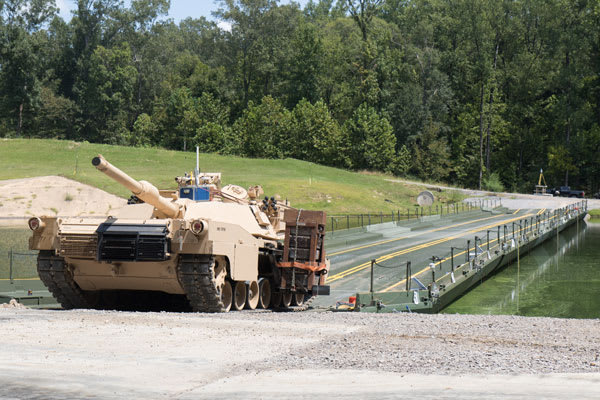
In today’s ever-changing world, technology is advancing at lightning speed. For the U.S. Army, that means constantly evolving vehicles, weapons, and systems. With that in mind, the U.S. Army Engineer Research and Development Center (ERDC) has partnered with the U.S. Army Program Executive Office Combat Support & Combat Service Support’s Project Manager Bridging to test high military load capacity vehicle weight limits of the Improved Ribbon Bridge (IRB).
The IRB floating bridge system is used to transport weapon systems, troops, and supplies over water when permanent bridges are not available. It provides wet-gap crossing capabilities either as a floating bridge or as a multi-bay raft for tracked and wheeled combat and tactical vehicles and has seen extensive combat operations with the Army and the U.S. Marine Corps since 2003.
The multi-laboratory project reaches across the organization and includes personnel from the Mississippi Army National Guard and Anniston Army Depot. The project itself will span two years and has three testing phases: a full-scale still-water prototype test, a small-scale model test and computational modeling and analysis.
The first test phase, completed in September 2021, consisted of full-scale water testing of several military vehicles at various speeds and weights.
“We executed a fully successful test series with the IRB here at one of our testing basins,” said Dr. Wes Trim, a research mechanical engineer with ERDC-GSL. “The IRB is a complex float bridge system, and it’s difficult to test it under laboratory conditions,” he said. “We developed, designed, and executed a full-scale still water test of the bridge, specifically aimed toward evaluating it against high military load capacity vehicles, by incrementally increasing our loading cases, not jumping into the heaviest most potentially damaging load first, but rather ramping up and taking a lot of measurements and inspections in between to safely approach our highest load targets.”
The team has since moved to the small-scale model testing phase of the project, which will replicate the full-scale test and began in October 2021.
“We are going to take our results from our full-scale static flow testing, and we are going to validate it with our small-scale model testing,” said Stephanie Robert, program manager and research civil engineer with the ERDC’s Geotechnical and Structures Laboratory (GSL). “In full-scale, we had still water conditions, so there was no flow going through the channels,” she continued. “It was just the bridge out there, and we ran our vehicle across. Now we’re introducing hydrodynamic effects. We’re introducing river velocities and speeds across it that we didn’t test out in the field, so we’re able to bridge that gap.”
“We are doing scaled testing on the IRB,” said Dr. Duncan Bryant, a research hydraulic engineer with the ERDC’s Coastal and Hydraulics Laboratory (CHL). “We take a lot of care to make sure that we choose a scale where the hydrodynamic forces that we get here are captured and can be correlated up to a larger scale.”
The two tests are designed to complement each other with the small-scale test incorporating hydrodynamic aspects such as flow and depth. "We can introduce river velocities, so we can ramp the river velocity up or down depending on what we are trying to simulate,” said Bryant. “As the water comes in, it impacts the IRB and changes the hydrodynamics. There is an operational space where it’s just too much flow for the bridge, and as you add more weight, that operational space changes. The way to do that safely is a scaled model. Here we don’t have to worry about sinking a tank or sinking a bridge, and we can try a lot of different scenarios out without any risk to anybody or any property.”
“We’re able to test conditions that we weren’t able to test in the full-scale here in a safe environment,” said Robert. “We’ll be able to determine river velocities. We’ll be able to determine max crossing speed of vehicles. We’ll be able to determine the type of crossings. We’ll be able to determine exactly how many bays we need in order to support the conditions that we are testing.”
The final phase of the project will begin when small-scale testing is complete. All data will go into a computational model to look at all loads and conditions the team was unable to test with the previous methods, which will allow the warfighter to know under what operational conditions they can safely cross the IRB.
More From SAE Media Group
Defense INSIDER
New Airfield Matting System Being Developed

Aerospace INSIDER
BAE Systems Acquires Developer of Electric Heavy Lift Quadcopters
Aerospace & Defense Tech Briefs
Army Issues Prototyping Contracts for Common Tactical Truck Replacement
Aerospace Manufacturing and Machining INSIDER
Army Launches $50 Million Advanced Manufacturing Initiative for Aviation and Weapon Systems

Aerospace Manufacturing and Machining INSIDER
Army Seeks to Expand 3D Printing to the Tactical Edge
Aerospace Manufacturing and Machining INSIDER
Army Unveils New Prototype M1E3 Abrams Tank
Defense INSIDER
Australia to Acquire New Class of Nuclear Submarines
Defense INSIDER
Conference to Focus on Counter-Drone Technology
Aerospace INSIDER
Army Starts Testing Prototype Modular Turreted Mortar System
Defense INSIDER
Army Receives New Robot Combat Vehicle Prototypes
Aerospace & Defense Tech Briefs
Smarter Pyrovalve Alternatives for Modern Missile and Munition Launcher Applications

Aerospace & Defense Tech Briefs
Autonomous Surveillance Technologies Relating to Dismounted Soldiers
Defense INSIDER
Anduril Becomes Third US Supplier of Solid Rocket Motors


Tech Briefs
2025 Award Finalists
Off-Highway Engineering
Kodiak Adapts Autonomous Tech for Military Vehicles

Aerospace Manufacturing and Machining INSIDER
Marines Receive First Combat and Control Variant of Amphibious Combat Vehicle
Aerospace & Defense Tech Briefs
Autonomous Navigation Kits

Tech Briefs
How Much Do You Know About MOSA?
Tech Briefs
Lubricating Aerospace One Zulu Pod at a Time
Top Stories
INSIDERDefense
 New Raytheon and Lockheed Martin Agreements Expand Missile Defense Production
NewsAutomotive
 Ford Announces 48-Volt Architecture for Future Electric Truck
INSIDERManufacturing & Prototyping
 Active Strake System Cuts Cruise Drag, Boosts Flight Efficiency
ArticlesTransportation
 Accelerating Down the Road to Autonomy
INSIDERMaterials
 How Airbus is Using w-DED to 3D Print Larger Titanium Airplane Parts
Road ReadyTransportation

Webcasts
Electronics & Computers
 Cooling a New Generation of Aerospace and Defense Embedded...
Power
 Battery Abuse Testing: Pushing to Failure
Connectivity
 A FREE Two-Day Event Dedicated to Connected Mobility
Automotive
 Quiet, Please: NVH Improvement Opportunities in the Early Design Cycle
Transportation
 Advantages of Smart Power Distribution Unit Design for Automotive &...
Aerospace
 Sesame Solar's Nanogrid Tech Promises Major Gains in Drone Endurance