




Accelerated Evaluation of Properties of Polyphase Alloys
Simulations are utilized as partial substitutes for laboratory experiments.
A methodology for accelerated evaluation of mechanical properties of polyphase alloys is based on digital representations of the alloys. For a given alloy material system, this representation is utilized in concert with (1) software tools and probes that simulate traditional laboratory testing equipment and instrumentation, and (2) real laboratory mechanical testing by nontraditional methods.
The representation is based on observable features of the internal geometry of an alloy material system, so that models of different forms and based on different size scales can be employed. The representation includes information on phases, grains within phases, dislocation structure, grain boundaries, and particles. At present, the representation is truncated at the size scale of constituent particles. Distributions of attributes are represented in a standardized manner by use of piecewise polynomial functions.
Finite-element alloy samples that simulate specimens machined from alloy stock can be created from data sampled from the aforementioned distributions of attributes. These simulated samples can be mechanically loaded and probed in a manner that mimics physical experimentation on real alloy samples. Mechanical and other physical responses of samples can be measured, and corresponding physical properties can be extracted from such virtual experiments, then stored in an appendix to a database that is part of the digital representation. By use of the information in this appendix, one can browse various estimates of critical material properties. Thus, the digital material system mimics a laboratory- based system for evaluation of mechanical properties.
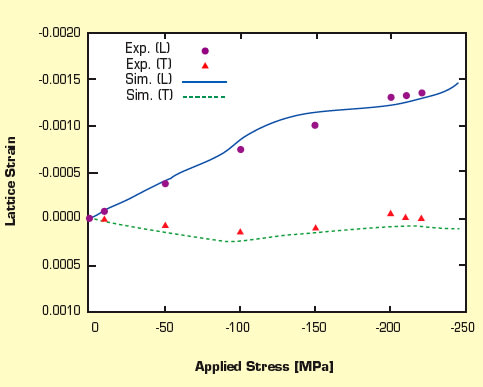
Although the methodology is largely oriented toward accelerating the development of alloys by using multiscale software simulations as substitutes for some physical tests, experimentation lies at the core of the methodology in the sense that the high-fidelity experiments are used to validate and calibrate the simulations. The primary role of the experimental data within the digital material system is the establishment of reference states, which are direct points of contact between measured and calculated values of attributes for the same nominal material states. As such, reference states enable both the initialization and validation of computational models of alloys. For example, one attribute that has been employed extensively is lattice strain (see figure), which is regarded as a direct link to the micromechanical state and, therefore, invaluable for validation of models.
This work was done by Paul Dawson, Matthew Miller, Tong Seok Han, and Joel Bernier of Cornell Univeristy for the Air Force Research Laboratory. For further information, download the free white paper at www.defensetechbriefs.com under the Materials category. AFRL-0001
This Brief includes a Technical Support Package (TSP).
Accelerated Evaluation of Properties of Polyphase Alloys
(reference AFRL-0001) is currently available for download from the TSP library.
Don't have an account?
More From SAE Media Group
Tech Briefs
Virtual Test Laboratory
Aerospace & Defense Tech Briefs
Dimensional Stabilization of Composite Space Structures
Aerospace & Defense Tech Briefs
Multi-Scale Analysis of Deformation and Failure in Polycrystalline Titanium Alloys Under High Strain Rates
Air Force Research Laboratory Technology Horizons
Strain-Induced Porosity Model
Photonics & Imaging Technology
Deformation Fingerprints Will Help Researchers Identify, Design Better Metallic Materials
Aerospace & Defense Tech Briefs
Evaluation of Additively Manufactured Ultrahard Steels
Aerospace & Defense Tech Briefs
Machine Learning Unlocks Secrets to Advanced Alloys
Automotive Engineering
Virtual and Physical Testing of Third-Generation High Strength Steel
Aerospace & Defense Tech Briefs
Aircraft Maintenance Technicians Seek Simplified, Portable, Fast Aviation Eddy Current Testing
Tech Briefs
Nanoprecipitates Toughen Structural Alloys
Tech Briefs
Fine-Tuning the Factory Using Simulation
Medical Design Briefs
What Medical Device OEMs Should Know About Outsourced MIM
Tech Briefs
Using 3D Printing to Strengthen Jet Engines
Tech Briefs
Crack Image Quality Indicator
Aerospace & Defense Tech Briefs
Low Distortion Titanium in Laser Powder Bed Fusion Systems

Aerospace & Defense Tech Briefs
Testing Military-Grade Adhesive in Extreme Loading Conditions
Aerospace & Defense Tech Briefs
‘First of Its Kind’ Composite Material to Help Space Vessels Travel Longer Distances


Medical Design Briefs
Material Property Simulation Offers Longer-Lasting Spinal Disc Implants
Automotive Engineering
Accelerating Materials Development with Quantum Computing
Tech Briefs
3D Printing Creates High-Performance Metal Alloy
Tech Briefs
Copper Strengthens 3D-Printed Titanium
Aerospace & Defense Tech Briefs
Plasma Electrolytic Oxidation: The Future of Lightweight Designs in Aerospace and Defense
Aerospace & Defense Tech Briefs
Hierarchical Diamond-Based Ceramic Composites
Air Force Research Laboratory Technology Horizons
Characterizing Mechanical Properties at the Microscale
Tech Briefs
Fine-Tuning Alloys for High-Temperature Use
Tech Briefs
Liquid Metal Lattice
Overview
The document presents a final technical report on the development of an accelerated methodology for evaluating the critical mechanical properties of polyphase alloys through simulation and experimental techniques. Authored by Paul Dawson, Matthew Miller, Tong-Seok Han, and Joel Bernier from the Sibley School of Mechanical and Aerospace Engineering at Cornell University, the research was sponsored by the Air Force Office of Scientific Research under grant number F49620-02-1-0047.
The core of the methodology is a digital representation of the material structure, which allows for rapid determination of the strength and stiffness of polyphase alloys. This digital material framework integrates various digital tools and probes that simulate traditional laboratory testing equipment, thereby reducing the need for extensive physical tests. The approach aims to shorten development times while maintaining high fidelity in experimental validation and calibration of multiscale simulations.
The report highlights several key publications resulting from the research, which document various aspects of the methodology. Notable articles include discussions on the digital material framework, representation of anisotropic phase morphology, and experimental measurements of lattice strain using synchrotron x-rays. These publications contribute to the understanding of mechanical responses under loading conditions and the behavior of materials at the microstructural level.
The methodology was exemplified through a case study involving an iron-copper (Fe-Cu) system, illustrating the practical application of the digital tools and nontraditional mechanical testing methods developed during the project. The report emphasizes the importance of high-fidelity experiments in validating the digital simulations, ensuring that the results are reliable and applicable in real-world scenarios.
In conclusion, this research represents a significant advancement in materials science, particularly in the evaluation of polyphase alloys. By leveraging digital methodologies and innovative testing techniques, the authors provide a framework that not only enhances the efficiency of material property evaluations but also contributes to the broader field of material design and engineering. The findings and methodologies outlined in this report are expected to have lasting implications for future research and development in the field.
Top Stories
INSIDERManufacturing & Prototyping
 How Airbus is Using w-DED to 3D Print Larger Titanium Airplane Parts
INSIDERManned Systems
 FAA to Replace Aging Network of Ground-Based Radars
NewsTransportation
 CES 2026: Bosch is Ready to Bring AI to Your (Likely ICE-powered) Vehicle
NewsSoftware
 Accelerating Down the Road to Autonomy
EditorialDesign
 DarkSky One Wants to Make the World a Darker Place
INSIDERMaterials
 Can This Self-Healing Composite Make Airplane and Spacecraft Components Last...
Webcasts
Defense
 How Sift's Unified Observability Platform Accelerates Drone Innovation
Automotive
 E/E Architecture Redefined: Building Smarter, Safer, and Scalable...
Power
 Hydrogen Engines Are Heating Up for Heavy Duty
Electronics & Computers
 Advantages of Smart Power Distribution Unit Design for Automotive...
Unmanned Systems
 Quiet, Please: NVH Improvement Opportunities in the Early Design...
