




Dimensional Stabilization of Composite Space Structures
Stability of terrestrial composite-material structures can be assessed for environmental effects.
A research project has yielded progress on several fronts toward the goal of minimizing thermal and aging distortions of composite-material (specifically, polymer- matrix/graphite-fiber) outer-space structures that are required to retain precise dimensions and shapes. The achievements of this project are also applicable to terrestrial composite-material structures to the extent to which various environmental effects can be properly taken into account. Examples include effects of expansion caused by absorption of atmospheric moisture (similar to effects of purely thermal expansion) and effects of outgassing of volatile constituents of polymers (effects of out-gassing are more pronounced in the outer-space vacuum).

In the computational simulations, initially, some assumed thermal distortions were shown to be reduced by trial-and-error positioning of anti-distortion appliqués. Subsequently, optimization software was employed to automatically adjust the design parameters of the anti-distortion appliqués so as to minimize an objective function based on distortional displacements in the structure. It was found that an effective and practical way to effect the optimization was to introduce only a few appliqués and set their location coordinates as design parameters.
Thus, the use of anti-distortion appliqués was demonstrated to have theoretical potential for order-of-magnitude improvement in dimensional stability in thermal environments. However, the practical potential may be limited in the near future for two reasons: (1) a large amount of computational modeling is needed to implement this approach and (2) at present, techniques for measuring distortional displacements of structures with the precision needed for further development of this approach are not yet available.
The other main approach followed in this project involved studying effects of damage of polymer matrices (and related effects associated with aging of polymer matrices) as sources of dimensional instability. In one example of such damage, in the course of cooling to the cryogenic environment of outer space, polymers become susceptible to microcracking. Even in cases in which damage may be so small as to degrade structural integrity insignificantly, it can cause dimensional instability. In this project, effects of matrix cracking on effective properties of composite laminae were studied in finite-element-model computational simulations. In comparison of results of the simulations with experimental data in the literature, it was found that the residual properties (defined here as the effective properties reduced by amounts that depend on degrees of damage) as predicted by use of the models closely approximate experimentally observed properties, except in experiments that were directed toward measuring extremely small changes in stiffness. The models were also found to expose several subtle dependences of the residual properties on the parameters of undamaged plies adjacent to the plies containing the cracks. These dependences were explained by the observation that the residual properties depend partly on the crack-opening behavior and that crack opening is restrained by adjacent plies to degrees determined by the properties of those plies.
This work was done by Mark R. Garnich, David Long, Akula M. K. Venkata, John F. Fitch, and Pu Liu of the University of Wyoming for the Air Force Research Laboratory.
AFRL-0060
This Brief includes a Technical Support Package (TSP).
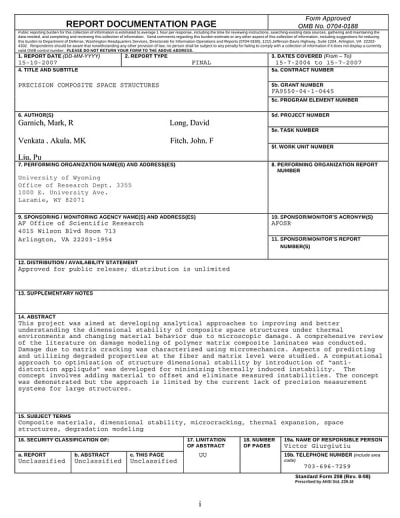
Dimensional Stabilization of Composite Space Structures
(reference AFRL-0060) is currently available for download from the TSP library.
Don't have an account?
More From SAE Media Group

Aerospace & Defense Tech Briefs
Accelerated Evaluation of Properties of Polyphase Alloys
Tech Briefs
Stretchable Thermoelectric Generators


Tech Briefs
Virtual Test Laboratory
Aerospace & Defense Tech Briefs
Hierarchical Diamond-Based Ceramic Composites

Aerospace & Defense Tech Briefs
Molecular Engineering for Mechanically Resilient and Stretchable Electronic Polymers and Composites
Air Force Research Laboratory Technology Horizons
Composites Design and Structural Analysis Tool
Aerospace & Defense Tech Briefs
‘Nanostitches’ Enable Lighter and Tougher Composite Materials
Medical Design Briefs
Mixing Silk with Polymers Could Lead to Better Biomedical Implants
Automotive Engineering
Virtual and Physical Testing of Third-Generation High Strength Steel
Aerospace & Defense Tech Briefs
Biobased Carbon Fibers and Thermosetting Resins for Use in DOD Composites Applications
Medical Design Briefs
Material Property Simulation Offers Longer-Lasting Spinal Disc Implants

Tech Briefs
Damage Simulation Tool for Composite Laminates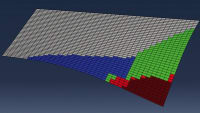
Tech Briefs
Color-Changing Dyes Visualize Stress in Plastics
Tech Briefs
Fiber-Metal Laminate Manufacturing Technique

Tech Briefs
Automated Tow/Tape Placement System
Automotive Engineering
Tenneco Tech Center Expands NVH Capabilities with New Materials Lab
Tech Briefs
Conductive Carbon Fiber Polymer Composite

Automotive Engineering
A Cool New Dimension to Automotive Plastics’ Testing
Aerospace & Defense Tech Briefs
Design of New Piezoelectric Composites Using Nanocellulose
Aerospace & Defense Tech Briefs
Designing Sensory and Adaptive Composite Materials
Overview
The document appears to be a technical script related to finite element analysis (FEA) using a software platform, likely Abaqus, for modeling composite materials. It outlines various functions and procedures for setting up a simulation, including defining material properties, boundary conditions, loads, and mesh configurations.
Key components of the document include:
-
Material and Section Definitions: Functions such as
lami_parti(),lami_mater(), andlami_section_1()are used to define the properties of the composite materials and their structural sections. This includes specifying the layers, orientations, and mechanical properties necessary for accurate simulation. -
Boundary Conditions and Loads: The script includes a section dedicated to imposing boundary conditions (
lami_bc()) and applying loads (lami_load()). It specifies how the model will react to external forces, such as concentrated loads at specific vertices of the model, and how displacements are constrained. -
Job Setup: The
lami_job()function prepares the simulation job, creating an input file for the analysis. This is crucial for running the simulation and obtaining results. -
Element and Node Management: The document contains code for reading input files and managing nodes and elements within the model. It initializes various parameters and arrays to store node and element data, which are essential for the simulation's computational processes.
-
Equation Writing for Constraints: The script includes loops that write equations for edge constraints, indicating how different elements interact with each other. This is vital for ensuring that the model behaves correctly under simulated conditions.
-
Output Management: The document specifies how results are written to output files, which is important for post-processing and analyzing the simulation results.
Overall, the document serves as a comprehensive guide for setting up a finite element model of a composite material, detailing the necessary steps to define the model, apply loads and boundary conditions, and prepare for simulation. It emphasizes the importance of accurate material definitions and boundary conditions in achieving reliable simulation outcomes. The structured approach in the script allows for flexibility and adaptability in modeling various composite configurations, making it a valuable resource for engineers and researchers in the field of materials science and structural analysis.
Top Stories
INSIDERManufacturing & Prototyping
 How Airbus is Using w-DED to 3D Print Larger Titanium Airplane Parts
INSIDERManned Systems
 FAA to Replace Aging Network of Ground-Based Radars
NewsTransportation
 CES 2026: Bosch is Ready to Bring AI to Your (Likely ICE-powered) Vehicle
NewsSoftware
 Accelerating Down the Road to Autonomy
EditorialDesign
 DarkSky One Wants to Make the World a Darker Place
INSIDERMaterials
 Can This Self-Healing Composite Make Airplane and Spacecraft Components Last...
Webcasts
Defense
 How Sift's Unified Observability Platform Accelerates Drone Innovation
Automotive
 E/E Architecture Redefined: Building Smarter, Safer, and Scalable...
Power
 Hydrogen Engines Are Heating Up for Heavy Duty
Electronics & Computers
 Advantages of Smart Power Distribution Unit Design for Automotive...
Unmanned Systems
 Quiet, Please: NVH Improvement Opportunities in the Early Design...
