




Alternative Fuels Face Challenges
With gasoline prices seeming to stabilize and fuel-economy measures taking hold, is there a compelling need for alternative fuels? Automotive engineers offer some surprising reasons why there is.

Oil companies are opening vast new reserves using hydraulic fracking technology. At the same time, fuel-efficiency measures seem to be taking hold, with drivers in North America using less gasoline and diesel. Vehicle refueling stations and the existing vehicle fleet are ill-equipped to accept much more ethanol.
Is it time to write off future development in alternative fuels? Not in the least, but the reasons for using alternatives are growing more complex. As Ron Graves, Director, Sustainable Transportation Programs at Oak Ridge national laboratory (ORNL) told Automotive Engineering, there are restrictive U.S. ePA Tier 3 emissions regulations looming, as well as the international motivation to reduce CO2 emissions through even better fuel efficiency. Automakers are looking ahead to the U.S. CAFE 2025 and European Union 2020 efficiency targets. With natural gas reserves rising and prices plum-meting in response — to below gasoline prices on an energy-equivalent basis — another question is how best to use natural gas as an alternative fuel.
Octane and alternative fuels

Higher-octane fuels are good for fuel efficiency, said Tom Leone, an engineer in the Research and Advanced Engineering group at ford, in an interview with Automotive Engineering. Today’s modern engine sensors will retard spark to prevent knock if a low-octane fuel is used. This is a condition most common when the engine runs at a combination of high load and high torque, according to Leone. Retarding spark is easier on the engine and reduces noise, but the trade-off is decreased efficiency and torque. The converse is true: the higher the octane, the more spark is advanced, enabling higher torque and efficiency.
Leone also pointed out that the trends in engine technology that automakers are using to increase fuel efficiency — gasoline turbocharged direct injection (GTDI) to downsize and downspeed; cylinder deactivation; and hybridization — would also benefit from higher-octane fuels.
Enter ethanol. It is a naturally higher-octane fuel, and when blended with gasoline raises the octane level. With the phase-out of MTBE as an additive, ethanol was a natural to replace it. To show how important this is, Ford conducted a study looking at the benefits on GTDI engines using E10, E20, and E30 splash-blended fuels, using an EcoBoost 3.5-L engine (see SAe international technical paper 2013-01-1321). The results, presented by Leone, were a bit surprising.
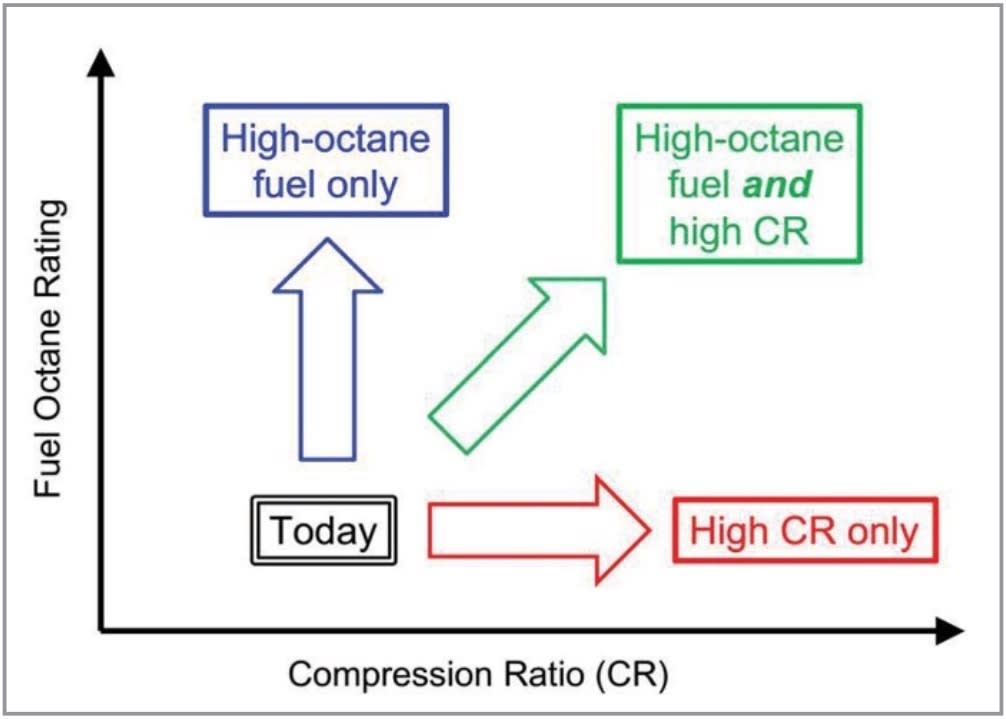
In a tank-to-wheels comparison, with octane ratings increased through higher levels of ethanol, Leone summarizes the results in terms of increasing efficiency and decreasing CO2 emissions. “Higher octane alone was good,” he said. “Higher octane combined with higher compression ratio was better.”

But increasing compression ratio without higher-octane fuel can actually degrade efficiency and increase CO2 emissions. All three scenarios were tested on FTP and US06 cycles, and high CR without higher-octane fuel caused degraded performance on the US06 cycle. Conclusion? Better results come with more octane.
Increasing octane through alternatives
Why is ethanol for octane so important? The quality of the new oils produced from fracking in rockbound, or tight, reservoirs is worse. As a result, “octane is becoming a bit more difficult to produce and, more importantly, more costly to produce,” said Terrence Higgins, Executive Director, Refining and Special Studies for hart energy. “This oil is a poor gasoline feedstock,” he said, speaking at the SAE 2014 High Octane Fuels Symposium. It contains more paraffin, resulting in a lower-octane fuel.
He explained in a follow-up interview with Automotive Engineering that there are a number of ways refiners can produce higher-octane gasoline. One is through reforming low-octane components such as naphtha into gasoline. This increases cost slightly because the refiners lose gasoline yield. It also produces LPG and fuel gas, which the refiners sell. The concurrent boom in natural gas in North America means there is an abundance of low-cost LPG and fuel gas.
“The greater the [price] difference between gasoline and fuel gas, the greater the opportunity cost [in creating gasoline with higher octane],” explained Higgins.
For these reasons, refinery octane levels (octane of gasoline prior to blending with an additive such as ethanol) have dropped from an average of 87.25 AKI in 2003 to 85.5 AKI in 2013.
“The decline in refinery octane has been due to [availability of] increased octane provided outside the refinery — that is, ethanol blending,” Higgins said. “There will be further declines in required refinery octane as ethanol blend-in increases, but that will be offset by refinery octane loss related to desulfurization” from the future implementation of the U.S. EPA’s Tier 3 regulation, which requires sulfur to drop to 10 ppm.

E30 as an alternative fuel
If ethanol is good as an octane enhancer, the question becomes: how much? The extreme as a truly alternative fuel is E85, which is now legally defined as containing at least 51% but no more than 83% ethanol. While E85 as an alternative has its advantages, fuel experts such as Bill Woebkenberg, U.S. Fuels Technical and Regulatory Affairs, mercedes-Benz, noted that a mid-level ethanol blend (MLEB) is better. These range from roughly E25 to about E35. “With about one-third ethanol blend, you get about two-thirds of the benefit of using ethanol,” he said.
However, taking full advantage of an MLEB fuel, such as E30, requires OEMs to develop MLEB-optimized engines and compatible fuel-delivery systems. “The components needed for an MLEB engine are similar to today’s FFVs [flexible-fuel vehicles],” he said, including probably larger fuel pumps, higher-flow fuel injectors, and corrosive-resistant components.
New sensors will also be critical for an MLEB engine. “Today’s methods of mitigating knock will be insufficient,” said Woebkenberg, noting that measuring the level of ethanol rather than inferring it before injection is critical to maximize engine efficiency and protect it from knock.
But wait....there is more: “There is research from groups like ORNL that there is more benefit to an MLEB fuel than higher octane. Additional cooling from ethanol is one,” he said. Also, ORNL tested 87 AKI E0 gasoline in its neat form and in mid-level alcohol–gasoline blends with 24% isobutanol/gasoline (IB24) and E30 in a high-compression-ratio configuration. E30 showed exceptional antiknock beyond its octane number, and it enabled the peak torque to double relative to regular-grade gasoline. This means an MLEB-optimized engine would enable even further downspeeding and downsizing.
Practicalities — infrastructure and legislation
The best MLEB may not be E30, according to John Eichberger, Vice President of Government Relations for nAcS (a global association representing convenience stores and fuel retailers). He’d prefer the ethanol level to not exceed E25. “We found that while costs to upgrade pumps from an E10 or E15 certified equipment to E25 could be as low as $5,000 per pump, even going to a 26% blend will most likely require us to upgrade to equipment certified for E85,” he told Automotive Engineering. E85-grade dispensing equipment is as much as four times more expensive than an E15 pump.
The voice of regulators will be vital. “While EPA certified that FFVs can operate on E0, E85, or any level of ethanol in between, the EPA currently does not have any specific regulations for MLEB — E16 through E50,” explained Marilyn Herman, President of herman and Associates. “EPA has granted waivers for use of up to E15 for use in conventional vehicles, but has not granted any waivers for fuels between E16-E50 for use in conventional vehicles.”

She cautions that removing barriers and streamlining regulatory requirements requires lead time. The process has started. She reports that the EPA requested comment on MLEB in its Tier 3 emissions proposal.
To put things in perspective, Herman uses the phase-out of leaded gasoline as an example. Starting with the Clean Air Act Amendments in 1970, Congress established a major national program to phase out the use of lead to protect the public health and welfare and prevent damage to vehicle emission controls; it was not until 1995 that leaded gasoline was finally phased out entirely from the fuel supply.
There is also the question of consumer choice. Leone from Ford stresses a clear point. “Our testing demonstrates the advantages of higher-octane fuels,” he said. But today’s world is a mix of high and lower octanes. Drivers can choose which to put in their tank, but that may not be enough. Why? To design engines with higher compression ratios to use higher-octane fuels requires voluntary compliance. “Most customers will not pay extra for premium fuel if a lower-priced alternative is available,” he explained.
Natural gas every day?
Natural gas is cleaner than oil, and in North America it represents a plentiful domestic source of transport fuel that is far cheaper on a gasoline-gallon equivalent to conventional gasoline. Could it represent an everyday fuel?

“Natural gas vehicles have not played a significant role in U.S. transport, and will likely not grow market share dramatically in the coming years,” said Andrew Soare Senior Analyst at lux Research. Consumers are motivated by more than just fuel price, and dislike natural gas vehicles because of reduced trunk space, limited vehicle selection, and fewer fueling options.
However, Soare believes fleet applications are ideal for natural gas. Driven more by economics and price, fleets have predictable driving patterns, he noted. Typically, organizations such as municipalities can also justify a dedicated refilling station, refueling overnight using cost-effective time-fill stations. This is reflected in the offerings from OEMs, who concentrate on offering CNG-powered cargo vans, stripped chassis, pick-up trucks, and taxis.
Converting natural gas into something closer to a drop-in fuel that uses today’s existing infrastructure would make it a more viable everyday fuel. One technology is converting natural gas into diesel using gas-to-liquid (GTL) technologies. Shell and the South African company Sasol have such facilities already operating in the Persian Gulf, and the latter is in the planning stages for one in Louisiana. “There are a number of other companies looking to scale down GTL, such as Sierra energy, compactgTl, and a few others. While these solutions are still a few years away from a sizable impact, finished fuels from natural gas (GTL) is positioned to grow in the U.S.,” said Soare.

Another approach is to convert natural gas into ethanol, a technique pursued by coskata.
“Coskata has been operating at the pilot and demonstration scale for over five years producing ethanol from natural gas,” said Bill Roe, the company’s CEO. He reports that the ethanol produced meets the ASTM standard for fuel-grade ethanol. This means that natural gas could be used to increase the octane levels and improve performance of more standard gasoline-based engines through its conversion to ethanol. Roe said that their path to ethanol requires less energy than GTL. It is also more scalable, allowing smaller projects than the typical GTL multi-billion-dollar projects.
More From SAE Media Group
Off-Highway Engineering
Alternative Fuels Overshadowed in EV Era
Off-Highway Engineering
Hexagon Bullish on CNG for Long-Haul Trucks
Off-Highway Engineering
Alternative Fuels, Propulsion Poised for Growth in U.S. Fleets
Off-Highway Engineering
Iveco Pursues Natural Gas in Stralis NP Models
Automotive Engineering
Future ICEs: What Comes After 2025?
Battery & Electrification Technology
Ultracapacitor Solutions to Address Energy-Storage Needs of Vehicles
Power Electronics INSIDER
Highway Segment Charges Electric Vehicles
Tech Briefs
EVs Are Growing Up—and Getting Practical

Automotive Engineering
Other Expert Voices
Off-Highway Engineering
Electrification’s Impact on Commercial-Vehicle Chassis Design
Off-Highway Engineering
Hyundai CE Debuts Hydrogen and Electric Excavators at Bauma 2022
Off-Highway Engineering
Delphi and Westport Team on Next-Gen Injectors for Natural Gas Engines
Battery Technology
New SAE Wireless Charging Standard is EV Game-Changer
Tech Briefs
When to Expect a Hydrogen Fuel Cell Truck

Off-Highway Engineering
Hybrid Powertrains in the Product Mix
Off-Highway Engineering
Diesel Isn’t Dead
Battery & Electrification Technology
Can Solid-State Batteries Commercialize by 2030?
Automotive Engineering
EFuels: An Alternative to the Alternative
Power Electronics INSIDER
New Smart Charger May Pave the Way for More EVs
Automotive Engineering
A Peek at Electrify America’s Charging Station Future
Off-Highway Engineering
Digital Tech a Las Vegas Headliner

Off-Highway Engineering
Danfoss and Sany Extend Electrification of Off-Highway Machines
Battery Technology
Advancing Battery Technology: THE 2021 BATTERY SHOW Preview
Automotive Engineering
Fuels to Transition the Global Legacy Fleet
Automotive Engineering
Time for Hydrogen
Automotive Engineering
Welcome to the Automotive Engineering Podcast
Off-Highway Engineering
ACT Expo 2025: Heavy-Duty EVs, H2 Trucks and Tariff Talk Dominate Day One
Top Stories
INSIDERManufacturing & Prototyping
 How Airbus is Using w-DED to 3D Print Larger Titanium Airplane Parts
NewsAutomotive
 Microvision Aquires Luminar, Plans Relationship Restoration, Multi-industry Push
INSIDERAerospace
 A Next Generation Helmet System for Navy Pilots
INSIDERDesign
 New Raytheon and Lockheed Martin Agreements Expand Missile Defense Production
ArticlesAR/AI
 CES 2026: Bosch is Ready to Bring AI to Your (Likely ICE-powered) Vehicle
Road ReadyDesign

Webcasts
Semiconductors & ICs
 Advantages of Smart Power Distribution Unit Design for Automotive...
Unmanned Systems
 Quiet, Please: NVH Improvement Opportunities in the Early Design...
Electronics & Computers
 Cooling a New Generation of Aerospace and Defense Embedded...
Power
 Battery Abuse Testing: Pushing to Failure
AR/AI
 A FREE Two-Day Event Dedicated to Connected Mobility
