




Picturing a Brighter Future
Displays are becoming a central focus for automotive interior design, forcing engineers to examine myriad trade-offs related to size, resolution, and supporting electronics.

Automotive developers are transforming interiors to meet expectations driven by consumer electronics, using larger color displays with sharper images. Design teams are working overtime to determine the best size and resolution, analyzing factors that include sunlight, distance, and durability while they strive to lower costs.
Buyers who view HD TVs and other dazzling displays will no longer accept low-resolution color displays or the monochromatic center stack displays that were satisfactory just a few years ago. Vivid displays meet consumer requirements for visual excitement as well as their desire to get more information from the myriad electronic systems throughout the car.
“Being able to access the information on the displays in a vehicle is critical for the driver to monitor speed, direction, driver alerts, etc.,” said Brian Pluckebaum, senior Product Marketing Manager at Renesas Electronics. “A driver must be able to see this information in all conditions.”
Bigger is better
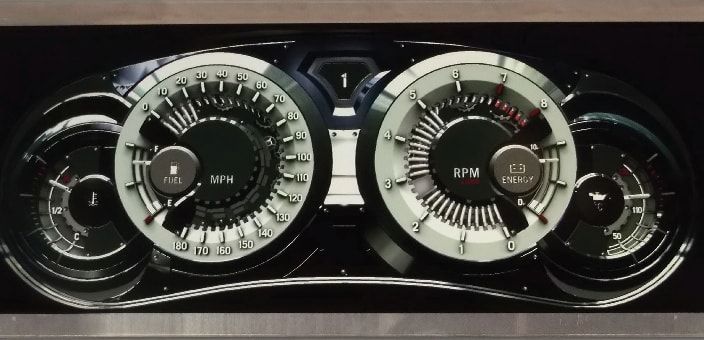
There’s limited space in dashboards, but more of it is going to flat-panel displays. As engineers analyze requirements for instrument clusters and center stack displays, their first concerns are size and resolution. both parameters are leveraging computer and consumer technologies.
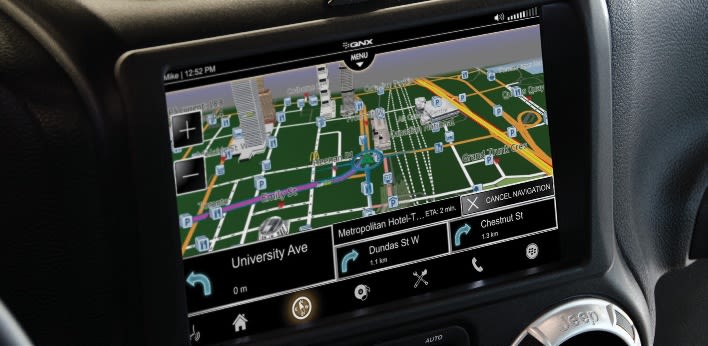
“For center stacks, the 4- to 5-in wide VGA information displays common in the current model year vehicles are being replaced by 10- to 14-in HD displays from model year ’15 onward,” said Andrew McLean, Applications Manager, Automotive Connectivity & Ethernet at Texas Instruments.
As screens get larger, they’re moving to higher resolution. that’s especially true for instrument clusters, which are closer to the driver so it’s easier to discern pixilation. Some vendors have already moved to retina-class displays that have such high resolution that it’s nearly impossible to discern visual flaws such as jagged edges.

“In instrument clusters, we’ve seen OEMs go from 1280 x 480 pixel resolution to 1920 x 720, and they may double resolution again in the 2019 time frame,” said Dan Loop, Senior Product Marketing Manager at Freescale Semiconductor. “In premium vehicles, you’re already seeing retina-class instrument cluster displays.”
Retina-class displays aren’t on the drawing boards for most mainstream vehicles. That’s because automotive screens are viewed at longer distances than tablets and phones. Many developers feel that today’s displays have high enough resolution — that further increases cannot be perceived by the human eye. However, they’re still exploring techniques that make images appear more appealing.
“At typical automotive viewing distance of approximately 30in or 75cm with pixel densities between 170 and 200 dpi, current display technology is significantly greater than what humans can perceive,” said Andres Garcia Ariza, Display Subsystems Manager at Visteon. “Mobile phone applications typically use 500-dpi pixel densities, as those devices are viewed from a shorter distance. Despite not needing more dpi, we’ve seen a recent trend regarding color depth being increased from 18-bit to 24-bit, which helps improve color-image reproduction.”
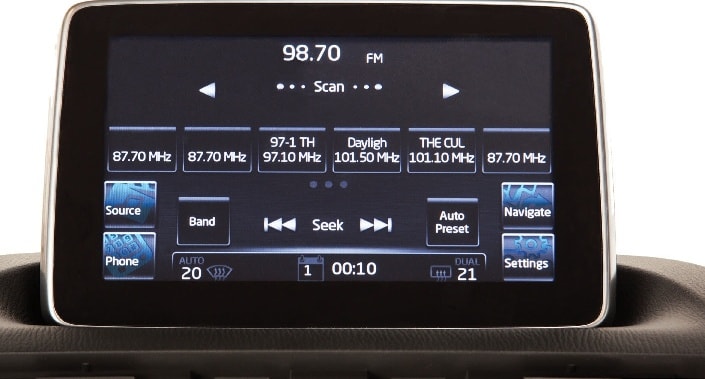
Maintaining visual appeal extends to transitions and overlays. As drivers bring in more apps, they’ll switch between them more often, expecting quick and smooth transitions. For tasks such as navigation, overlays will add information without obscuring map images.
“You’ve got to have good technology when the screen changes from one application to another,” said Andy Gryc, Senior Automotive Product Marketing Manager for QNX Software Systems. “You’ve also got to handle multiple applications that are sharing the screen. For navigation, you want to overlay something like point-of-interest information so you don’t have to completely redraw the map.”
The selection criterion for microcontrollers changes for graphics. Raw speed falls in importance, replaced by drawing capabilities.
“Processor speeds aren’t the best measure; people are interested in frame rates,” said Danny Shapiro, Senior Director of Automotive at Nvidia. “They want a minimum of 30 frames per second, often asking for 60 frames/second.”
Taking a broad view
Screen selection parameters go well beyond size and resolution. lifetimes are far longer than those required by tablets and notebooks, while ruggedness specifications are far more stringent.
“Automotive displays have strong requirements in brightness, temperature, night/daylight settings, and safety, which includes glass breakage,” said Franz Walkembach, Automotive Product Line Manager at Wind River. “They have to function in temperature ranges from minus 20 to plus 80 degrees Celsius. Some displays have also special heating included to make them react faster in lower temperatures.”
These special requirements make the screens quite different than those used on tablets and notebooks. The focus on safety is especially important for automakers.
“Automotive displays need to be rigid enough for passenger usage, while being flexible enough to collapse during a head-impact collision,” said Paul Weindorf, Display Technical Fellow at Visteon. “This is particularly challenging for a free-standing information display. Typically the front surface is a hard coated plastic film or structure in front of the glass to ensure that head-impact requirements are met.”

In some cases, those films and structures provide touch sensing along with protection. Regardless of the function, additional layers can’t be too heavy. In this era of tightening CAFE (Corporate Average Fuel Economy) requirements, engineers are even concerned about the weight of circuit boards that drive displays.
“The relatively heavy glass and electronics used in large displays detracts from prized fuel-economy figures,” TI's McLean said.
While automotive developers have to add more protection, the extra layer can’t reduce visibility. Drivers have to be able to see images even when the sun is shining on a screen. At the same time, it can’t take too much power to achieve this brightness.
“Power consumption and brightness are two major concerns,” said Pluckebaum of Renesas. “The power-consumption concern is due to the leakage current [not related to screen brightness] and drain on the automotive battery. Brightness is a concern due to the lighting conditions in a vehicle. In certain conditions, it is difficult to see many commercial devices’ display due to the position of the sun.”
Said Visteon's Weindorf: “Automotive displays are becoming two times brighter than consumer displays. Automobiles have the advantage of being able to offer this to their displays, because they do not need to rely on battery power in the same way as tablets.”
More From SAE Media Group
Off-Highway Engineering
Software Makes Solid Impact
Sensor Technology
What Will 5G Do for the IoT/IIoT?

Automotive Engineering
Managing the Deluge of Data
Automotive Engineering
Driver Distraction From Connectivity Poses Conflicting Challenges
Automotive Engineering
Ford and University of Michigan Unveil Automated-vehicle Testbed
Off-Highway Engineering
Gearshift Actuator Dynamics in a Dual Clutch Transmission
Off-Highway Engineering
Systems That Talk Together, Are Efficient Together
Off-Highway Engineering
Screens, Cameras Provide New Look in Cabs
Automotive Engineering
Planning for a Digital World
Automotive Engineering
Accelerating Down the Road to Autonomy
Automotive Engineering
CES 2026: Qualcomm Expands Partnerships For More Snapdragons
Off-Highway Engineering
FPT’s Battery Pack Dives into Marine Market
Automotive Engineering
Securing the Software-Defined Vehicle
Aerospace Manufacturing and Machining INSIDER
Army Launches CMOSS Prototyping Competition for Computer Chassis and Cards
Automotive Engineering
Company Says Tiny Motions Can Predict Big Problem: Impaired Driving

Motion Design INSIDER
Improving Traffic Signal Timing with a Handful of Connected Vehicles
Off-Highway Engineering
The Role of a Cloud-based Server in Service Workshops

Motion Design INSIDER
Physics-Aware Neural Networks Improve Camera-Based Machines
Tech Briefs
How Much Do You Know About GPS and its History?
Aerospace & Defense Tech Briefs
SAE International Extends Call for Abstracts, Seeks Submissions for AeroTech Conference
Off-Highway Engineering
Freightliner’s Medium-Duty Makeover
Motion Design INSIDER
Charting a Safe Course Through a Highly Uncertain Environment
Battery & Electrification Technology
Ultracapacitor Solutions to Address Energy-Storage Needs of Vehicles
Battery & Electrification Technology
Micro-Supercapacitors Enable Fast Charging
Battery & Electrification Technology
The Rechargeable Renaissance
Autonomous Vehicle Engineering
Ensuring No Child Left Inside
Top Stories
INSIDERManufacturing & Prototyping
 How Airbus is Using w-DED to 3D Print Larger Titanium Airplane Parts
INSIDERManned Systems
 FAA to Replace Aging Network of Ground-Based Radars
NewsTransportation
 CES 2026: Bosch is Ready to Bring AI to Your (Likely ICE-powered) Vehicle
NewsSoftware
 Accelerating Down the Road to Autonomy
EditorialDesign
 DarkSky One Wants to Make the World a Darker Place
INSIDERMaterials
 Can This Self-Healing Composite Make Airplane and Spacecraft Components Last...
Webcasts
Defense
 How Sift's Unified Observability Platform Accelerates Drone Innovation
Automotive
 E/E Architecture Redefined: Building Smarter, Safer, and Scalable...
Power
 Hydrogen Engines Are Heating Up for Heavy Duty
Electronics & Computers
 Advantages of Smart Power Distribution Unit Design for Automotive...
Unmanned Systems
 Quiet, Please: NVH Improvement Opportunities in the Early Design...
