




From 3D Printer to Practice
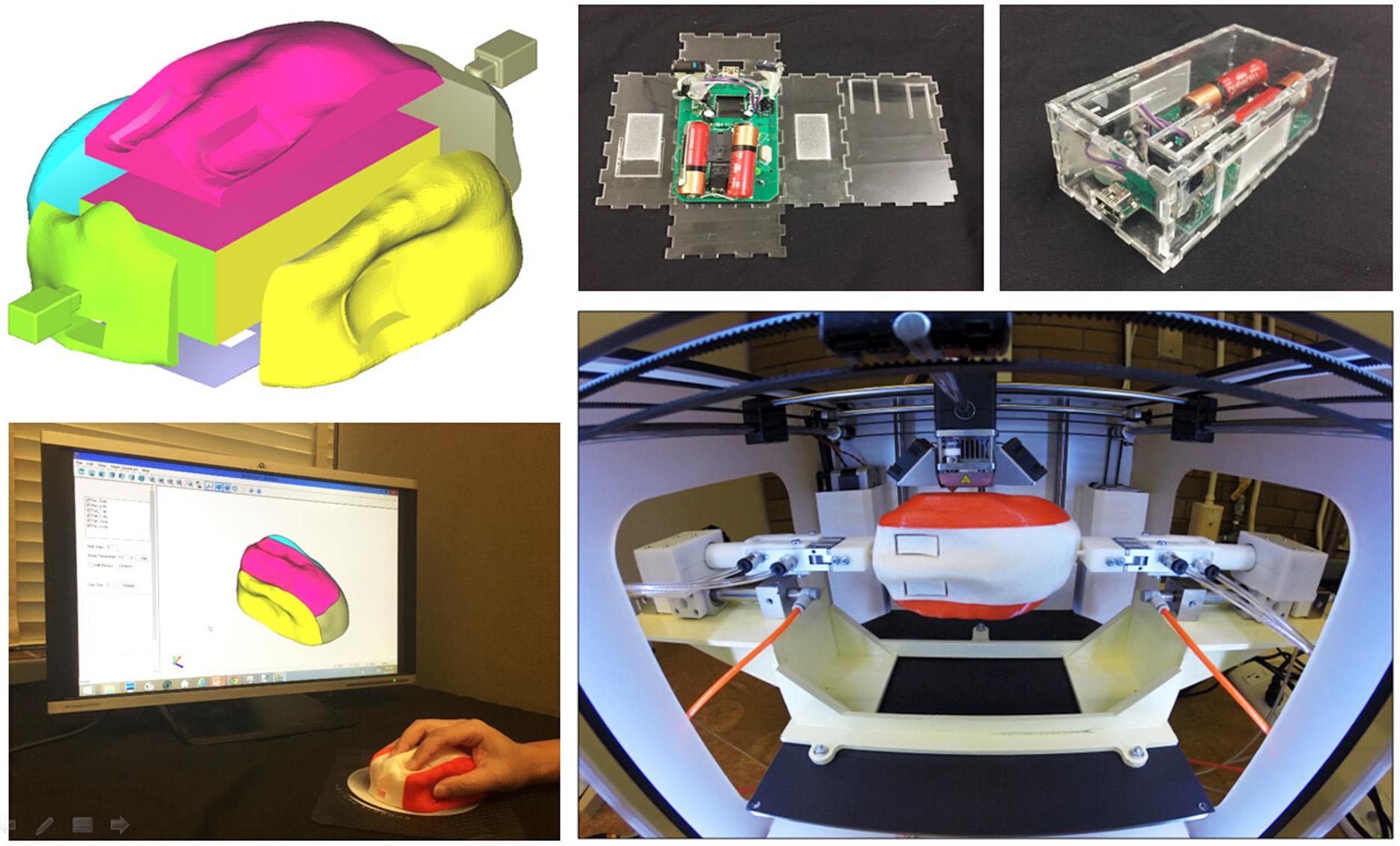
Conventional 3D printers create objects layer-by-layer from the bottom up, which can be a challenge when printing parts with enclosed electronics and overhanging or protruding features. Such features must be formed using supporting structures—later removed—adding time and material to the process. In traditional manufacturing the parts have to be assembled along with electronics packaging that goes on the inside.
A new system developed at Purdue University, called RevoMaker, is said to not only reduce the need for supporting structures, but also introduces a new technique for multi-directional printing. RevoMaker avoids assembly steps by printing the structure around enclosed electronics. Different parts of the object are partitioned digitally and printed around a box that contains electronic and mechanical components.
"With a traditional 3D printer you print on a planar print bed and the platform is fixed," said Raymond Cipra, a professor of mechanical engineering at Purdue. "Our strategy is to replace the print bed with a laser-cut cuboid which can be rotated about an axis to provide orthogonal printing surfaces on each side of the volume. This cuboidal volume is also the space into which the electronics, motors, batteries are embedded before the printing process begins. Perhaps you could have multiple cuboids that you snap together in a customizable fashion."
According to Purdue doctoral student Wei Gao, "Our focus lies in enhancing an existing 3D printer at minimal cost and complexity so that one does not have to use a more complex and expensive multi-axis machine. By just rotating the cuboid and using the printer's own X, Y, and Z-step control, we add much greater functionality and capability to the process. The process also enables side-surface functionalities, such as push-buttons, that also interact with housed modules in a compact volume "
The cuboid base is generated inside any geometric model using Purdue's cuboidization algorithm. As the whole model is partitioned by the base, the algorithm computes the cuboid with as large a volume as possible cuboid to save printing material and with optimized orientation to reduce the necessary supporting material. The cuboid has to be repositioned at certain points during the printing process.
The Purdue research team views the technology as being particularly useful for unique, possibly one-off components.
"The idea is that this is more personalized than traditional printing jobs, not mass manufactured," said Karthik Ramani, Purdue's Donald W. Feddersen Professor of Mechanical Engineering and a professor of electrical and computer engineering. "I can envision products that are produced from modules and can be made for a small number of [applications]."
The new system has been demonstrated by creating items with complex shapes, using different colors to show how the segments are printed separately but in a continuous process as the piece is turned and repositioned. In one project, a mouse was tailored to a person's hand by first creating a clay mold and then scanning it into a computer. The mouse was fully functioning out of the printer.
Production time and the amount of material needed were reduced by as much as 37%, depending on the product.
"Using our methods we will soon be able to make things that actually walk out of the printer by themselves," Ramani said. The research team developed both the hardware and software programming for the system. The team sees the RevoMaker as a step toward a more open community and platform.
More From SAE Media Group

Tech Briefs
Product of the Month
Robotics & Automation INSIDER
New Imaging Technique Reconstructs the Shapes of Hidden Objects
Aerospace & Defense Tech Briefs
High-Performance Enclosure Systems for Aerospace and Defense Applications: Preparing for What’s Next
Aerospace & Defense Tech Briefs
Software for Additive Design, Manufacturing Evolves Quickly
Aerospace & Defense Tech Briefs
Industry Invited to Participate in AeroTech Aerospace and Defense Technical Program

Aerospace Manufacturing and Machining INSIDER
Army Launches CMOSS Prototyping Competition for Computer Chassis and Cards
Aerospace & Defense Tech Briefs
CAD-CAM-CNC System
Tech Briefs
Embracing Agile Product Development
Aerospace & Defense Tech Briefs
In-Network Processing on Low-Cost IoT Nodes for Maritime Surveillance
Aerospace & Defense Tech Briefs
Rockwell Collins Launches New High-Fidelity Image Generator

Aerospace INSIDER
New Web-Based Software Enables Quick Drone Design
Aerospace & Defense Tech Briefs
Architecture Developed for Monitoring and Anomaly Detection of Space Systems
Aerospace & Defense Tech Briefs
No Shortcuts for Verifying, Validating Aerospace System Designs
Aerospace & Defense Tech Briefs
Automating the Software Build Process for an Aerospace Embedded System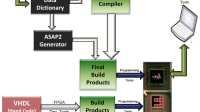
Aerospace & Defense Tech Briefs
New Products
Aerospace & Defense Tech Briefs
Factory-as-a-Service for Missile Production

Aerospace & Defense Tech Briefs
Surviving the Challenge of Thermal Design in Aerospace Electronics
Aerospace & Defense Tech Briefs
3D Scanning Provides Key Weapon for Aerospace and Defense Manufacturing
Aerospace Manufacturing and Machining
How Augmented Reality Can Modernize Aerospace And Defense Manufacturing
Motion Design
Guiding the Way in Automotive Plants
Aerospace & Defense Tech Briefs
Centre for Modelling & Simulation to Develop Digital Twins for GKN Aerospace Additive, Composite, and Industry 4.0 Technologies
Tech Briefs
Why the RenAM 500Q?
Sensor Technology
Digital Twins for Industry
Motion Design
CAD Model Offers Robots Precise Pick-and-Place Solutions
Top Stories
INSIDERDefense
 New Raytheon and Lockheed Martin Agreements Expand Missile Defense Production
NewsAutomotive
 Ford Announces 48-Volt Architecture for Future Electric Truck
INSIDERManufacturing & Prototyping
 Active Strake System Cuts Cruise Drag, Boosts Flight Efficiency
ArticlesTransportation
 Accelerating Down the Road to Autonomy
INSIDERMaterials
 How Airbus is Using w-DED to 3D Print Larger Titanium Airplane Parts
Road ReadyTransportation

Webcasts
Electronics & Computers
 Cooling a New Generation of Aerospace and Defense Embedded...
Power
 Battery Abuse Testing: Pushing to Failure
Connectivity
 A FREE Two-Day Event Dedicated to Connected Mobility
Automotive
 Quiet, Please: NVH Improvement Opportunities in the Early Design Cycle
Transportation
 Advantages of Smart Power Distribution Unit Design for Automotive &...
Aerospace
 Sesame Solar's Nanogrid Tech Promises Major Gains in Drone Endurance