




No Shortcuts for Verifying, Validating Aerospace System Designs
Product designs are increasingly being tested multiple times as they move forward, not just when versions are completed. Verifying the integrity of designs and ensuring that everything meets the original requirements is an important step in the design of products that meet safety requirements. As systems become more complex, it’s becoming more difficult to find all potential problems.
“You need very stringent modified condition/decision coverage analysis to make sure all branches are tested during the verification process,” said Jim McElroy, Vice President of Marketing at LDRA. “It’s important to verify code on the host. Our tests let them use simulation until the target hardware is ready. Then they run the same tests on the target hardware.”
Many of the software tests are run before target hardware is developed. When pieces of hardware are completed, they are often integrated into hardware-in-the-loop (HIL) systems to ensure that code runs the same on simulated hardware and real hardware.
“The simulation of plant models with HIL systems is allowing for faster regression testing of controllers for both normal and abnormal operating conditions,” said Mahendra Muli, New Business Development Director at dSPACE. “With capabilities for simulating bus communications over various standard communication bus interfaces, such as ARINC 429, 1394B, Ethernet etc., the entire system can be simulated without the need for real components. This is helping reduce costs in development as more and more testing on the test bench is helping catch errors early on.”
Though HIL is used widely throughout the aerospace industry, there’s some discussion about reducing reliance on these tests. Sometimes, simulated tests can cover more possible faults that can cause problems.
“We’re still in an environment where HIL comes into play,” said Bill Chown, Product Marketing Manager, System Design Management at Mentor Graphics. “Conceptually, we see interest in reducing the use of HIL. If you build an instance of hardware, you have one instance. Meeting safety standard requirements requires looking at all the corner cases.”
While there’s some potential for reducing HIL for electronic tests, there’s no chance that physical prototypes are going away. These prototypes confirm that everything works in a real-world system. These prototype tests go well beyond software, systems, and electronic cabinets. Safety tests must also cover the enclosure for electronics—the airframe.
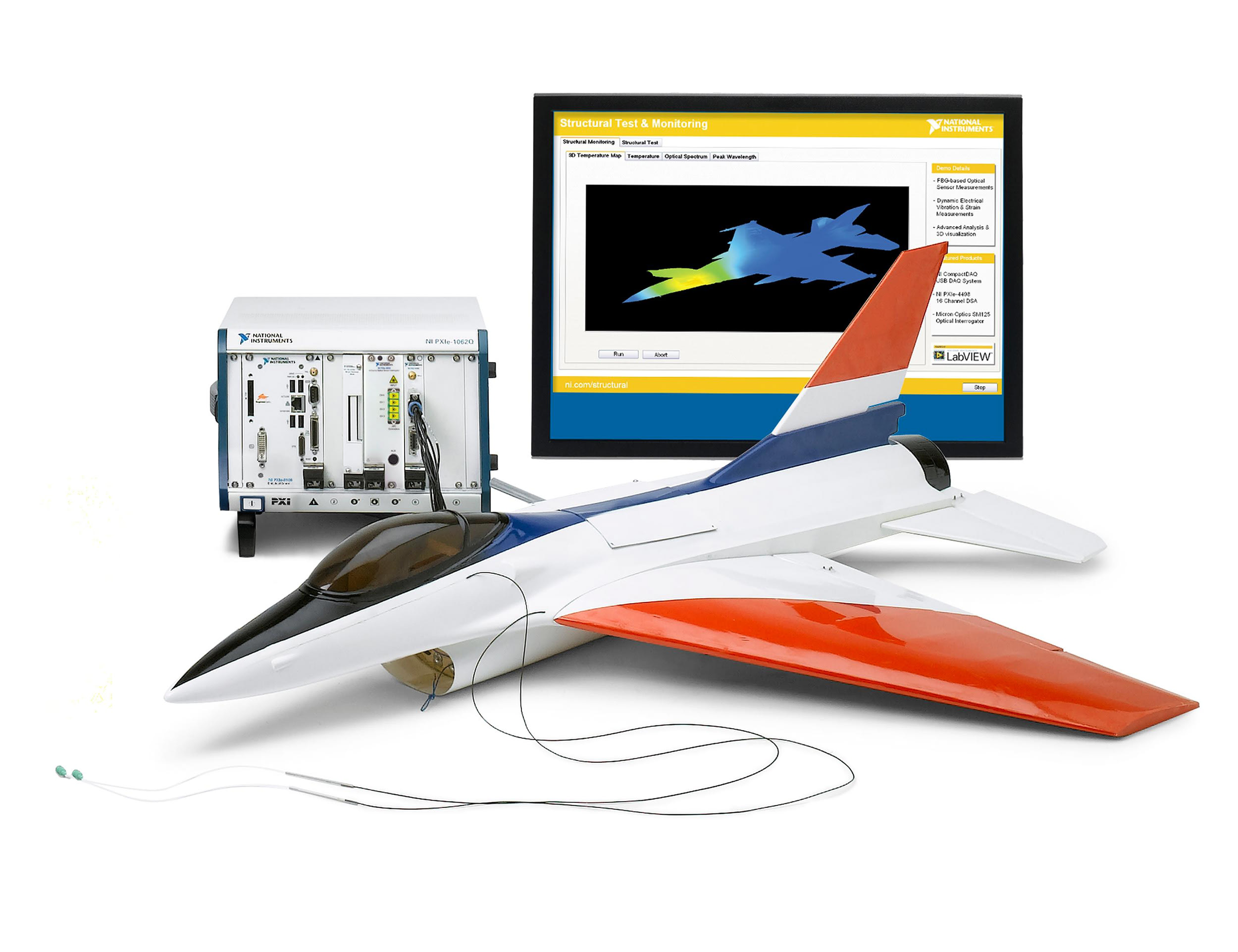
“In basic airframe testing, the strain gauge is still the king,” said David Potter, Principal Market Development Manager at National Instruments. “Fiber-optic sensing is a new sensor technology that’s getting a lot of interest. It’s well suited for measuring strain in composites, which flex more than metals. Fiber-optic sensors have a better range and better fatigue life, they don’t fail as quickly.”
More From SAE Media Group

Tech Briefs
Embracing Agile Product Development
Aerospace & Defense Tech Briefs
Industry Invited to Participate in AeroTech Aerospace and Defense Technical Program
Aerospace & Defense Tech Briefs
MathWorks Rolls out Major Update to Aerospace Blockset
Aerospace & Defense Tech Briefs
High-Performance Enclosure Systems for Aerospace and Defense Applications: Preparing for What’s Next
Aerospace & Defense Tech Briefs
Digital Transformation for a CONNECTED ENTERPRISE
Tech Briefs
Product of the Month
Aerospace & Defense Tech Briefs
Turn Growing Complexity into Competitive Advantage Through Digitalization -- Focus of AeroTech Keynote Thursday
Automotive Engineering
DSpace Launches Simphera AV Development Simulator
Aerospace & Defense Tech Briefs
Automating the Software Build Process for an Aerospace Embedded System
Aerospace & Defense Tech Briefs
Rockwell Collins Launches New High-Fidelity Image Generator
Aerospace & Defense Tech Briefs
VR, COTS, NextGen and SESAR to Take Center Stage at Flight Simulator Engineering and Maintenance Conference
Off-Highway Engineering
Comprehensive Simulation Environment
Aerospace & Defense Tech Briefs
Centre for Modelling & Simulation to Develop Digital Twins for GKN Aerospace Additive, Composite, and Industry 4.0 Technologies

Aerospace & Defense Tech Briefs
New Products

Robotics & Automation INSIDER
New Imaging Technique Reconstructs the Shapes of Hidden Objects
Aerospace & Defense Tech Briefs
In-Network Processing on Low-Cost IoT Nodes for Maritime Surveillance
Aerospace & Defense Tech Briefs
From 3D Printer to Practice
Aerospace & Defense Tech Briefs
Architecture Developed for Monitoring and Anomaly Detection of Space Systems
Aerospace & Defense Tech Briefs
Embracing the Digital Transformation in Aerospace & Defense

Aerospace & Defense Tech Briefs
Automatic Collision Avoidance Added to Inspection Software
Aerospace & Defense Tech Briefs
CAD-CAM-CNC System
Aerospace & Defense Tech Briefs
Software for Additive Design, Manufacturing Evolves Quickly
Aerospace INSIDER
New Web-Based Software Enables Quick Drone Design
Aerospace & Defense Tech Briefs
MBSE Is Transforming Aerospace Engineering, Systems Integration
Aerospace & Defense Tech Briefs
AGI and ANSYS Partner to Integrate Next-Gen Digital Modeling into Engineering Design
Aerospace & Defense Tech Briefs
A 'STEP' Forward for Product Lifecycle Management
Top Stories
INSIDERManufacturing & Prototyping
 How Airbus is Using w-DED to 3D Print Larger Titanium Airplane Parts
INSIDERManned Systems
 FAA to Replace Aging Network of Ground-Based Radars
NewsTransportation
 CES 2026: Bosch is Ready to Bring AI to Your (Likely ICE-powered) Vehicle
NewsSoftware
 Accelerating Down the Road to Autonomy
EditorialDesign
 DarkSky One Wants to Make the World a Darker Place
INSIDERMaterials
 Can This Self-Healing Composite Make Airplane and Spacecraft Components Last...
Webcasts
Defense
 How Sift's Unified Observability Platform Accelerates Drone Innovation
Automotive
 E/E Architecture Redefined: Building Smarter, Safer, and Scalable...
Power
 Hydrogen Engines Are Heating Up for Heavy Duty
Electronics & Computers
 Advantages of Smart Power Distribution Unit Design for Automotive...
Unmanned Systems
 Quiet, Please: NVH Improvement Opportunities in the Early Design...
