




Haptic Feedback Is Key to Continental’s New Anti-Distraction Touch Screen
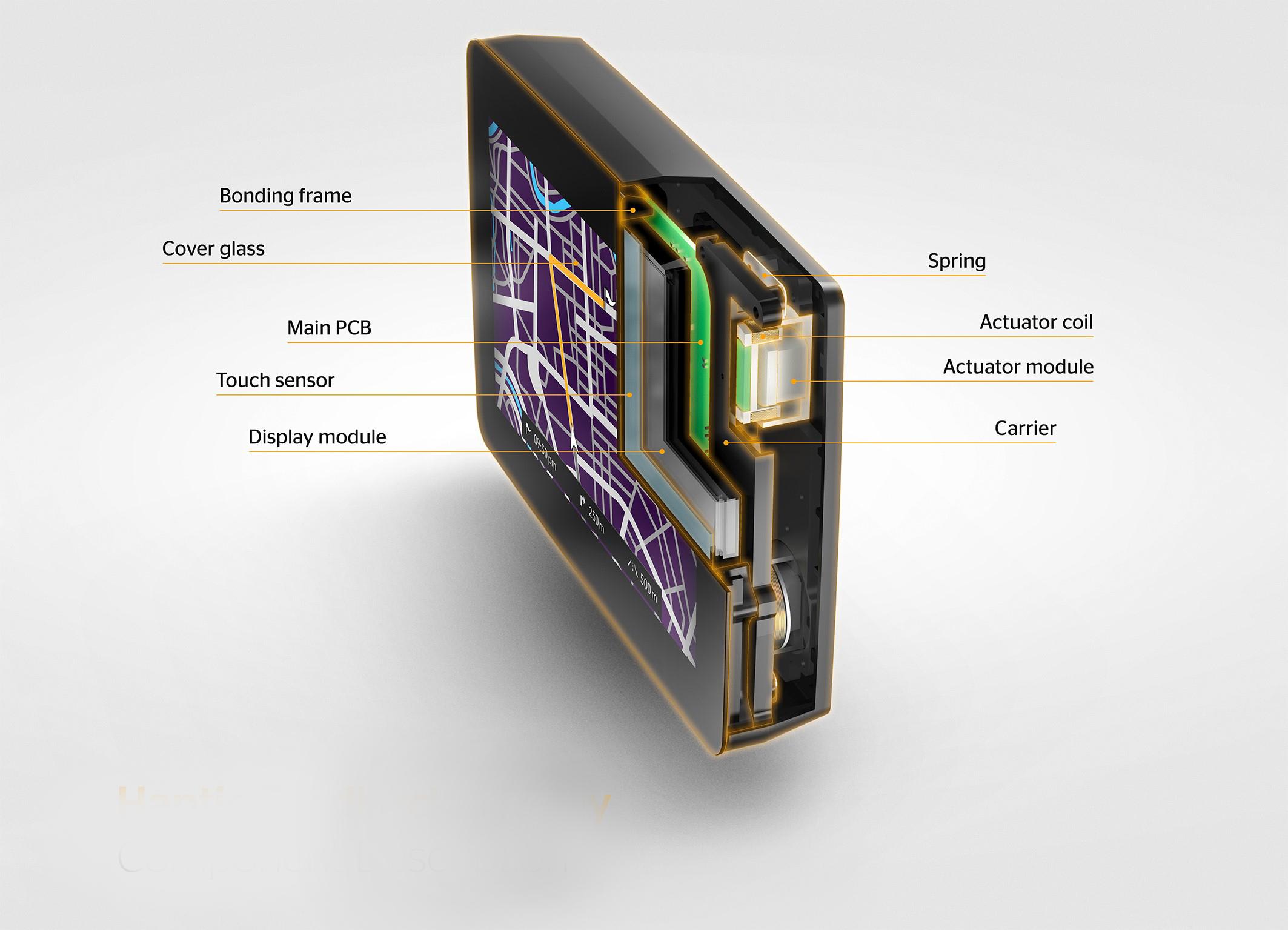
Can haptic feedback help reduce the driver distraction that is associated with operating in-vehicle touch screens? Continental Automotive engineers believe it can. The company recently unveiled a new active Haptic Feedback Display that provides driver feedback using a movement impulse that can be felt through one's fingers. The resulting vibration the driver feels indicates that the desired operation has been triggered and understood by the system.
Continental has put its first complete touch display with haptic feedback into demonstrator vehicles as a prelude to production for evaluation by OEM engineers and technology media. (Automotive Engineering will report our driving impressions in an upcoming article). The unit is a touch-sensitive 8-in flat screen with an integrated haptic actuator system. The actuators consist of an electromagnetic spool with two windings.
In certain operating situations, the actuators trigger mechanical feedback that can be clearly felt by the user, while helping to measure the force exerted. The actuators are located behind the construction elements of the touch display, under the screen's bonded layers of protective glass, a capacitive sensor, and the display.
For in-vehicle use, a rigid structure of the individual elements is required, according to Continental engineers. The production-intent system can be scaled to larger display sizes depending on OEM requirements, currently up to 12.3 in.
The tactile feedback from the display is not visible to the naked eye as a mechanical movement—the “deflection" is only around 0.1 mm (0.004 in). However, because this takes place with very high acceleration, the mechanical impulse generated can be clearly felt by a finger.
The feedback always takes place on the entire display area. The characteristics and intensity of the haptic feedback can be freely configured, so that the unit can be adapted to an OEM’s brand-specific standards, as well as to particular driving and operating situations, the company noted.
More From SAE Media Group

Off-Highway Engineering
Dynamic Inclination Sensor
Automotive Engineering
Haptic Feedback for Gesture-Control HMI
Aerospace & Defense Tech Briefs
Honeywell’s New Sensors Self-Diagnose Internal Failures
Automotive Engineering
Gas-Damped Auto Crash Sensor
Off-Highway Engineering
Vertical Connectors
Off-Highway Engineering
Fan Driver
Off-Highway Engineering
Switches Under Pressure?
Off-Highway Engineering
Rotary Position Sensor
Off-Highway Engineering
Displays Add Color to Simplify Operator Tasks
Off-Highway Engineering
CAN Controller
Off-Highway Engineering
Rotary Speed Sensor
Automotive Engineering
Q&A: Print Your Next Wiring Harness
Off-Highway Engineering
14-Mm Mount Panel LED
Automotive Engineering
High-Temperature Pressure Sensor
Automotive Engineering
Integrated Accelerometer/gyro Combo Series
Automotive Engineering
Actuator Sensor Manipulation Box
Automotive Engineering
Smart Force Sensor
Off-Highway Engineering
Position Sensor
Automotive Engineering
LIN Family for In-Vehicle Networking
Automotive Engineering
Hella's Vehicle-Damage Detection Technology Moves Toward Production
Off-Highway Engineering
Material Handling Indicators
Automotive Engineering
Electromechanical Joining System
Automotive Engineering
Nano Dimension Creates the First Printed Circuit Boards with Side-Mounted Features
Automotive Engineering
High-Performance Redundant Linear Hall Sensor
Off-Highway Engineering
Compact Pressure Transducers
Automotive Engineering
‘Zonal’ for the Win
Automotive Engineering
Pedestrian Headforms
Medical Design Briefs
Product of the Month: Projected Capacitive Touch Screens
Tech Briefs
Artificial Skin Provides Haptic Feedback
Top Stories
INSIDERManufacturing & Prototyping
 How Airbus is Using w-DED to 3D Print Larger Titanium Airplane Parts
INSIDERManned Systems
 FAA to Replace Aging Network of Ground-Based Radars
NewsTransportation
 CES 2026: Bosch is Ready to Bring AI to Your (Likely ICE-powered) Vehicle
NewsSoftware
 Accelerating Down the Road to Autonomy
EditorialDesign
 DarkSky One Wants to Make the World a Darker Place
INSIDERMaterials
 Can This Self-Healing Composite Make Airplane and Spacecraft Components Last...
Webcasts
Defense
 How Sift's Unified Observability Platform Accelerates Drone Innovation
Automotive
 E/E Architecture Redefined: Building Smarter, Safer, and Scalable...
Power
 Hydrogen Engines Are Heating Up for Heavy Duty
Electronics & Computers
 Advantages of Smart Power Distribution Unit Design for Automotive...
Unmanned Systems
 Quiet, Please: NVH Improvement Opportunities in the Early Design...
