




Northrop Grumman's MQ-4C Triton UAS Enters Next Phase of Testing
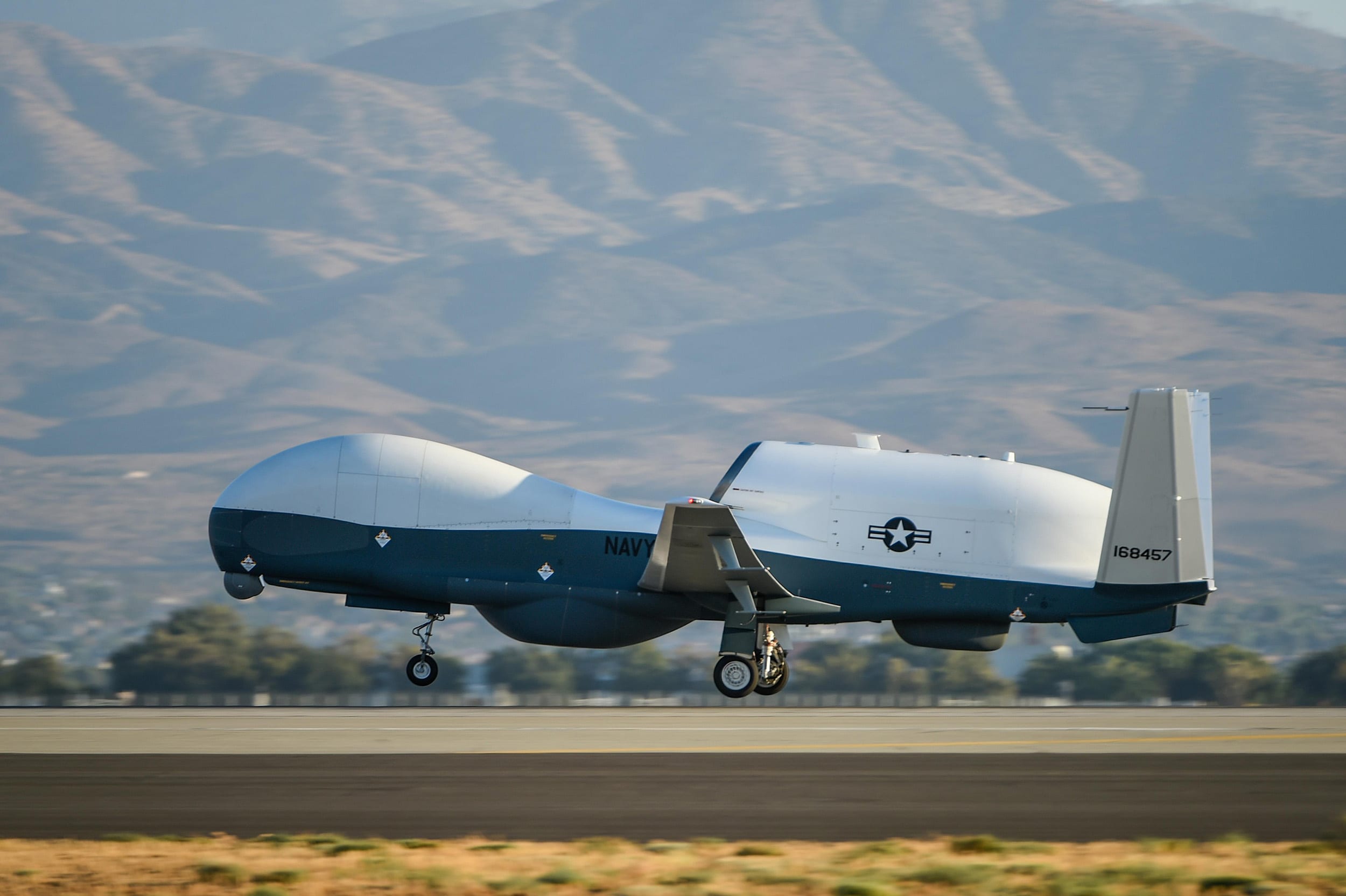
The first U.S. Navy MQ-4C Triton unmanned aircraft system (UAS) recently flew 11 hours from the Northrop Grumman facility in Palmdale, CA, to the Naval Air Station Patuxent River in Maryland to start its next phase of testing, moving the program closer toward operational assessment. The MQ-4C Triton UAS provides real-time intelligence, surveillance, and reconnaissance over ocean and coastal regions. (For a short video of the flight, click here .)

During the flight, the joint Navy/Northrop team controlled the aircraft from a ground station in Palmdale, which served as the forward operating base, and a Navy System Integration Lab at Patuxent River, which served as the main operating base. The aircraft traveled along the same flight path that was used to transfer the Broad Area Maritime Surveillance Demonstrator from Palmdale to Patuxent River several years ago.
At Patuxent River, the aircraft will be outfitted with a sensor suite, before going through a series of sensor integration flights. One of Triton's primary sensors, the AN/ZPY-3 multifunction active sensor radar, will provide what Northrop describes as "an unprecedented 360° field of regard" for detecting and identifying ships.
Over the next few weeks, two other Tritons, one of which is a demonstration aircraft owned by Northrop, will also fly to Patuxent River. Both will be used during system development and demonstration tests.
Based on the Global Hawk UAS, Triton features a reinforced airframe and wing, along with de-icing and lightning protection systems. These features allow the aircraft to descend through cloud layers to gain a closer view of ships and other targets at sea when needed.
Triton is specifically designed for maritime missions of up to 24 hours. It can fly at altitudes higher than 10 mi, allowing for coverage of 1 million nmi² of ocean, in a single mission.
The Navy’s program of record calls for 68 aircraft to be fielded.
More From SAE Media Group
Aerospace & Defense Tech Briefs
Perdix: Overwhelming Numbers and Success
Aerospace & Defense Tech Briefs
Northrop Grumman Proves SYERS-2 Ready to Graduate from U-2 to RQ-4
Aerospace & Defense Tech Briefs
Unmanned Demonstrator Aircraft for Maritime Surveillance
Aerospace & Defense Tech Briefs
A Tern Toward a Full-Scale VTOL UAV Demonstrator
Aerospace INSIDER
BAE Systems Acquires Developer of Electric Heavy Lift Quadcopters
Aerospace INSIDER
Lockheed Martin Delivers 500th C-130J Super Hercules Airlifter
Aerospace & Defense Tech Briefs
New Sensor Payload Helps Global Hawk Stay Relevant
Aerospace & Defense Tech Briefs
Lockheed Martin Offering Its 'Production Ready' T-50A for USAF Trainer Competition
Aerospace & Defense Tech Briefs
Unmanned Aerial Vehicle
Motion Design INSIDER
Tailless Jet Flies Free with Novel Control Technique
Defense INSIDER
Making Future Vertical Lift Open, Safe and Secure
Aerospace & Defense Tech Briefs
Light Attack Reconnaissance Helicopter Secures Vertical Lift Dominance
Aerospace INSIDER
KC-46A Pegasus Approved to Refuel 97% of Joint Force Receivers
Aerospace & Defense Tech Briefs
Long-Range Air Force Strategies Include New B-21 Long-Range Bomber
Aerospace & Defense Tech Briefs
Unmanned Autonomous Helicopter
Aerospace & Defense Tech Briefs
T-X down to Two Main Contenders

Aerospace INSIDER
Radar and Weapons Upgrades for Netherlands Air Force MQ-9A Reapers
Aerospace & Defense Tech Briefs
Sikorsky’s S-97 Takes Successful First Flight
Aerospace & Defense Tech Briefs
Sikorsky Awarded Contract to Replace ‘Marine One’ Helicopter Fleet
Aerospace INSIDER
MQ-1C Completes First Air-Launched Effect Flight Demonstration
Aerospace & Defense Tech Briefs
Boeing's Pegasus Makes First Refueling Flight
Aerospace & Defense Tech Briefs
Attack Reconnaissance Helicopter
Aerospace & Defense Tech Briefs
Rising Sun Breaks Cover on Japanese Defense Industry
Aerospace INSIDER
Navy Completes 73-Hour Nonstop Flight of Solar-Powered UAS
Aerospace & Defense Tech Briefs
KC-46A Tanker Completes Its First Flight
Aerospace & Defense Tech Briefs
Unmanned Aircraft System Offers Superior Surveillance Imagery
Top Stories
INSIDERManufacturing & Prototyping
 How Airbus is Using w-DED to 3D Print Larger Titanium Airplane Parts
INSIDERManned Systems
 FAA to Replace Aging Network of Ground-Based Radars
NewsTransportation
 CES 2026: Bosch is Ready to Bring AI to Your (Likely ICE-powered) Vehicle
NewsSoftware
 Accelerating Down the Road to Autonomy
EditorialDesign
 DarkSky One Wants to Make the World a Darker Place
INSIDERMaterials
 Can This Self-Healing Composite Make Airplane and Spacecraft Components Last...
Webcasts
Defense
 How Sift's Unified Observability Platform Accelerates Drone Innovation
Automotive
 E/E Architecture Redefined: Building Smarter, Safer, and Scalable...
Power
 Hydrogen Engines Are Heating Up for Heavy Duty
Electronics & Computers
 Advantages of Smart Power Distribution Unit Design for Automotive...
Unmanned Systems
 Quiet, Please: NVH Improvement Opportunities in the Early Design...
