




Long-Range Air Force Strategies Include New B-21 Long-Range Bomber

With the Government Accountability Office (GOA) recently ruling in Northrop Grumman’s favor for the contract for the U.S. Air Force’s new long-range strike bomber, which is designated the B-21, it’s appearing more and more that the new bomber may actually be developed and flown during its namesake 21st century.
Air Force Secretary Deborah Lee James recently revealed the first artist’s rendering of the B-21 at the Air Force Association’s Air Warfare Symposium in late February. While there are obviously no existing prototypes of the aircraft, the rendering is based on the initial design concept, which happens to somewhat resemble another flying-wing long-range strike bomber, the B-2, that also happens to have been developed by Northrop Grumman and in production from 1987-2000.
James said at AWS that the B-21 will allow the Air Force to operate in tomorrow's high end threat environment, and explained why the B-21 shares some resemblance to the B-2.
“The B-21 has been designed from the beginning based on a set of requirements that allows the use of existing and mature technology,” James said.
The reveal comes just weeks after both James and Air Force Chief of Staff Gen. Mark A. Welsh III made it clear to the Senate Appropriations Committee that modernization is a top priority for the Air Force.
“The platforms and systems that made us great over the last 50 years will not make us great over the next 50,” Welsh said during testimony on February 10. “There are many other systems we need to either upgrade or recapitalize to ensure viability against current and emerging threats… the only way to do that is to divest old capability to build the new.”
With a requested top-line budget of $120.4 billion for fiscal year 2017, the USAF is looking to be able to defend against a myriad of threats, “such as terrorist groups, China, North Korea, and a resurgent Russia.”
To do so, the USAF is looking to harvest other technologies and “building blocks” above and beyond the B-21, including autonomous learning systems.
“These are computers that can learn and adapt over time,” James said. “They’ll be able to sort through massive amounts of data in a flash to help the warfighter make high-pressure decisions on cyberattacks, satellite movements, and target identification.”
Also, human-machine collaboration would be another building block, playing a key role in the USAF of the future. “This is where a machine acts as a human’s assistant to prevent overload,” she said. “This allows the user to focus on the life or death decisions that only the brain of the trained Airman can make.”
Assisted human operations, including wearable technology or combat applications to help ground troops, may also be used one day in cockpits, the flightline, and even in space to give space operators a “virtual presence” on satellites, she said.
The fourth building block, human-machine combat teaming, would integrate autonomously operating platforms with a manned strike package. One example she provided is the F-35 Lightning II helmet, which breaks down complex sensor and computer data from the aircraft before giving it to the pilot.
“Autonomous platforms could conduct initial ISR [intelligence, surveillance, and reconnaissance] to identify surface-to-air threats, and relay the information back to the manned package for follow-on electronic warfare operations,” James said.
Lastly, network-enabled semi-autonomous technology, found in weapons like the small diameter bomb, could allow weapons to talk and share data with each other.
“So they can still hit the target if they lose data link from the aircraft or access to GPS, as they may in a highly contested environment,” she said.
To ensure mission readiness, James also identified other aircraft programs besides the B-21 that will contribute to future defense efforts including the F-35, KC-46A Pegasus, and combat rescue helicopter programs. Plans are also in place to add two dozen MQ-9A Reaper drones, extra munition buys, and to postpone the retirements of A-10 Thunderbolt II and EC-130 Compass Call aircraft.
In terms of the B-21, the program recently entered into the Engineering and Manufacturing Development phase and the USAF plans to field the initial capability of the aircraft in the mid-2020s. Estimates of how many aircraft the USAF plans to purchase during B-21's run range from 80-100 at an average of about $550 million per aircraft.
More From SAE Media Group
Aerospace INSIDER
US Air Force Targets First Flight of B-21 Raider This Year
Aerospace & Defense Tech Briefs
When It Comes to Fifth-Generation Assets, Air Force Values Virtual Training over Live Flying
Aerospace INSIDER
How the Air Force's B-21 Raider is Advancing Across Test and Production
Aerospace & Defense Tech Briefs
Perdix: Overwhelming Numbers and Success
Aerospace INSIDER
KC-46A Pegasus Approved to Refuel 97% of Joint Force Receivers
Aerospace INSIDER
The B-21 Raider Starts Flight Testing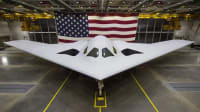
Aerospace INSIDER
Production Ready B-21 Bomber on Track for First Flight This Year
Aerospace & Defense Tech Briefs
T-X down to Two Main Contenders
Aerospace & Defense Tech Briefs
Lockheed Martin Offering Its 'Production Ready' T-50A for USAF Trainer Competition
Aerospace & Defense Tech Briefs
Remotely Piloted Air Systems
Aerospace & Defense Tech Briefs
Northrop Grumman's MQ-4C Triton UAS Enters Next Phase of Testing
Aerospace INSIDER
BAE Systems Acquires Developer of Electric Heavy Lift Quadcopters
Aerospace INSIDER
Lockheed Martin Delivers 500th C-130J Super Hercules Airlifter
Aerospace & Defense Tech Briefs
Light Attack Reconnaissance Helicopter Secures Vertical Lift Dominance
Aerospace & Defense Tech Briefs
Boeing's Pegasus Makes First Refueling Flight
Aerospace & Defense Tech Briefs
Neuron's Busy European Summer Involves Flight Test Campaign
Aerospace INSIDER
First F-15Es Equipped With EPAWSS Ready for Flight
Aerospace INSIDER
Bombardier to Start Building New Army HADES Prototype Spy Plane
Defense INSIDER
Making Future Vertical Lift Open, Safe and Secure
Aerospace & Defense Tech Briefs
Attack Reconnaissance Helicopter
Aerospace INSIDER
Autonomous Black Hawk® Flies Missions Without Pilots on Board
Aerospace INSIDER
Navy Completes 73-Hour Nonstop Flight of Solar-Powered UAS

Aerospace & Defense Tech Briefs
KC-46A Tanker Completes Its First Flight
Aerospace & Defense Tech Briefs
Dassault, BAE Collaborate on Next-Generation Combat Aircraft
Defense INSIDER
New Airfield Matting System Being Developed
Motion Design INSIDER
Tailless Jet Flies Free with Novel Control Technique
Top Stories
NewsSensors/Data Acquisition
 Microvision Aquires Luminar, Plans Relationship Restoration, Multi-industry Push
INSIDERRF & Microwave Electronics
 A Next Generation Helmet System for Navy Pilots
INSIDERWeapons Systems
 New Raytheon and Lockheed Martin Agreements Expand Missile Defense Production
NewsAutomotive
 Ford Announces 48-Volt Architecture for Future Electric Truck
INSIDERAerospace
 Active Strake System Cuts Cruise Drag, Boosts Flight Efficiency
ArticlesTransportation

Webcasts
Aerospace
 Cooling a New Generation of Aerospace and Defense Embedded...
Energy
 Battery Abuse Testing: Pushing to Failure
Power
 A FREE Two-Day Event Dedicated to Connected Mobility
Automotive
 Quiet, Please: NVH Improvement Opportunities in the Early Design Cycle
Electronics & Computers
 Advantages of Smart Power Distribution Unit Design for Automotive &...
Unmanned Systems
 Sesame Solar's Nanogrid Tech Promises Major Gains in Drone Endurance