




Sikorsky’s S-97 Takes Successful First Flight

Just over six months since Sikorsky opened the curtains to unveil its S-97 Raider helicopter featuring X2 technology, the first flight of the rigid coaxial rotor helicopter prototype was successfully conducted at Sikorsky’s Development Flight Center in West Palm Beach, FL, where the two-prototype Raider helicopter test program is based.

During the May 22 flight, which lasted approximately one hour, Raider pilots took the aircraft through a series of maneuvers designed to test the aircraft’s hover and low-speed capability. With first flight achieved, the Raider helicopter now moves into more progressive flight testing to demonstrate key performance parameters critical to future combat operations including armed reconnaissance, light assault, light attack, and special operations.
The Raider helicopter program is part of the portfolio of Sikorsky Innovations, the technology development organization within Sikorsky Aircraft’s Research & Engineering division.
“It is the Sikorsky Innovations charter to identify the toughest challenges in vertical flight, and to demonstrate solutions to them,” said Mark Miller, Vice President of Research & Engineering. “Getting an all-new aircraft into flight, especially one with game-changing capabilities, is a remarkable feat. This exemplifies the very DNA of Sikorsky Aircraft: to explore, to challenge, to pioneer, and in doing so, to ultimately change what is possible for our customers.”
Sikorsky launched the S-97 Raider helicopter program in September 2010, with objectives of maturing the X2 rotorcraft configuration and demonstrating a helicopter that meets current U.S. Army special operations and armed reconnaissance needs, while maturing technologies for Future Vertical Lift (FVL). According to Miller, the S-97 Raider helicopter leverages a mix of evolutionary rotorcraft technologies “that, when combined in this new way, results in revolutionary capability.”
The program is 100% industry-funded by Sikorsky Aircraft and its 53 industry partners, with Sikorsky providing 75% of the investment, with the partners providing the rest. (For more background on the S-97, visit Sikorsky’s All-New Raider Helicopter Prototype Is Ready to Fly.)
Based on the X2 coaxial rotor design, the single-engine Raider helicopter is capable of being developed into a unique multi-mission configuration that is able to carry six troops and external weapons. The fly-by-wire helicopter will feature coaxial counter-rotating rigid main rotor blades for lift and forward flight, and a pusher propeller for high-speed acceleration and deceleration. The latter feature contributes to it achieving cruise speeds up to 220 knot, more than double the speed of conventional helicopters. Dash speeds are expected to be up to 240 knot or higher. The aircraft features a single-piece composite airframe and a maximum gross weight of slightly more than 11,000 lb.
“With this flight, we have started the demonstration of solutions to not only near-term capability gaps but also solutions for future vertical lift needs,” said Samir Mehta, President of Sikorsky Defense Systems & Services. “With the Raider’s combination of speed, maneuverability, and acoustic signature, Sikorsky Aircraft is positioned to provide the military with essential mission-specific capabilities.”
In March, final assembly began on the second Raider helicopter prototype, which is on track to be completed this year. A demonstration tour of the Raider helicopter is planned for 2016.
More From SAE Media Group
Aerospace & Defense Tech Briefs
Light Attack Reconnaissance Helicopter Secures Vertical Lift Dominance
Aerospace & Defense Tech Briefs
Attack Reconnaissance Helicopter
Aerospace & Defense Tech Briefs
Sikorsky’s All-New Raider Helicopter Prototype Is Ready to Fly
Aerospace INSIDER
Autonomous Black Hawk® Flies Missions Without Pilots on Board
Aerospace & Defense Tech Briefs
Sikorsky-Boeing’s FVL Contender Takes Flight
Aerospace & Defense Tech Briefs
Sikorsky, Boeing Debut Future Vertical Lift Dual-Rotor Design with SB>1 DEFIANT Helicopter
Defense INSIDER
Making Future Vertical Lift Open, Safe and Secure


Aerospace Manufacturing and Machining INSIDER
Bell and Rolls-Royce Collaborate on Advanced Propulsion Systems
Aerospace & Defense Tech Briefs
Sikorsky, NREC Partner for Matrix Application to Demonstrate U.S. Army Autonomous UGV Delivery
Aerospace & Defense Tech Briefs
Sikorsky’s All-New Raider Helicopter Prototype is Ready to Fly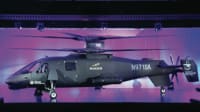
Aerospace & Defense Tech Briefs
Fabrication and Testing of High-Speed Single-Rotor and Compound-Rotor Systems
Aerospace & Defense Tech Briefs
Sikorsky Awarded Contract to Develop New Combat Rescue Helicopter
Aerospace & Defense Tech Briefs
Airbus Helicopters Looks to the Future in Heavy-Lift Rotorcraft with the X6 Concept
Aerospace & Defense Tech Briefs
Sikorsky Awarded Contract to Replace ‘Marine One’ Helicopter Fleet
Aerospace INSIDER
Army Delivers First T901 ITEP Engines for FARA Prototype Helicopters

Motion Design INSIDER
Tailless Jet Flies Free with Novel Control Technique
Aerospace Manufacturing and Machining INSIDER
Bell and U.S. Army Advance V-280 Valor Development and Aviation Modernization
Aerospace & Defense Tech Briefs
A Tern Toward a Full-Scale VTOL UAV Demonstrator
Aerospace INSIDER
Lockheed Martin Delivers 500th C-130J Super Hercules Airlifter
Aerospace INSIDER
BAE Systems Acquires Developer of Electric Heavy Lift Quadcopters
Aerospace & Defense Tech Briefs
Boeing to Modernize Spanish Chinook Fleet with Autonomous-Ready Avionics and Flight Control Systems
Defense INSIDER
Sikorsky Converts Black Hawk into U-Hawk Autonomous Helicopter

Aerospace & Defense Tech Briefs
AUSA 2021: High Tech, Big Tech
Aerospace & Defense Tech Briefs
Boeing's Pegasus Makes First Refueling Flight
Aerospace & Defense Tech Briefs
Aurora Wins DARPA VTOL X-Plane Program Contract
Aerospace & Defense Tech Briefs
India to Operate Advanced Apache and Chinook Helicopters from Boeing
Top Stories
INSIDERDefense
 New Raytheon and Lockheed Martin Agreements Expand Missile Defense Production
NewsAutomotive
 Ford Announces 48-Volt Architecture for Future Electric Truck
INSIDERManufacturing & Prototyping
 Active Strake System Cuts Cruise Drag, Boosts Flight Efficiency
ArticlesTransportation
 Accelerating Down the Road to Autonomy
INSIDERMaterials
 How Airbus is Using w-DED to 3D Print Larger Titanium Airplane Parts
Road ReadyTransportation

Webcasts
Electronics & Computers
 Cooling a New Generation of Aerospace and Defense Embedded...
Power
 Battery Abuse Testing: Pushing to Failure
Connectivity
 A FREE Two-Day Event Dedicated to Connected Mobility
Automotive
 Quiet, Please: NVH Improvement Opportunities in the Early Design Cycle
Transportation
 Advantages of Smart Power Distribution Unit Design for Automotive &...
Aerospace
 Sesame Solar's Nanogrid Tech Promises Major Gains in Drone Endurance