




Training Drones to Avoid Obstacles at High Speeds
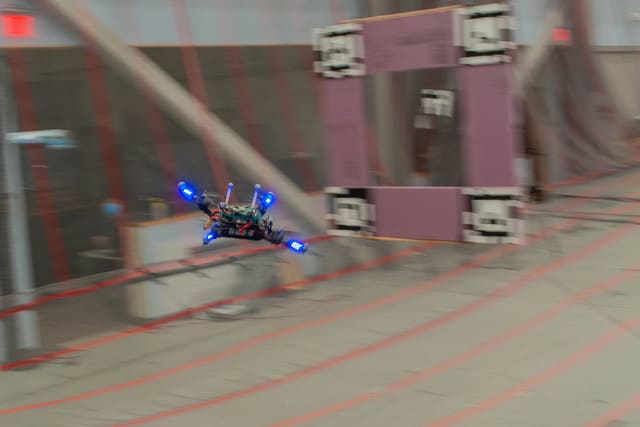
The faster drones fly, the more unstable they become and at high speeds, their aerodynamics can be too complicated to predict. Crashes, therefore, are a common and often spectacular occurrence. But if they can be pushed to be faster and more nimble, drones could be put to use in time-critical operations beyond the race course; for instance to search for survivors in a natural disaster.
MIT has devised an algorithm that helps drones find the fastest route around obstacles without crashing. The new algorithm combines simulations of a drone flying through a virtual obstacle course with data from experiments of a real drone flying through the same course in a physical space.
A drone trained with their algorithm flew through a simple obstacle course up to 20 percent faster than a drone trained on conventional planning algorithms.
More From SAE Media Group
Aerospace INSIDER
Automated Flight Control System for Drone Swarms

Aerospace INSIDER
Drones Learn Autonomous Flying by Imitating Cars and Bikes
Aerospace & Defense Tech Briefs
Robust MADER: Decentralized Multiagent Drone Trajectory Planner

Aerospace INSIDER
Algorithm Flies Drones Faster than Human Pilots
Aerospace INSIDER
AI Algorithms Fly Uncrewed XQ-58A Valkyrie Drone for Three Hour Sortie
Aerospace & Defense Tech Briefs
DDDAMS-based Urban Surveillance and Crowd Control via UAVs and UGVs
Tech Briefs
Approach Makes Unmanned Agents Self-Sufficient
Autonomous Vehicle Engineering
Foretellix Building Precise Software Language for Validating Self-Driving Scenarios
Robotics & Automation INSIDER
New System Enables Robots to Solve Manipulation Problems in Seconds
Aerospace & Defense Tech Briefs
Creating and Verifying Stable AI-Controlled Systems in a Rigorous, Flexible Way
Tech Briefs
AI-Powered Action for Rapid Disaster Response
Motion Design INSIDER
Helping Robots Make Good Decisions in Real Time

Aerospace & Defense Tech Briefs
AI Algorithms Fly Valkyrie XQ-58A
Aerospace & Defense Tech Briefs
5 Startups Developing AI for Defense Application
Aerospace & Defense Tech Briefs
Low Cost Air Traffic Control for Drones
Motion Design INSIDER
Charting a Safe Course Through a Highly Uncertain Environment
Aerospace INSIDER
Simulation Software Improves Pilot Training
Aerospace & Defense Tech Briefs
New Method to Measure Wind Speed Could Unlock Drones’ Potential
Motion Design INSIDER
AI-Powered Vision System Helps Drones Navigate Safely
Aerospace INSIDER
Helsing AI Agent Completes Saab Gripen E Test Flight
Top Stories
NewsRF & Microwave Electronics
 Microvision Aquires Luminar, Plans Relationship Restoration, Multi-industry Push
INSIDERAerospace
 A Next Generation Helmet System for Navy Pilots
INSIDERDesign
 New Raytheon and Lockheed Martin Agreements Expand Missile Defense Production
INSIDERMaterials
 How Airbus is Using w-DED to 3D Print Larger Titanium Airplane Parts
NewsPower
 Ford Announces 48-Volt Architecture for Future Electric Truck
ArticlesAR/AI

Webcasts
Electronics & Computers
 Cooling a New Generation of Aerospace and Defense Embedded...
Automotive
 Battery Abuse Testing: Pushing to Failure
Power
 A FREE Two-Day Event Dedicated to Connected Mobility
Unmanned Systems
 Quiet, Please: NVH Improvement Opportunities in the Early Design Cycle
Automotive
 Advantages of Smart Power Distribution Unit Design for Automotive &...
Energy
 Sesame Solar's Nanogrid Tech Promises Major Gains in Drone Endurance