




Algorithm Flies Drones Faster than Human Pilots

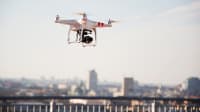
For the first time an autonomously flying quadrotor has outperformed two human pilots in a drone race. The success is based on a novel algorithm that was developed by researchers of the University of Zurich. It calculates time-optimal trajectories that fully consider the drones’ limitations.
Because of a drone’s limited battery life, it must complete its task in the shortest possible time, often by going through waypoints like windows or rooms. Rather than assigning sections of the flight path to specific waypoints, the algorithm tells the drone to pass through all waypoints, but not how or when to do that.
Once the algorithm found the best trajectory, it can reproduce it faithfully many times, unlike human pilots.
More From SAE Media Group

Aerospace INSIDER
Automated Flight Control System for Drone Swarms
Aerospace INSIDER
MQ-1C Completes First Air-Launched Effect Flight Demonstration
Aerospace INSIDER
BAE Systems Acquires Developer of Electric Heavy Lift Quadcopters
Aerospace INSIDER
Training Drones to Avoid Obstacles at High Speeds

NASA Spinoff
A Better Backup Plan for the Unthinkable


Aerospace INSIDER
NASA Brings Air Mobility Vision to Stratospheric Heights
Motion Design INSIDER
AI-Powered Vision System Helps Drones Navigate Safely
Aerospace & Defense Tech Briefs
Aerospace & Defense Podcasts

NASA Spinoff
Swarming Technology Lets Drones Work as a Team
Tech Briefs
Approach Makes Unmanned Agents Self-Sufficient
Aerospace INSIDER
Reliable Robotics to Provide Aircraft Automation Study for US Air Force
Aerospace INSIDER
AI Algorithms Fly Uncrewed XQ-58A Valkyrie Drone for Three Hour Sortie

Aerospace & Defense Tech Briefs
One Person Can Supervise a Swarm of 100 Unmanned Autonomous Vehicles
Aerospace & Defense Tech Briefs
Robust MADER: Decentralized Multiagent Drone Trajectory Planner
Robotics & Automation INSIDER
MIT Engineers Help Multirobot Systems Stay In the Safety Zone


Aerospace & Defense Tech Briefs
Creating and Verifying Stable AI-Controlled Systems in a Rigorous, Flexible Way
Aerospace & Defense Tech Briefs
Advancing Metrology at Mach Speed
Aerospace INSIDER
New Drones and Software Selected for DoD's Replicator 1.2
Top Stories
INSIDERManufacturing & Prototyping
 How Airbus is Using w-DED to 3D Print Larger Titanium Airplane Parts
INSIDERManned Systems
 FAA to Replace Aging Network of Ground-Based Radars
NewsTransportation
 CES 2026: Bosch is Ready to Bring AI to Your (Likely ICE-powered) Vehicle
NewsSoftware
 Accelerating Down the Road to Autonomy
EditorialDesign
 DarkSky One Wants to Make the World a Darker Place
INSIDERMaterials
 Can This Self-Healing Composite Make Airplane and Spacecraft Components Last...
Webcasts
Defense
 How Sift's Unified Observability Platform Accelerates Drone Innovation
Automotive
 E/E Architecture Redefined: Building Smarter, Safer, and Scalable...
Power
 Hydrogen Engines Are Heating Up for Heavy Duty
Electronics & Computers
 Advantages of Smart Power Distribution Unit Design for Automotive...
Unmanned Systems
 Quiet, Please: NVH Improvement Opportunities in the Early Design...
