




Army Detects Broadest Frequencies Ever with Quantum Receiver
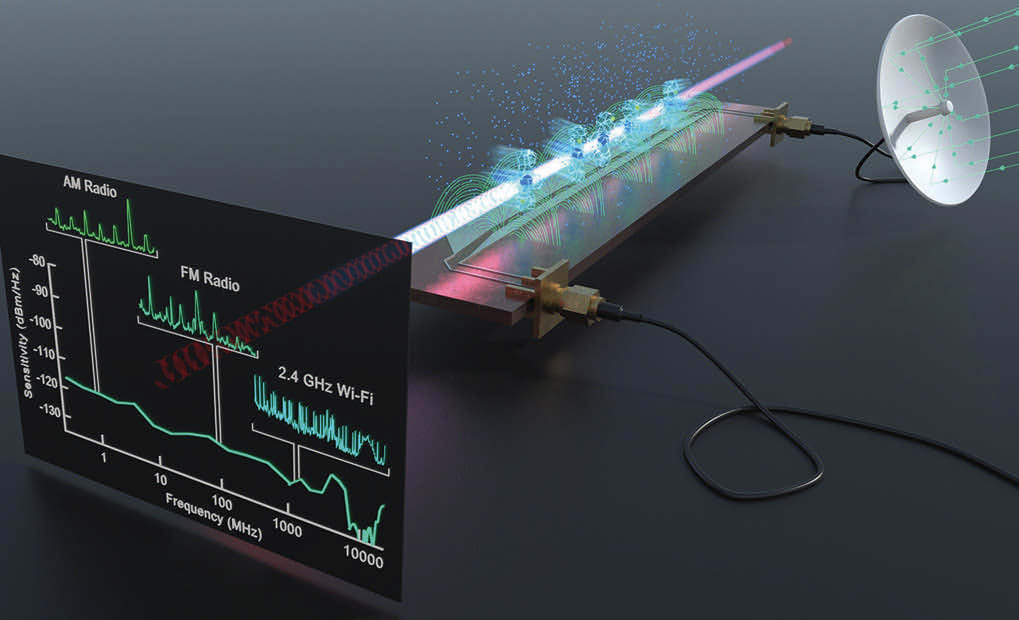
A new quantum sensor can analyze the full spectrum of radio-frequency and real-world signals, unleashing new potential for soldier communications, spectrum awareness, and electronic warfare.
Army researchers built the quantum sensor, which can sample the radio-frequency spectrum — from zero frequency up to 20 GHz — and detect AM and FM radio, Bluetooth, Wi-Fi, and other communication signals.
How it Works
The Rydberg sensor uses laser beams to create highly excited Rydberg atoms directly above a microwave circuit to boost and home in on the portion of the spectrum being measured. The Rydberg atoms are sensitive to the circuit’s voltage, enabling the device to be used as a sensitive probe for the wide range of signals in the RF spectrum.
“All previous demonstrations of Rydberg atomic sensors have only been able to sense small and specific regions of the RF spectrum, but our sensor now operates continuously over a wide frequency range for the first time,” said Dr. Kevin Cox, a researcher at the U.S. Army Combat Capabilities Development Command (DEVCOM) Army Research Laboratory. “This is a really important step toward proving that quantum sensors can provide a new and dominant set of capabilities for our soldiers, who are operating in an increasingly complex electromagnetic battlespace.”

The Rydberg spectrum analyzer has the potential to surpass fundamental limitations of traditional electronics in sensitivity, bandwidth, and frequency range. Because of this, the lab’s Rydberg spectrum analyzer and other quantum sensors have the potential to unlock a new frontier of Army sensors for spectrum awareness, electronic warfare, sensing, and communications — part of the Army’s modernization strategy.
“Devices that are based on quantum constituents are one of the Army’s top priorities to enable technical surprise in the competitive future battlespace,” said Army researcher Dr. David Meyer. “Quantum sensors in general, including the one demonstrated here, offer unparalleled sensitivity and accuracy to detect a wide range of mission-critical signals.”
The Future

The researchers plan additional development to improve the signal sensitivity of the Rydberg spectrum analyzer, aiming to outperform existing state-of-the-art technology.
“Significant physics and engineering effort is still necessary before the Rydberg analyzer can integrate into a field-testable device,” Cox said. “One of the first steps will be understanding how to retain and improve the device’s performance as the sensor size is decreased. The Army has emerged as a leading developer of Rydberg sensors and we expect more cutting-edge research to result as this futuristic technology concept quickly becomes a reality.”
For more information, contact the Army DEVCOM Army Research Laboratory Public Affairs at 703-693-6477.
More From SAE Media Group
Aerospace & Defense Tech Briefs
Ka-Band Front-End Monolithic Microwave Integrated Circuits (MMICs) and Transmit/Receive (T/R) Modules Testing
Tech Briefs
Quantum Sensor Enables Wide Spectral Coverage
Aerospace & Defense Tech Briefs
Electronic Warfare: Vying for Control of the Electromagnetic Spectrum
Tech Briefs
Atoms Can Receive Common Communications Signals
Aerospace & Defense Tech Briefs
EW: New Challenges, Technologies, and Requirements
Aerospace & Defense Tech Briefs
Explosive Ordnance Disposal (EOD) Jamming Unit
Tech Briefs
Atom-Based Radio Communications
Automotive Engineering
Homing in on STEM Innovation

Aerospace & Defense Tech Briefs
Airborne Early Warning and Control Sensor
Aerospace & Defense Tech Briefs
Revolutionizing Electronic Warfare: Unleashing the Power of High-Performance Software-Defined Radios
Tech Briefs
Wireless, Wearable Transmitter
Tech Briefs
Microwave Radar Sensor Module
Aerospace & Defense Tech Briefs
Digital Radar Warning Receiver
Aerospace & Defense Tech Briefs
Making Fully Digital Beamforming for Radar and Electronic Warfare Applications a Reality
Tech Briefs
Quantum Radio Aids Communications and Mapping
Medical Design Briefs
Using 24 GHz Doppler Radar Sensors for Noncontact Human Vitals Detection
Aerospace & Defense Tech Briefs
What Today’s Advances in Radar Technology Mean for Testing and Training
Aerospace & Defense Tech Briefs
Multi-Agent RF Propagation Simulator
RF & Microwave Technology
Ballistic Radomes for Communications Antennas
Aerospace & Defense Tech Briefs
Army and Universities Deploy New Warfighter Communication Technology
Aerospace & Defense Tech Briefs
Anti-Drone Jammer

Sensor Technology
‘Impossible’ Millimeter Wave Sensor Has Wide Potential
Aerospace & Defense Tech Briefs
What System Designers Should Know About MOSA Standards
Tech Briefs
New on the Market: January 2022
Aerospace & Defense Tech Briefs
Rydberg Technologies Shows Potential of Long-Range RF with Quantum Sensor at NetModX23
Automotive Engineering
Radiated Emissions Testing Gathers Bandwidth
Aerospace & Defense Tech Briefs
Everyday Life, Improved by Light: GRYPHON’s Photonic Discoveries
RF & Microwave Technology
Automated Testing Ensures Top Performance of Army Radios
Top Stories
INSIDERMaterials
 How Airbus is Using w-DED to 3D Print Larger Titanium Airplane Parts
NewsRF & Microwave Electronics
 Microvision Aquires Luminar, Plans Relationship Restoration, Multi-industry Push
INSIDERWearables
 A Next Generation Helmet System for Navy Pilots
INSIDERManufacturing & Prototyping
 New Raytheon and Lockheed Martin Agreements Expand Missile Defense Production
NewsAutomotive
 Ford Announces 48-Volt Architecture for Future Electric Truck
ArticlesTransportation

Webcasts
Unmanned Systems
 Quiet, Please: NVH Improvement Opportunities in the Early Design Cycle
Aerospace
 Cooling a New Generation of Aerospace and Defense Embedded...
Energy
 Battery Abuse Testing: Pushing to Failure
Connectivity
 A FREE Two-Day Event Dedicated to Connected Mobility
Electronics & Computers
 Advantages of Smart Power Distribution Unit Design for Automotive &...
Aerospace
 Sesame Solar's Nanogrid Tech Promises Major Gains in Drone Endurance