




Automated Testing Ensures Top Performance of Army Radios
To keep soldiers safe and the lines of communication open, frequent testing of radios used on the battlefield is imperative. That testing is becoming more automated and efficient with updates to the Communications Electronic Warfare Instrumentation System (CEWIS), a suite of test equipment developed by the Communications Electronic Warfare Branch of the U.S. Army Research Laboratory’s Survivability/Lethality Analysis Direct orate(ARL/SLAD).
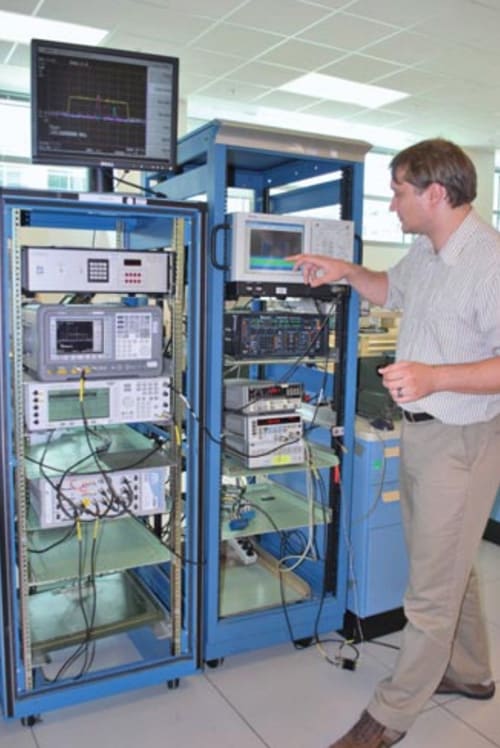
ARL/SLAD first brought the CEWIS capability online in the mid-1990s, and has continually evolved the technology to keep up with the times, explained Jim Lurski, electrical engineer with ARL/ SLAD. “The newer test equipment is more automated and more capable.”
In CEWIS, a variety of test equipment such as spectrum analyzers, signal generators, and oscilloscopes is combined into a single system. It allows analysts to assess the robustness of a communication link. For example, two radios may be brought into the lab, where CEWIS is used to inject a jamming signal to disrupt their communications. The jamming signal starts low and is increased until the communication fails. ARL informs the customer (e.g., a program manager or the Army Evaluation Center) of results such as the radios’ ability to maintain their link up to a specific level of jamming.
To achieve precision in the testing process, CEWIS transmits several hundred messages at each level of jamming signal. With that many messages, it is important that the process be automated.
“Prior to this, we would have to handset the equipment, and the messaging software would send the messages,” said Lurski. “After that, we would have to go by hand to change up everything from the jammer side, and take the data from each run and store to the side, and go through the next run,” he explained.
CEWIS is now the main control point for such tests. All of its jamming capabilities are controlled through a workstation, so the characteristics of the signal can be changed easily to accommodate a changing threat.
“The nice thing about CEWIS is that it provides a controlled, repeatable environment,” said Lurski. “We can do a test now and compare it to test results from years ago.”
Lurski noted that the waveforms used in CEWIS have to evolve to keep pace with the evolution of threat systems. To know which threats must be tested, ARL reviews documentation from intelligence organizations and also applies their own technical expertise to foresee how adversaries’ capabilities could evolve.
ARL/SLAD has recently used CEWIS to test both vehicle-mounted and manpack radios. They have performed electronic-warfare testing for the Joint Tactical Radio Systems (JTRS) Rifleman Radio, JTRS Ground Mobile Radio, the Single Channel Ground Air Radio System (SINCGARS), and the Enhanced Position Location Reporting System (EPLRS).
Involved with JTRS since its early development, ARL has tested it and provided feedback so problems can be fixed in follow-on development.
Another system for which CEWIS has been invaluable is Nett Warrior, which provides situational awareness and mission command for dismounted soldiers on the battlefield. ARL pre-tested the Nett Warrior system for the most recent Network Integration Evaluation (NIE) in November 2012, providing useful data for the test planners. NIE is a series of twice-annual, soldier-led events designed to evaluate the effectiveness of multiple networked devices in a tactical, operational test environment. The NIEs, of which the most recent involved 3,800 soldiers, help assess the network, systems, and soldiers while they operate in the presence of a validated, persistent cyber threat.
In the months prior to the most recent NIE, SLAD analysts procured radios for lab tests. Now that NIE has concluded, they will use the data gathered to analyze radios with regard to survivability; the results will be used to inform decision-makers, so that the proper equipment can be produced to aid soldiers on the battlefield.
Because this approach allowed the Army to track down and eliminate problems encountered in earlier NIEs, it’s now being generalized.
As Lurski explained, “The plan is to pre-test before each NIE the systems that will be undergoing testing, to ensure that the threat planned for the NIE makes sense.”
With a resource as valuable as CEWIS, ARL/SLAD’s experts in communications electronic warfare are not only improving the performance of Army radios, but also enhancing the effectiveness and rigor of the testing that ensures those radios are the world’s most capable.
For more information on CEWIS, contact the Army Research Laboratory’s Public Affairs Division at
More From SAE Media Group
Aerospace & Defense Tech Briefs
Revolutionizing Electronic Warfare: Unleashing the Power of High-Performance Software-Defined Radios
Aerospace & Defense Tech Briefs
Explosive Ordnance Disposal (EOD) Jamming Unit
Aerospace & Defense Tech Briefs
What Today’s Advances in Radar Technology Mean for Testing and Training
Aerospace & Defense Tech Briefs
Software Enables New-Age, Flexible Test Solution for Analog and Digital Radios
Aerospace & Defense Tech Briefs
Anti-Drone Jammer
Aerospace & Defense Tech Briefs
Electronic Warfare: Vying for Control of the Electromagnetic Spectrum
Aerospace & Defense Tech Briefs
Electronic Warfare Development Targets Fully Adaptive Threat Response Technology
Aerospace & Defense Tech Briefs
Defeating Commercial Drone Threats with Software Defined Radio
Tech Briefs
Automated RF Interference Mitigation System
Aerospace & Defense Tech Briefs
Army Advances Materials for New Low-Profile Antenna
Aerospace & Defense Tech Briefs
What is Drone Jamming and How Can it Be Countered?
Aerospace & Defense Tech Briefs
Multi-Agent RF Propagation Simulator

Aerospace & Defense Tech Briefs
Army and Universities Deploy New Warfighter Communication Technology
Aerospace & Defense Tech Briefs
Digital Radar Warning Receiver
Aerospace & Defense Tech Briefs
What System Designers Should Know About MOSA Standards
Defense INSIDER
MAPS GEN II: Navigation System Upgrades for Army Vehicles
Aerospace & Defense Tech Briefs
Tackling Ruggedization Challenges for RF Communications in Software Defined Radios
Aerospace & Defense Tech Briefs
EW: New Challenges, Technologies, and Requirements
Aerospace & Defense Tech Briefs
Army Detects Broadest Frequencies Ever with Quantum Receiver
Aerospace & Defense Tech Briefs
Radar Recording Proves Next-Level System Performance
Aerospace & Defense Tech Briefs
Counter UAS Defense System


Aerospace & Defense Tech Briefs
Secure Wireless Communication System
Automotive Engineering
Homing in on STEM Innovation
Aerospace & Defense Tech Briefs
What is Pulse Shaping?
Tech Briefs
Test Strategies to Track Hypersonic Threats

Aerospace & Defense Tech Briefs
Air Force Technology Tracks “Sporadic E”
Top Stories
NewsSensors/Data Acquisition
 Microvision Aquires Luminar, Plans Relationship Restoration, Multi-industry Push
INSIDERRF & Microwave Electronics
 A Next Generation Helmet System for Navy Pilots
INSIDERWeapons Systems
 New Raytheon and Lockheed Martin Agreements Expand Missile Defense Production
NewsAutomotive
 Ford Announces 48-Volt Architecture for Future Electric Truck
INSIDERAerospace
 Active Strake System Cuts Cruise Drag, Boosts Flight Efficiency
ArticlesTransportation

Webcasts
Aerospace
 Cooling a New Generation of Aerospace and Defense Embedded...
Energy
 Battery Abuse Testing: Pushing to Failure
Power
 A FREE Two-Day Event Dedicated to Connected Mobility
Automotive
 Quiet, Please: NVH Improvement Opportunities in the Early Design Cycle
Electronics & Computers
 Advantages of Smart Power Distribution Unit Design for Automotive &...
Unmanned Systems
 Sesame Solar's Nanogrid Tech Promises Major Gains in Drone Endurance