




Micro-Displays and Augmented Reality Improve Situational Awareness

Several new technologies are being developed that, once combined, will give soldiers an unprecedented overview of the battlefield. Those technologies involve the marriage of micro-displays with augmented reality.
The Army's preferred method of acquiring new technologies is to use what industry is already developing for consumers, or modifying that technology for its own use, said Rupal Varshneya, an electrical engineer at CERDEC. The Army employs its scientists and research laboratories for designing needed technologies that industry is not interested in pursuing, she said. Such was the case when the Army needed a very bright, high-definition micro-display, about the size of a postage stamp.
First off, the Army approached makers of smartphones, tablets, TVs and even the gaming industry. None of them were interested in making the micro-display because they didn't foresee consumer demand or profit potential. So, the Army researchers at CERDEC went to work building displays with progressively greater capability. About eight years ago, they developed a monochrome version. Then, several years later, researchers developed a new silicone technology and manufacturing methods that enabled the micro-display to increase in brightness, making it sunlight readable.
Although the technology was being developed for dismounted soldiers, other program managers took notice. For example, the program manager responsible for Apache helicopters wanted their pilots to have them for head-mounted displays. They are not yet fielded for the Apaches, but a contract for them has already been signed. Other program managers wanted them for night vision goggles and even for weapons sights. The next step was to develop an extremely high resolution, 2048-by-2048-pixel display in full color. That advancement came to fruition recently, and some of them were on display. The next phase of development had to do with taking the improved micro-display and pairing it with augmented reality, using the Nett Warrior system. Previously, soldiers had a small radio attached to their chest. Whenever they needed to get location coordinates or other data they had to look down and lost situational awareness to their front. The micro-display attachment to the helmet allows soldiers to stay focused on what's in front of them.
The micro-display not only gives soldiers a clear view of what's ahead of them, night or day, it also can accommodate overlays such as maps and symbols showing friendly forces and enemy forces. In this way, it replaces traditional night vision goggles. Furthermore, information that's wirelessly fed into the micro-display, such as maps and symbols, can be shared among other soldiers using the device, as well as leaders in the tactical operation center. They all have the ability to share the same picture of the battlefield and can add or manipulate the symbols as needed.
Researchers are also adding micro-displays on the soldiers' weapons and feeding that display into the one attached to the soldiers' helmets via a tablet worn on the waist. That enables soldiers to get a split view of what's around them plus the target the weapon is trained on. So, if the rifle is pointed rearward and the soldier is looking forward, the image shows both views. That creates novel ways for soldiers to fire their weapons, such as shooting over a wall without being exposed.
More From SAE Media Group
Defense INSIDER
Heads-up Display Improves Soldiers’ Situational Awareness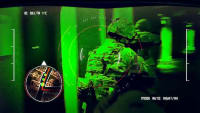
Defense INSIDER
Anduril Brings AI-Powered Display to New EagleEye Army Helmets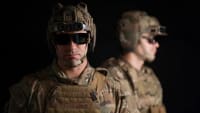
Defense INSIDER
MAPS GEN II: Navigation System Upgrades for Army Vehicles
Aerospace & Defense Tech Briefs
Rockwell Collins and Elbit Show off F-35 Gen III Helmet at Farnborough


Aerospace & Defense Tech Briefs
Day/Night-Vision Data Display
Defense INSIDER
Army Researchers Enable Night Lethality
Aerospace & Defense Tech Briefs
Through-Wall Imaging System
Aerospace & Defense Tech Briefs
Thailand Army Vehicle Computer System Upgrades


Aerospace & Defense Tech Briefs
Military Vehicle Situational Awareness System


Aerospace INSIDER
Northrop's New Multifunction Active Electronically Scanned Array
Aerospace INSIDER
Apache Version 6.5 Software Upgrade on Track to Fly This Year

Aerospace & Defense Tech Briefs
Autonomous Surveillance Technologies Relating to Dismounted Soldiers
Aerospace & Defense Tech Briefs
The World’s Largest Real Time EW Test Range
Robotics & Automation INSIDER
New Imaging Technique Reconstructs the Shapes of Hidden Objects
Aerospace INSIDER
L3Harris Starts Low Rate Production Of New F-16 Viper Shield
Defense INSIDER
Army Aviation Team Achieves Software Success in Live Fire Test
Defense INSIDER
Army Gets a Clearer View of Multi-Domain Battlefield
Aerospace & Defense Tech Briefs
Rugged Server and Display System
Aerospace Manufacturing and Machining INSIDER
Army Launches CMOSS Prototyping Competition for Computer Chassis and Cards
Aerospace & Defense Tech Briefs
From the Editor: New Year, New Editor
Aerospace & Defense Tech Briefs
Leveraging COTS Products for Maneuverable Aerial Identification
Top Stories
INSIDERDefense
 New Raytheon and Lockheed Martin Agreements Expand Missile Defense Production
NewsAutomotive
 Ford Announces 48-Volt Architecture for Future Electric Truck
INSIDERManufacturing & Prototyping
 Active Strake System Cuts Cruise Drag, Boosts Flight Efficiency
ArticlesTransportation
 Accelerating Down the Road to Autonomy
INSIDERMaterials
 How Airbus is Using w-DED to 3D Print Larger Titanium Airplane Parts
Road ReadyTransportation

Webcasts
Electronics & Computers
 Cooling a New Generation of Aerospace and Defense Embedded...
Power
 Battery Abuse Testing: Pushing to Failure
Connectivity
 A FREE Two-Day Event Dedicated to Connected Mobility
Automotive
 Quiet, Please: NVH Improvement Opportunities in the Early Design Cycle
Transportation
 Advantages of Smart Power Distribution Unit Design for Automotive &...
Aerospace
 Sesame Solar's Nanogrid Tech Promises Major Gains in Drone Endurance