




Anduril Brings AI-Powered Display to New EagleEye Army Helmets
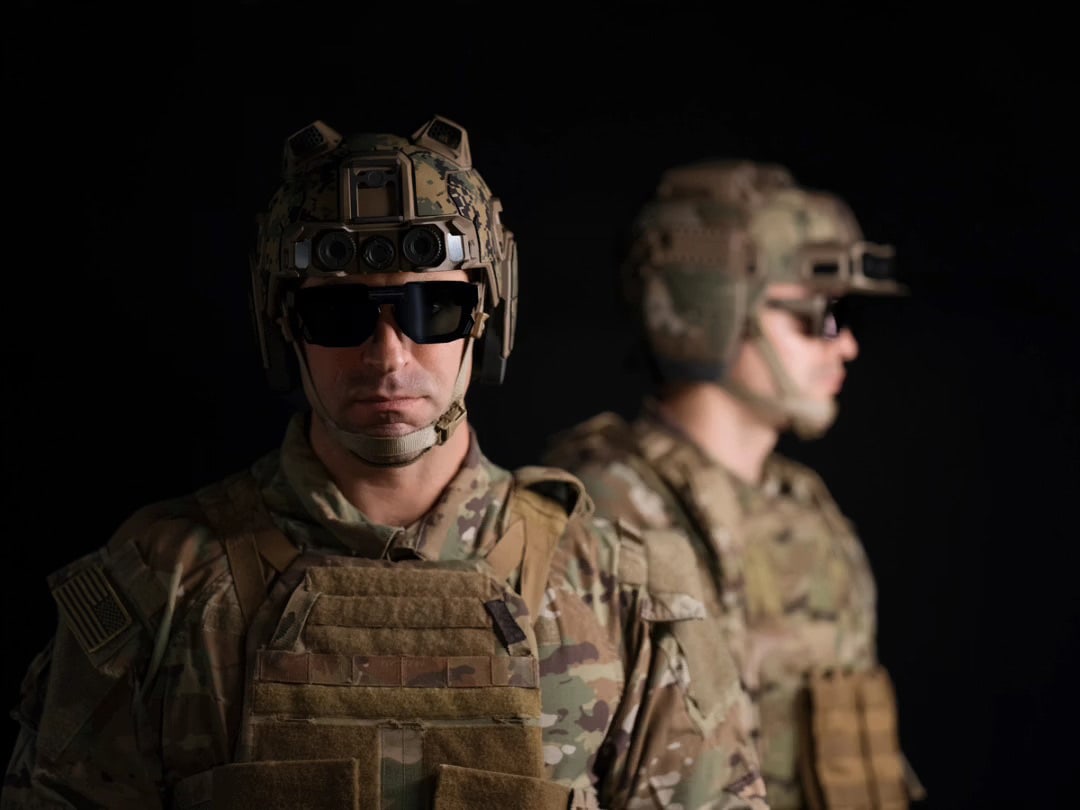
Anduril has unveiled its new EagleEye artificial intelligence (AI)-powered helmet designed to meet the startup company's vision of turning every warfighter into a connected node on the battlefield.
EagleEye consolidates mission planning, perception, and control of unmanned assets into a lightweight system that reduces weight and cognitive load while improving protection. Anduril describes the new helmet technology as a modular, AI-powered family of systems that unifies command and control, digital vision, and survivability within a single, adaptive architecture.
Anduril is already delivering the Army’s Soldier Borne Mission Command (SBMC) and Soldier Borne Mission Command–Architecture (SBMC-A) programs. Together, SBMC and SBMC-A form a mixed-reality platform that equips U.S. Army Soldiers with integrated situational awareness, mission planning, and training tools to improve decision-making and mobility. EagleEye builds on these advances, pairing mission command software with a heads-up display (HUD) and helmet-native hardware for balance, protection, and battlefield effectiveness.
“We don’t want to give service members a new tool, we’re giving them a new teammate,” said Palmer Luckey, Anduril’s founder. “The idea of an AI partner embedded in your display has been imagined for decades. EagleEye is the first time it’s real.”
EagleEye enables mission command through a high-resolution, collaborative 3D sand table. Operators can rehearse missions, coordinate movements, and integrate live video feeds pinned to terrain. This creates a shared operational picture before and during the mission.
The HUD enhances the operator’s view by overlaying digital information onto the real world, delivering vital contextual insights. EagleEye includes both an optically transparent daytime HUD and a digital night-vision HUD, each purpose-built for its environment. The system’s advanced approach to blue force tracking enables warfighters to know the precise location of teammates in world space, such as their exact position within a building or on a specific floor, rather than simply appearing as a dot on a 2D map. With Anduril’s Lattice network of distributed sensors, the system fuses real-time feeds from across the battlespace, allowing operators to detect and track threats even when terrain or structures block direct line of sight.
EagleEye also provides beyond-full-cut ballistic protection and blast wave mitigation in an ultralightweight shell designed for long wear. Rear- and flank-view sensors expand awareness without distraction. Spatial audio and radio frequency (RF) detection add layers of protection, alerting operators to hidden or immediate threats.
The AI-powered helmet also consolidates soldier networking and command tools into a body-worn system. Operators can task unmanned aerial vehicles (UAS), call for fires, and control robotic teammates while staying mobile. Lattice mesh networking ensures resilient command and control in denied, degraded, intermittent, or limited (DDIL) environments.
Anduril designed EagleEye with ergonomic form factors modular add-ons, and a software-first architecture. Configurations include helmet, visor, and glasses variants. The system balances weight, reduces the bulk of traditional night vision goggles (NVGs), and keeps sensors aligned with the warfighter’s center of gravity. The totality of these attributes make EagleEye a standard-setting technology meant to perform to the requirements of military operations.
The new Army helmet technology was developed by Anduril in partnership with commercial leaders such as Meta, OSI, Qualcomm Technologies, Inc., and Gentex Corporation, who have invested billions in augmented reality, rugged eyewear, compute, sensing, and ballistic helmets, in an effort to bring proven off-the-shelf technology directly into defense. This approach lowers cost, accelerates development, and ensures a path to continuous upgrades.
More From SAE Media Group

Defense INSIDER
Mounted Troops to Get High-Tech Situational Awareness Tools
Defense INSIDER
Heads-up Display Improves Soldiers’ Situational Awareness
Aerospace & Defense Tech Briefs
Virtual Environment System

Aerospace & Defense Tech Briefs
5 Startups Developing AI for Defense Application
Aerospace INSIDER
Northrop Grumman to Develop Prototype Artificial Intelligence Assistant
Aerospace & Defense Tech Briefs
Autonomous Surveillance Technologies Relating to Dismounted Soldiers
Tech Briefs
NIST Researchers Use A.I. to Boost 5G Efficiency

Aerospace & Defense Tech Briefs
The Marines New Installation Counter UAS System


Electronics & Sensors INSIDER
Bringing Together Real-World Sensors and VR to Improve Building Maintenance
Medical Design Briefs
Show Preview: MD&M West
Medical Design Briefs
Immersive Mixed Reality: Moving Automation Technologies to the Cloud
Defense INSIDER
The Army's New Supercomputer is Named After ENIAC Programmers

Automotive Engineering
Panasonic Augments Driver Safety with New HUD Tech
Aerospace & Defense Tech Briefs
Autonomous Air Defense Production

Tech Briefs
Products of Tomorrow

Motion Design INSIDER
Teaching a Robot to Hang a T-shirt Starts with Data
Tech Briefs
Adapter Makes All Headphones Intelligent
Aerospace & Defense Tech Briefs
Thailand Army Vehicle Computer System Upgrades


Aerospace & Defense Tech Briefs
The Future of Aerospace: Embracing Digital Transformation and Emerging Technologies
Top Stories
NewsRF & Microwave Electronics
 Microvision Aquires Luminar, Plans Relationship Restoration, Multi-industry Push
INSIDERAerospace
 A Next Generation Helmet System for Navy Pilots
INSIDERDesign
 New Raytheon and Lockheed Martin Agreements Expand Missile Defense Production
INSIDERMaterials
 How Airbus is Using w-DED to 3D Print Larger Titanium Airplane Parts
NewsPower
 Ford Announces 48-Volt Architecture for Future Electric Truck
ArticlesAR/AI

Webcasts
Electronics & Computers
 Cooling a New Generation of Aerospace and Defense Embedded...
Automotive
 Battery Abuse Testing: Pushing to Failure
Power
 A FREE Two-Day Event Dedicated to Connected Mobility
Unmanned Systems
 Quiet, Please: NVH Improvement Opportunities in the Early Design Cycle
Automotive
 Advantages of Smart Power Distribution Unit Design for Automotive &...
Energy
 Sesame Solar's Nanogrid Tech Promises Major Gains in Drone Endurance