




Panasonic Augments Driver Safety with New HUD Tech
The 2.0 system’s simulated 3D provides an intuitive awareness of the situation and surrounding environment ahead of the vehicle.
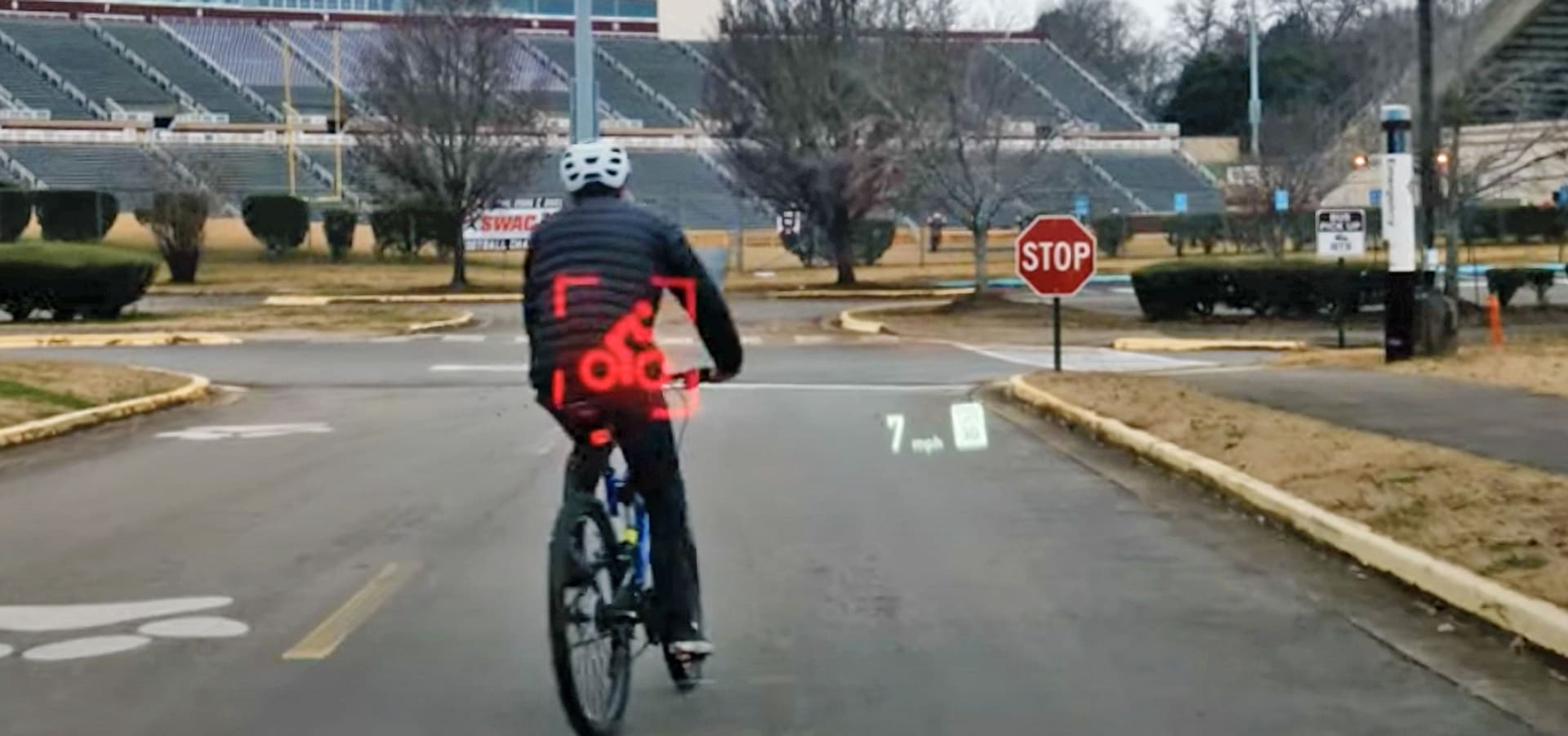
At CES 2022 Panasonic Automotive Systems Company of America unveiled AR HUD 2.0 (Augmented Reality Head-Up Display 2.0), the first system to include a new, patented eye-tracking system (ETS). If you’ve ever thought about what exists beyond the limits of a HUD and the small rectangular box it displays on the windshield, welcome to the world of AR.
And be careful because AR is not Virtual Reality. VR is a space in which headsets or special glasses allow the wearer to experience a 3D world that doesn’t exist except in this technology. It’s increasingly used in automotive interior design. Panasonic’s AR HUD expands that small viewing rectangle far beyond the windshield out into the real world, placing information into your world that will not change your world but will enhance it.
For example, it’s raining and you can’t see a traffic light. AR can add that stop light to the field of view, explained Andrew Poliak, Panasonic Automotive Systems Company of America’s CTO, “2.0 is the patented ETS technology that identifies the individual driver’s height and head movement behind the wheel and dynamically adjusts and compensates the images in the ‘eye box,’” Poliak said.
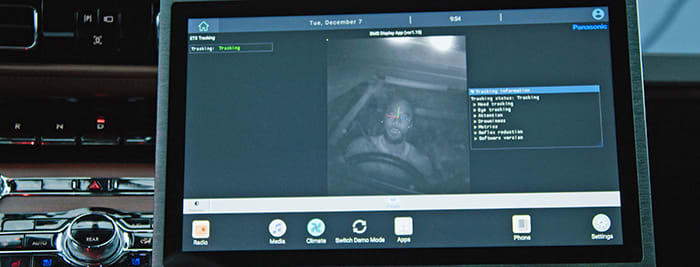
Drivers constantly shift their head and change their line of sight, but with parallax alignment and dynamic autofocus working together (above) in the Panasonic HUD system, drivers will see only accurately positioned, crisp, high-resolution overlays and icons. The driver’s experience is powered by AI (Augmented Intelligence, a sub-category of artificial intelligence) navigation software which intelligently matches the changing environment with 3D AR overlays, icons and mapping, providing an intuitive awareness of the situation and surrounding environment.
The 3D is simulated using a tilted, dual-image plane – providing 3D at what Panasonic claims is the cost of 2D. As Poliak explained: “Today we are just mapping the virtual world over the real world.” Even in its latest iteration, AR HUD 2.0 is a benign technology. It is not connected to a vehicle’s ADAS (advanced driver-assistance system). Instead, it enhances the driving experience and helps drivers make more intelligent decisions regarding navigation and safety related issues, the company said.
However, as the auto industry moves to more automated driving, Panasonic’s technology will evolve to integrate with a vehicle’s ADAS. What makes Panasonic’s AR HUD 2.0 technology different? According to Hans Troemel Jr., the company’s advanced engineering vision & sensing group manager, “We are unique in having experience right down to the component level with every technology required to design these systems. Our breath and our depth are a big advantage over the competition.”
Panasonic employs a user-experience group that surveys customers for answers to such questions as how much and what types of information do customers want displayed and when? “For example,” Troemel continues, “Driver distraction is a major safety issue today. Based on feedback we’ve received we are starting to enable machine learning functions in the vehicle so that the system learns what info the driver wants displayed and when. Reducing the cognitive load is critical to the driver. We can customize the experience for each driver. We’ve gotten a lot of good feedback from our user-experience groups telling us that once you experience this technology , you really don’t want to go back.”
More From SAE Media Group
Off-Highway Engineering
Next-Gen HMI Crucial to Increasing ADAS Efficacy
Automotive Engineering
WCX 2023: Making the ‘Smart Cockpit’ and UX Safer
Autonomous Vehicle Engineering
Data Drives Driverless Truck Launch
Autonomous Vehicle Engineering
GM Announces Door-To-Door Ultra Cruise ADAS

ADAS & Autonomous Vehicle Engineering
Mercedes-Benz Architecting Its Own Operating System
Automotive Engineering
McLaren Applied Technologies’ All-Electric, AI-Infused Vision of Formula 1 Racing
Autonomous Vehicle Engineering
The Future of Automated Vehicle Cabins
Off-Highway Engineering
Artificial Intelligence Being Schooled for Mining Applications
Automotive Engineering
Volvo Cars Mixes Virtual with Real-World Testing
Automotive Engineering
Tuning-Up AI’s ‘Understanding’ to Make Safer ADAS, AVs
Automotive Engineering
Volvo EX90 Uses AI, NVIDIA SoC to Make Automated Driving Safer
Aerospace & Defense Tech Briefs
Industry Invited to Participate in AeroTech Aerospace and Defense Technical Program
Automotive Engineering
Snapdragon Ride Flex Puts Safety, Infotainment onto Single Chip
Off-Highway Engineering
Augmented, Mixed and Virtual Reality Transform Heavy-Vehicle Engineering
Automotive Engineering
Valeo Debuts New Lidars, EV Tech at CES 2022
Automotive Engineering
SAE WCX 2022: OEM Learnings from Level 2 ADAS
Automotive Engineering
Toyota Reinvesting in Collaborative Safety Research
Tech Briefs
5Ws of the EgoTouch
Automotive Engineering
When Will AVs Become Reality? Answer: When Safety Science Catches Up.
Automotive Engineering
Spelling Ford with an ‘E’
Aerospace & Defense Tech Briefs
SAE International Extends Call for Abstracts, Seeks Submissions for AeroTech Conference
Automotive Engineering
Designing and Assessing Vehicle Safety Functions with a Use Case Approach
Automotive Engineering
CASE Struggles to Fulfil Expectations
Autonomous Vehicle Engineering
'Level 2+': Making Automated Driving Profitable, Mainstream
Autonomous Vehicle Engineering
BMW 7-Series Drives Itself Through Own Assembly
Aerospace & Defense Tech Briefs
AI Co-Pilot Enhances Human Precision for Safer Aviation
Medical Design Briefs
Incorporating 3D Artificial Intelligence with AR and VR Technology
Off-Highway Engineering
New CM Labs Excavator Simulator Training Offers GPS Guidance, HMI Experience
Top Stories
NewsSensors/Data Acquisition
 Microvision Aquires Luminar, Plans Relationship Restoration, Multi-industry Push
INSIDERRF & Microwave Electronics
 A Next Generation Helmet System for Navy Pilots
INSIDERWeapons Systems
 New Raytheon and Lockheed Martin Agreements Expand Missile Defense Production
NewsAutomotive
 Ford Announces 48-Volt Architecture for Future Electric Truck
INSIDERAerospace
 Active Strake System Cuts Cruise Drag, Boosts Flight Efficiency
ArticlesTransportation

Webcasts
Aerospace
 Cooling a New Generation of Aerospace and Defense Embedded...
Energy
 Battery Abuse Testing: Pushing to Failure
Power
 A FREE Two-Day Event Dedicated to Connected Mobility
Automotive
 Quiet, Please: NVH Improvement Opportunities in the Early Design Cycle
Electronics & Computers
 Advantages of Smart Power Distribution Unit Design for Automotive &...
Unmanned Systems
 Sesame Solar's Nanogrid Tech Promises Major Gains in Drone Endurance