




New Research Finds Cause of Alloy Weakness

Sometimes calculations don’t match reality. That’s the problem that has faced materials scientists for years when trying to determine the strength of alloys. There has been a disconnect between the theoretical strength of alloys and how strong they actually are. Why?
New research has found the answer to this problem with a study done as a collaboration between researchers at Binghamton University, the University of Pittsburg, the University of Michigan and Brookhaven National Laboratory. The work was also supported by the U.S. Department of Energy’s Office of Science.
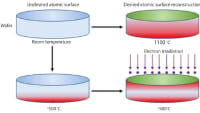
Researchers used advanced technology to look at alloys on an atomic level in order to understand what has been affecting the strength and other properties. Binghamton University materials science and engineering professor Guangwen Zhou was one of the scientists working on the project. Zhou and his team used a Transmission Electron Microscope (TEM) for the study, a tool that has been around since 1935 and has evolved dramatically in recent years with the incorporation of aberration correction techniques and environmental capabilities. It’s powerful enough to look deep into the structure of atoms.
“We were able to observe that the changes in alloys from surface segregation were accompanied by the formation of dislocations in the subsurface,” explained Zhou. “Atoms typically make patterns, but when there’s a dislocation, that means the pattern has been interrupted.”
Dislocations are what make the alloys weaker than the theoretical calculations expect and Zhou’s research found that surface segregation is what leads to those dislocations. “By understanding how the dislocation forms, we can start to control it,” said Zhou.
This could lead to strengthening a variety of alloys that are valued specifically for their strength and light weight. This groundbreaking research provides insight into what needs to change in order to strengthen all kinds of alloys that are used in airplanes, jewelry, medical tools, bridges, cookware and a plethora of other common objects.
More From SAE Media Group
Aerospace & Defense Tech Briefs
Modeling and Experimenting with 2D Materials for CMOS Type Devices and Digital Integrated Circuits
Aerospace INSIDER
Quantum Effect Triggers Unusual Material Expansion

Aerospace Manufacturing and Machining INSIDER
Superstrong Al Alloys May Change Aerospace Manufacturing Processes
Aerospace & Defense Tech Briefs
Evaluation of Additively Manufactured Ultrahard Steels
Aerospace & Defense Tech Briefs
Testing Military-Grade Adhesive in Extreme Loading Conditions


Aerospace Manufacturing and Machining INSIDER
Cracking in Harsh Environments Needs Both Stress and Corrosion

Aerospace INSIDER
Can Neutrons Improve 3D-Printing of Aluminum Aerospace Components?
Aerospace Manufacturing and Machining INSIDER
Supernova to 3D Print Military Grade Energetic Materials
Aerospace INSIDER
A New Platform for Developing Advanced Aerospace Metals at Scale
Automotive Engineering
Lyten Says 3D Graphene Could Disrupt Racing, Automotive and Space
Aerospace INSIDER
Using Ultrabright X-Rays to Test Materials for Ultrafast Aircraft
Tech Briefs
Automated Tow/Tape Placement System
Photonics & Imaging Technology
Deformation Fingerprints Will Help Researchers Identify, Design Better Metallic Materials
Aerospace & Defense Tech Briefs
Beyond Boundaries: Elevating Aerospace Design with Fluorosilicones
Tech Briefs
A New Method to Design Better Metallic Materials
Aerospace Manufacturing and Machining INSIDER
Can This Self-Healing Composite Make Airplane and Spacecraft Components Last for Centuries?
Aerospace Manufacturing and Machining INSIDER
Developing Multifunctional Composite Materials for Aerospace Applications
Tech Briefs
Macroflash Cup Cryostat


Aerospace & Defense Tech Briefs
Coating Technology Enables Effective Missile Countermeasures
Aerospace & Defense Tech Briefs
Physics-Guided Neural Network for Regularization and Learning Unbalanced Data Sets
Tech Briefs
Molten Target Sputtering (MTS) Deposition
Aerospace & Defense Tech Briefs
Design of New Piezoelectric Composites Using Nanocellulose
Top Stories
INSIDERManufacturing & Prototyping
 How Airbus is Using w-DED to 3D Print Larger Titanium Airplane Parts
INSIDERManned Systems
 FAA to Replace Aging Network of Ground-Based Radars
NewsTransportation
 CES 2026: Bosch is Ready to Bring AI to Your (Likely ICE-powered) Vehicle
NewsSoftware
 Accelerating Down the Road to Autonomy
EditorialDesign
 DarkSky One Wants to Make the World a Darker Place
INSIDERMaterials
 Can This Self-Healing Composite Make Airplane and Spacecraft Components Last...
Webcasts
Defense
 How Sift's Unified Observability Platform Accelerates Drone Innovation
Automotive
 E/E Architecture Redefined: Building Smarter, Safer, and Scalable...
Power
 Hydrogen Engines Are Heating Up for Heavy Duty
Electronics & Computers
 Advantages of Smart Power Distribution Unit Design for Automotive...
Unmanned Systems
 Quiet, Please: NVH Improvement Opportunities in the Early Design...
