




Stress-Corrosion Cracking and Corrosion Fatigue Impact of IZ-C17+Zinc-Nickel on 4340 Steel
New protective material could replace cadmium and aluminum coatings on critical components.
The protection of cathodic metallic materials used for aircraft components, like 4340, Aermet 100, and PH 13-8 corrosion-resistant steel, is critical to keeping the steel from pitting and cracking due to exposure to the operating environment. Two important properties are resistance to stress-corrosion cracking (SCC) and corrosion fatigue. These are insidious failure mechanisms that can lead to part failure in service.
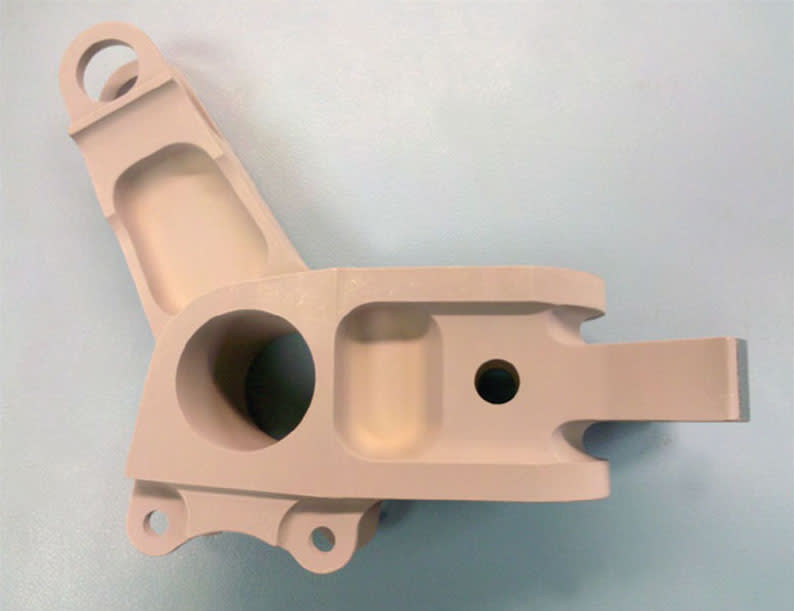
Cadmium and aluminum coatings are currently used to protect high-strength steels from corrosion, pitting, and cracking. These coatings are applied on new components and also at Navy Fleet Readiness Centers (FRC) during component repair and overhaul. Both are effective but each has shortcomings.
Cadmium is electroplated or sometimes applied in a vacuum chamber. The electroplating process allows for coating of all component surfaces using a low-cost method. However, cadmium is toxic and carcinogenic and alternatives are desired to eliminate these risks.
Aluminum is electroplated or applied by the ion-vapor deposition (IVD) process. At Navy FRCs, the IVD process is used. This requires a vacuum and is limited by line-of-sight, so not all surfaces of components can be coated depending on their geometry. IVD is a relatively high-cost practice and requires more maintenance than a cadmium electroplating line.
Alternatives to cadmium have been investigated for at least 50 years, with IVD aluminum being an early commercialized alternative. More recently, zinc-nickel alloys have been optimized to have coating properties that are very close to cadmium. The deposition process for these new alloys is electroplating.
A company called Dipsol provides a commercial zinc-nickel plating solution, IZ-C17+, that has been optimized for use on high-strength steels to perform similarly to cadmium and aluminum. One shortcoming of the data available is the ability of the coating to minimize SCC and corrosion fatigue of the substrate material and how it compares to cadmium and aluminum. These are two critical requirements for sacrificial coatings used on Navy and Marine Corps aircraft components.
Prior work documents the method to assess SCC and corrosion fatigue and the performance of electroplated cadmium on 4340 steel by itself, with a MIL-PRF-23377 Class C primer, and with both the primer and a MIL-PRF-85285 gloss white topcoat. This protective coating system is typical for high-strength steel components.
The purpose of this research was to assess the ability of electroplated IZ-C17+ zinc-nickel to suppress SCC and corrosion fatigue of 4340 steel using methods previously developed by the Materials Engineering Division. The zinc-nickel coating was assessed by itself, primer only, and with the primer and standard gloss white topcoat used on fleet aircraft components. The primer used was a standard MIL-PRF-23377, TY I chromate-based primer currently used on high-strength steel parts that are coated with cadmium or aluminum.
This work was done by Craig Matzdorf, Charles Lei, and Matt Stanley for the Naval Air Warfare Center. NAWC-0003
This Brief includes a Technical Support Package (TSP).
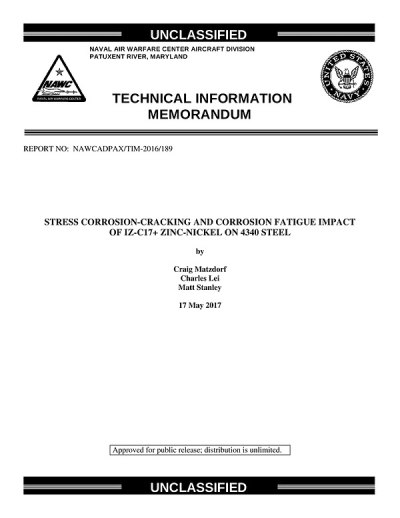
Stress-Corrosion Cracking and Corrosion Fatigue Impact of IZ-C17+Zinc-Nickel on 4340 Steel
(reference NAWC-0003) is currently available for download from the TSP library.
Don't have an account?
More From SAE Media Group
Aerospace & Defense Tech Briefs
Remanufacturing Reimagined: How Selective Electroplating Extends Service Life and Reduces the Cost of Aerospace Components
Aerospace & Defense Tech Briefs
Improving Component Life in Abrasive, Corrosive Aerospace Environments

Tech Briefs
Aluminum Electroplating Using Bromide Salts
Aerospace & Defense Tech Briefs
Plasma Electrolytic Oxidation: The Future of Lightweight Designs in Aerospace and Defense
Aerospace & Defense Tech Briefs
Evaluation of Additively Manufactured Ultrahard Steels
Aerospace Manufacturing and Machining
Does Your Coating Thickness Meet Spec?
Aerospace & Defense Tech Briefs
Cold Sprayed Coatings with Dual Nanoparticle Reinforcements for Wear and Corrosion Protection
Tech Briefs
Copolyimide Surface-Modifying Coating
Tech Briefs
High-Temperature Ni-Based Superalloy Composition
Aerospace & Defense Tech Briefs
Plasma-Spray Coating as an Alternative to Chromium Plating
Off-Highway Engineering
NASA Highlights Material and Coating Technology Ready for Commercial Applications
Air Force Research Laboratory Technology Horizons
Nonchromated Treatment for Aluminum Surfaces
Aerospace & Defense Tech Briefs
Pulse Plasma Nitriding for Aerospace Applications

Aerospace & Defense Tech Briefs
Cold Spray Technology
Automotive Engineering
Lightweight Steel on a (Cold) Roll
Tech Briefs
Copper Strengthens 3D-Printed Titanium
Tech Briefs
Method 3D-Prints Marine-Grade Stainless Steel
Aerospace & Defense Tech Briefs
More Bang for the Buck: A New Design and Manufacturing Method for Deep Penetrating Bomb Cases

Aerospace Manufacturing and Fabrication
New Products & Services
Aerospace & Defense Tech Briefs
Composite Repair Engineering Case Studies for U.S. Army Aerostructures
Overview
The technical information memorandum titled "Stress Corrosion-Cracking and Corrosion Fatigue Impact of IZ-C17+ Zinc-Nickel on 4340 Steel" (NAWCADPAX/TIM-2016/189) was authored by Craig Matzdorf, Charles Lei, and Matt Stanley and released by the Naval Air Warfare Center Aircraft Division on May 17, 2017. This report investigates the performance of IZ-C17+, a zinc-nickel alloy coating, in mitigating stress corrosion cracking (SCC) and corrosion fatigue in 4340 steel, a high-strength alloy commonly used in aerospace and military applications.
The document is structured into several sections, including an introduction, methods, experimental results, conclusions, and recommendations. The introduction outlines the significance of corrosion resistance in military applications, particularly for components subjected to harsh environments. The authors emphasize the need for effective protective coatings to enhance the longevity and reliability of critical components.
In the methods section, the report details the experimental procedures used to evaluate the corrosion performance of the zinc-nickel coating compared to traditional cadmium coatings. Various tests were conducted to assess both SCC and corrosion fatigue performance, including exposure to corrosive environments and mechanical loading conditions.
The experimental results section presents data demonstrating the superior performance of the IZ-C17+ zinc-nickel coating over cadmium in terms of resistance to stress corrosion cracking and fatigue. Figures included in the report illustrate the corrosion fatigue performance and SCC performance of the coatings on 4340 steel, highlighting the advantages of the zinc-nickel system.
The conclusions drawn from the study indicate that the IZ-C17+ zinc-nickel coating significantly improves the corrosion resistance of 4340 steel, making it a viable alternative to cadmium coatings, which are increasingly restricted due to environmental and health concerns. The authors recommend further research and development to optimize the coating application processes and to explore its use in various military and aerospace applications.
Overall, this memorandum provides valuable insights into the effectiveness of zinc-nickel coatings in enhancing the durability of steel components, contributing to improved material performance in demanding operational environments. The findings support ongoing efforts to adopt more environmentally friendly coating technologies in military applications.
Top Stories
NewsSensors/Data Acquisition
 Microvision Aquires Luminar, Plans Relationship Restoration, Multi-industry Push
INSIDERRF & Microwave Electronics
 A Next Generation Helmet System for Navy Pilots
INSIDERWeapons Systems
 New Raytheon and Lockheed Martin Agreements Expand Missile Defense Production
NewsAutomotive
 Ford Announces 48-Volt Architecture for Future Electric Truck
INSIDERAerospace
 Active Strake System Cuts Cruise Drag, Boosts Flight Efficiency
ArticlesTransportation

Webcasts
Aerospace
 Cooling a New Generation of Aerospace and Defense Embedded...
Energy
 Battery Abuse Testing: Pushing to Failure
Power
 A FREE Two-Day Event Dedicated to Connected Mobility
Automotive
 Quiet, Please: NVH Improvement Opportunities in the Early Design Cycle
Electronics & Computers
 Advantages of Smart Power Distribution Unit Design for Automotive &...
Unmanned Systems
 Sesame Solar's Nanogrid Tech Promises Major Gains in Drone Endurance