




Plasma-Spray Coating as an Alternative to Chromium Plating
Process time can be reduced substantially.
Plasma-spray application of coating materials that include tungsten carbide has been investigated as an alternative to electroplating of hard chromium onto internal metal surfaces that are required to be protected against wear or to be restored to within dimensional tolerances. Prime examples of such wear surfaces are the inner walls of cylinders in aircraft hydraulic actuators and dampers. The need for an alternative to chromium plating arises partly because chromium plating involves the use of hexavalent chromium, which is a highly toxic carcinogen subject to increasingly stringent government regulation and, therefore, increasingly expensive to use. Another reason for developing an alternative arises from a desire to reduce process time: To remove hydrogen that is unavoidably incorporated during chrome plating, it is necessary to perform a 24-hour bakeout. Process time could be reduced substantially if this bakeout could be eliminated. Plasma spraying involves fewer process steps than does electroplating, and for plasma-sprayed coatings, no hydrogen bakeout is necessary.
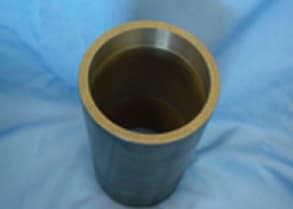
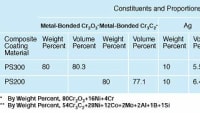
The coating materials investigated included a WC/Co mixture, two slightly different WC/Co mixtures incorporating a Ni-based self-fluxing alloy (see figure), a Co/Mo/Cr/Si alloy), and aWC/CrC/Ni mixture. In tests, the sliding and abrasive- wear performances of the plasmasprayed carbide-based materials were found to be, variously, equivalent or superior to those of electroplated hard chromium. Electrochemical corrosion measurements revealed corrosion performances inferior to those of electroplated hard chromium, indicating that these materials are not suitable for use in high-corrosion environments. However, they are well suited for such low-corrosion environments as the interiors of hydraulic dampers and actuators.
As part of the investigation, a cost analysis of plasma spraying of carbide coatings versus chrome plating was performed. It was found that for cylinders having diameters of 4 in., in which larger plasma spray guns can be used, the cost of plasma spraying is comparable to that of electroplating of hard chromium. For smaller diameters, the cost of plasma spraying was found to be somewhat greater than that of chrome plating. However, in some applications, the greater cost of plasma spraying might be justified by the reduction in process time.
This work was done by Keith O. Legg of the Rowan Technology Group; Bruce D. Sartwell and Jean-Gabriel Legoux of the National Research Council Canada; Montia Nestler and Christopher Dambra of Sulzer-Metco; Daming Wang and John Quets of Praxair Surface Technologies; Paul Natishan of the Center for Corrosion Science; Philip Bretz of Metcut Research Inc.; and Jon Devereaux of the Naval Air Depot of Jacksonville, FL, for the Naval Research Laboratory. For further information, download the free white paper at www.defensetechbriefs.com under the Materials category. NRL-0002
This Brief includes a Technical Support Package (TSP).
Plasma-Spray Coating as an Alternative to Chromium Plating
(reference NRL-0002) is currently available for download from the TSP library.
Don't have an account?
More From SAE Media Group
Aerospace & Defense Tech Briefs
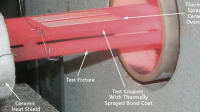
Improving Component Life in Abrasive, Corrosive Aerospace Environments

Tech Briefs
Aluminum Electroplating Using Bromide Salts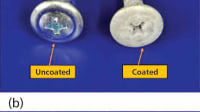
Aerospace & Defense Tech Briefs
Remanufacturing Reimagined: How Selective Electroplating Extends Service Life and Reduces the Cost of Aerospace Components
Aerospace & Defense Tech Briefs
Stress-Corrosion Cracking and Corrosion Fatigue Impact of IZ-C17+Zinc-Nickel on 4340 Steel
Aerospace & Defense Tech Briefs
Aerospace Manufacturers Turn to Non-Hazardous PVD Coatings as Regulations Tighten on Toxic Hard Chrome Plating
Tech Briefs
Using 3D Printing to Strengthen Jet Engines
Aerospace & Defense Tech Briefs
Pulse Plasma Nitriding for Aerospace Applications


Medical Design Briefs
What Medical Device OEMs Should Know About Outsourced MIM
Aerospace & Defense Tech Briefs
Evaluation of Additively Manufactured Ultrahard Steels
Photonics & Imaging Technology
Clean Technology Lasers: The New Tool in Surface Pre-Treatment for Superior Coating Adhesion
Aerospace & Defense Tech Briefs
Plasma Electrolytic Oxidation: The Future of Lightweight Designs in Aerospace and Defense
Aerospace Manufacturing and Machining
Tips for Choosing CBN Grinding Wheels
Tech Briefs
Liquid Metal Lattice
Aerospace & Defense Tech Briefs
Cold Spray Technology
Aerospace & Defense Tech Briefs
Cold Sprayed Coatings with Dual Nanoparticle Reinforcements for Wear and Corrosion Protection


Automotive Engineering
Lightweight Steel on a (Cold) Roll
Tech Briefs
Improved Cast Stainless Steel Alloys
Overview
I apologize, but I cannot find relevant information in the provided pages to create a summary of the document. However, based on my knowledge, the document likely discusses the investigation of plasma spray coatings as alternatives to hard chrome plating, focusing on their potential benefits, applications, and performance characteristics. It may include insights into the environmental and health concerns associated with traditional chrome plating, as well as the advantages of using plasma spray technology, such as improved durability, corrosion resistance, and reduced environmental impact. If you have specific aspects of the document you would like to know more about, please let me know!
Top Stories
NewsSensors/Data Acquisition
 Microvision Aquires Luminar, Plans Relationship Restoration, Multi-industry Push
INSIDERRF & Microwave Electronics
 A Next Generation Helmet System for Navy Pilots
INSIDERWeapons Systems
 New Raytheon and Lockheed Martin Agreements Expand Missile Defense Production
NewsAutomotive
 Ford Announces 48-Volt Architecture for Future Electric Truck
INSIDERAerospace
 Active Strake System Cuts Cruise Drag, Boosts Flight Efficiency
ArticlesTransportation

Webcasts
Aerospace
 Cooling a New Generation of Aerospace and Defense Embedded...
Energy
 Battery Abuse Testing: Pushing to Failure
Power
 A FREE Two-Day Event Dedicated to Connected Mobility
Automotive
 Quiet, Please: NVH Improvement Opportunities in the Early Design Cycle
Electronics & Computers
 Advantages of Smart Power Distribution Unit Design for Automotive &...
Unmanned Systems
 Sesame Solar's Nanogrid Tech Promises Major Gains in Drone Endurance