




Coupling of Coastal Wave Transformation and Computational Fluid Dynamics Models for Seakeeping Analysis
New analytical tools improve understanding of vessel operating environments in the littorals.
This research focused on depth-integrated modeling of coastal wave and surf-zone processes in support of computational fluid dynamics (CFD) simulation of ship motions. There were two components of the project. The first was the development of a numerical dispersion relation for a family of Boussinesq-type equations commonly used in modeling of coastal wave transformation. The relation depicts numerical dissipation and dispersion in wave propagation and provides guidelines for model setup in terms of temporal and spatial discretization. The second component was an extension of existing depth-integrated wave models to describe overtopping of coastal reefs and structures along with a series of CFD and laboratory experiments for model validation. The basic approach utilizing the HLLS Riemann solver performs reasonably well and produces stable and efficient numerical results for practical application.
Seakeeping analysis has traditionally been focused on dynamic response of vessels in the open ocean. As the attention is shifted to the littoral, a capability gap becomes obvious in the naval research and ship design communities. The distinct wave processes in the coastal region result in vessel loads and motions that are significantly different from those in the open ocean. Recent advances in depth-integrated models have enabled computations of wave transformation from the open ocean to the coast to provide important information for seakeeping analysis. However, such endeavors involve appreciable numerical errors and complex near-shore flows that might present a challenge to practical application.
Most coastal wave models are based on finite difference solution of Boussinesq-type equations. The depth-integrated governing equations express the vertical flow structure in terms of high-order spatial derivatives of the horizontal velocity through the irrotational flow condition. Subsequent developments have improved the dispersion and nonlinear properties, but greatly increased the complexity of the governing equations. Since the depth-integrated formulation cannot handle an overturning free surface, these early Boussinesq-type models typically utilized an empirical approach to approximate energy dissipation due to wave breaking.
Following the exponential growth of computing resources and parallel pursuit of highly nonlinear and dispersive theories, present-day computational models based on Boussinesqtype equations are being applied over vast regions from deep to shallow water with increasing resolution. The computational scheme, however, does not explicitly solve the governing system of partial differential equations. Discretization schemes involve numerical dispersion and dissipation that distort the true character of the governing equations. The leading term in the truncation error contains a derivative of the same order as the dispersion terms in Boussinesqtype equations. Such numerical errors have been studied extensively for the shallow-water equations, which represent a leading-order approximation of the Boussinesq-type equations. A wavenumber-based discretization scheme to preserve the dispersion relation of the governing equations has been proposed, but there has been no research on the effects of numerical dispersion in Boussinesq-type equations and the resulting wave propagation characteristics.
Overtopping on coastal reefs or structures becomes an important process as modeling of wave transformation extends into the nearshore region. George (2008) included effects of a bottom step as a forcing or source term in the Riemann problem and derived an approximate solver for the augmented system. The resulting model reproduces field and laboratory measurements of dam-break flows over rugged mountain terrain (George, 2011). Murillo and Garcia-Navarro (2010, 2012) generalized the effects of the bottom step as a hydrostatic force on the flow. Implementation of the resulting solver, known as HLLS (S for step), in one and two-dimensional nonlinear shallow-water models produces good agreement with analytical solutions and laboratory measurements. Application of these Riemann solvers has so far been limited to stepwise approximation of irregular topography for conservation of the hyperbolic flow character. Although these solvers do not include vertical flows to physically describe overtopping, they can better approximate the resulting characteristic flows for modeling of coastal wave processes.
This work was done by Kwok Fai Cheung, University of Hawaii at Manoa for the Office of Naval Research. ONR-0036
This Brief includes a Technical Support Package (TSP).
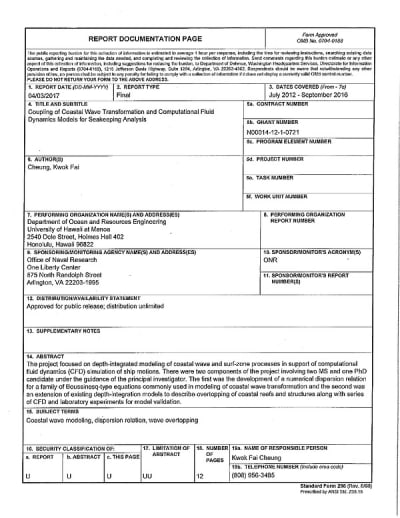
Coupling of Coastal Wave Transformation and Computational Fluid Dynamics Models for Seakeeping Analysis
(reference ONR-0036) is currently available for download from the TSP library.
Don't have an account?
More From SAE Media Group
Aerospace & Defense Tech Briefs
Comparing Blade-Element Momentum Modeling to 3-D CFD
Aerospace & Defense Tech Briefs
Model Development Using Accelerated Simulations of Hypersonic Flow Features
Tech Briefs
Rocket Nozzle Side-Load Analysis Software
Aerospace & Defense Tech Briefs
Airbus’ Quantum Computing Challenge May Fundamentally Change Aircraft Development
Aerospace & Defense Tech Briefs
Blast-Induced Acceleration in a Shock Tube
Aerospace & Defense Tech Briefs
Rotorcraft Icing Computational Tool Development
Aerospace & Defense Tech Briefs
Characterization of Bore Temperatures and Stresses in Small Caliber Gun Barrels
Aerospace & Defense Tech Briefs
R/V Athena Model (5365) Response in Waves
Aerospace & Defense Tech Briefs
Optimizing Thermal Management to Meet SWaP-C Requirements
Tech Briefs
Flap Edge Noise Reduction Fins

Motion Control Technology
Computational Fluid Dynamics Aids Aerospace Apps

Aerospace & Defense Tech Briefs
Aeroacoustic Simulation Delivers Breakthroughs in Aircraft Noise Reduction
Photonics & Imaging Technology
Ray Optics Simulation of Inertial Navigation Systems
Aerospace INSIDER
Engineers Assess Flow Quality in Wind Tunnel Test Facility
Aerospace & Defense Tech Briefs
Bringing Turbine Power to Small Aircraft
Aerospace & Defense Tech Briefs
Surviving the Challenge of Thermal Design in Aerospace Electronics
Aerospace & Defense Tech Briefs
New Tools Bring Faster, Simpler Fluid Flow Analysis Into the Engineering Mainstream
Aerospace & Defense Tech Briefs
UGVs — On the Cutting Edge of Thermal Management
Aerospace & Defense Tech Briefs
Aerodynamic Modeling of a Flapping Wing Unmanned Aerial Vehicle
Aerospace & Defense Tech Briefs
Thermal Trends and Improvements for Rugged COTS Cards
Off-Highway Engineering
Advances in Virtual Powertrain Development
Tech Briefs
Los Alamos National Laboratory
Tech Briefs
Fine-Tuning the Factory Using Simulation
Aerospace & Defense Tech Briefs
Inside the Navy’s Quiet Water Tunnel Facility
Aerospace & Defense Tech Briefs
Testing Reality in an Increasingly Complex Design Space
Aerospace & Defense Tech Briefs
Software Tool Enables High-Fidelity Simulation of Explosive Device Effects
Aerospace & Defense Tech Briefs
Reduced Order Modeling for Rapid Simulation of Blast Events of a Military Ground Vehicle and its Occupants
Aerospace & Defense Tech Briefs
Application of CFD to a Slender-Bodied, Finned Projectile
Overview
The document presents a final report on a research project focused on enhancing the modeling of coastal wave and surf-zone processes to support computational fluid dynamics (CFD) simulations of ship motions. Conducted by the University of Hawaii, the project involved two Master’s students and one PhD candidate, all under the guidance of a principal investigator.
The project had two main components. The first was the development of a numerical dispersion relation for a family of Boussinesq-type equations, which are commonly used in modeling coastal wave transformation. This relation quantifies numerical dissipation and dispersion in wave propagation, providing essential guidelines for model setup regarding temporal and spatial discretization. The second component involved extending existing depth-integrated wave models to better describe wave overtopping of coastal reefs and structures. This was complemented by a series of CFD and laboratory experiments aimed at validating the models.
The report highlights the use of the HLLS Riemann solver, which demonstrated stable and efficient numerical results for practical applications. The research significantly advanced the understanding of coastal wave modeling, particularly in quantifying model errors and improving the resolution of model setups. The development of a numerical dispersion relation replaced empirical approaches with a more systematic method for estimating model errors.
Additionally, the project emphasized the importance of training and education, providing research opportunities and financial support to graduate students in the Department of Ocean and Resources Engineering. The report lists the students involved, their current employment, and their contributions to quality research suitable for publication.
In conclusion, the research has enhanced the capability to model coastal environments, which is crucial for understanding ship loads and motions in these settings. The findings contribute to the ongoing development of CFD codes for realistic coastal environment modeling, ultimately aiding in seakeeping analysis for vessels. The document serves as a comprehensive overview of the advancements made in coastal wave modeling and its applications in maritime engineering.
Top Stories
INSIDERManufacturing & Prototyping
 How Airbus is Using w-DED to 3D Print Larger Titanium Airplane Parts
NewsAutomotive
 Microvision Aquires Luminar, Plans Relationship Restoration, Multi-industry Push
INSIDERAerospace
 A Next Generation Helmet System for Navy Pilots
INSIDERDesign
 New Raytheon and Lockheed Martin Agreements Expand Missile Defense Production
ArticlesAR/AI
 CES 2026: Bosch is Ready to Bring AI to Your (Likely ICE-powered) Vehicle
Road ReadyDesign

Webcasts
Semiconductors & ICs
 Advantages of Smart Power Distribution Unit Design for Automotive...
Unmanned Systems
 Quiet, Please: NVH Improvement Opportunities in the Early Design...
Electronics & Computers
 Cooling a New Generation of Aerospace and Defense Embedded...
Power
 Battery Abuse Testing: Pushing to Failure
AR/AI
 A FREE Two-Day Event Dedicated to Connected Mobility
