




Airbus’ Quantum Computing Challenge May Fundamentally Change Aircraft Development

A global quantum computing competition to advance optimization and modularity in aircraft life-cycle is open to post-graduate students, academics, researchers, and professionals. The Airbus Quantum Computing Challenge (AQCC) was initiated by the Toulouse-based aerospace corporation to bring quantum computing out of laboratories and apply it directly to challenges facing the aviation industry.
With traditional computing techniques approaching their limits, quantum computing – using non-binary quantum-mechanical phenomena like superposition and entanglement – has the potential to deliver a new level of processing power not practically feasible using traditional digital methods.
Discover SAE International's computational fluid dynamics content on Mobilus
AQCC is accepting submissions until October 2019. Individuals and teams will collaborate with Airbus industry experts and vie for access to hardware and to see their solutions realized. There are currently has five distinct challenges that focus on different aspects of design, operations, and revenue streams:
- Aircraft Climb Optimization: While the cruise phase is considered the most important flight phase from a fuel and time optimization perspective, the ever-increasing volume of short-haul flights are bringing more attention to the climb phase. Quantum computing can be applied to arrive at a low-cost index (the relative cost of time and fuel), which is central to climb efficiency.
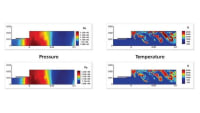
- Computational Fluid Dynamics: Computational Fluid Dynamics (CFD) is used to demonstrate airflow behavior around the aircraft and reveal the aerodynamic forces acting on its surfaces; however, accurate CFD simulations are a resource- and time-consuming task. Quantum computing algorithms or a hybrid use of quantum and traditional computing may be able to expedite aerodynamic simulations and reduce the computing power needed to perform CFD analysis.
- Quantum Neural Networks for Solving Partial Deferential Equations: Partial Differential Equations (PDEs) are a major challenge when solving aerodynamic problems; their resolution requires complex numerical schemes and high computational costs. Recently, neural networks – deep-learning-based algorithms – have been developed to solve coupled PDEs. While these networks compute the time and space derivatives of a PDE, quantum computing may be able to augment this approach.
- Wingbox Design Optimization: Design configurations such as airframe loads, mass modelling, and structural analysis must be simultaneously calculated, which often causes long design lead times, convoluted processes, and conservative assessments when using traditional computing. Quantum computing can evaluate different parameters simultaneously, preserving structural integrity while optimizing weight – which is particularly important in aircraft wingbox design, where weight optimization is key to low operating costs and reduced environmental impact.
- Aircraft Loading Optimization: Determining payload capability to maximize revenue, optimize fuel burn, and lower overall operating costs is limited by the aircraft’s operational envelope, which is determined by each mission’s maximum payload capacity, the aircraft’s center of gravity, and fuselage shear limits. By calculating the optimal aircraft configuration under coupled operational constraints, quantum computing can be used for practical problem solving and scale towards more complex issues.
Airbus has integrated quantum computing technologies into its products and solutions to varying degrees. As an active user of high-performance computing (HPC), Airbus is leverages quantum technologies in fields such as route optimization and satellite imagery.
Airbus will use the challenge to supplement its own quantum computing applications with in-house and external knowledge, data, and expertise.
William Kucinski is content editor at SAE International, Aerospace Products Group in Warrendale, Pa. Previously, he worked as a writer at the NASA Safety Center in Cleveland, Ohio and was responsible for writing the agency’s System Failure Case Studies. His interests include literally anything that has to do with space, past and present military aircraft, and propulsion technology.
More From SAE Media Group
Aerospace & Defense Tech Briefs
AGI and ANSYS Partner to Integrate Next-Gen Digital Modeling into Engineering Design
Aerospace & Defense Tech Briefs
Centre for Modelling & Simulation to Develop Digital Twins for GKN Aerospace Additive, Composite, and Industry 4.0 Technologies
Off-Highway Engineering
Advanced Simulation Techniques Drive Powertrain Design
Aerospace & Defense Tech Briefs
MathWorks Rolls out Major Update to Aerospace Blockset
Aerospace & Defense Tech Briefs
Industry Invited to Participate in AeroTech Aerospace and Defense Technical Program
Off-Highway Engineering
Advances in Virtual Powertrain Development
Aerospace & Defense Tech Briefs
Connected Aircraft Technologies Benefit Manufacturers, Airlines, and Travelers
Autonomous Vehicle Engineering
Truck Platooning an Evolving Pathway to Full Autonomy
Autonomous Vehicle Engineering
'Road Race' for AV Testing May Be Slowing
Tech Briefs
Analytical Model Evaluates Battery Capability
Off-Highway Engineering
Digitalization of Product Engineering
Aerospace & Defense Tech Briefs
Unleashing AI in Aviation Will Accelerate Move to Zero-Pilot Cargo and Passenger Aircraft
Aerospace INSIDER
Accelerating Climate-Compatible Aircraft Design with AI
Aerospace & Defense Tech Briefs
Embracing the Digital Transformation in Aerospace & Defense



Off-Highway Engineering
Commercial Vehicle ADAS: Testing, Testing and More Testing
Off-Highway Engineering
Virtual Factories Accelerate Collaboration, Advance Technologies

Aerospace & Defense Tech Briefs
SAE International Launches Aerospace Technology Symposium at Japan Aerospace 2018
Aerospace & Defense Tech Briefs
First Airbus A330-800 Airliner Goes Airborne in Maiden Flight, Enters Flight Test Phase
Aerospace & Defense Tech Briefs
NRL Scientists Deliver Quantum Algorithm to Develop New Materials and Chemistry

Autonomous Vehicle Engineering
Horiba to Expand Virtual AV Vetting with Physical-Body Testing
Aerospace & Defense Tech Briefs
SAE International Extends Call for Abstracts, Seeks Submissions for AeroTech Conference

Transcript
No transcript is available for this video.
Top Stories
INSIDERManufacturing & Prototyping
 How Airbus is Using w-DED to 3D Print Larger Titanium Airplane Parts
INSIDERManned Systems
 FAA to Replace Aging Network of Ground-Based Radars
NewsTransportation
 CES 2026: Bosch is Ready to Bring AI to Your (Likely ICE-powered) Vehicle
NewsSoftware
 Accelerating Down the Road to Autonomy
EditorialDesign
 DarkSky One Wants to Make the World a Darker Place
INSIDERMaterials
 Can This Self-Healing Composite Make Airplane and Spacecraft Components Last...
Webcasts
Defense
 How Sift's Unified Observability Platform Accelerates Drone Innovation
Automotive
 E/E Architecture Redefined: Building Smarter, Safer, and Scalable...
Power
 Hydrogen Engines Are Heating Up for Heavy Duty
Electronics & Computers
 Advantages of Smart Power Distribution Unit Design for Automotive...
Unmanned Systems
 Quiet, Please: NVH Improvement Opportunities in the Early Design...
