




Vapor Pressure Data and Analysis for Selected Organophosphorous Compounds: DIBMP, DCMP, IMMP, IMPA, EMPA, and MPFA
Determining the thermophysical properties of chemical warfare agent simulants can help evaluate the performance of defensive equipment.
Knowledge of the physical properties of materials is critical for understanding their behavior in the environment as well as in the laboratory. Vapor pressure is an important physical property for a wide variety of chemical defense-related applications, including estimation of persistence, prediction of downwind time-concentration profiles after dissemination, generation of controlled challenge concentrations for detector testing, evaluation of toxicological properties, and assessment of the efficiency of air filtration systems.
The U.S. Army Edgewood Chemical Biological Center (Aberdeen Proving Ground, MD) has a long history of interest in quantification of the physical properties of chemical warfare agents (CWAs) and related materials, including the development of correlations to enable the accurate prediction of values at untested temperatures. Recent efforts have focused on investigation and documentation of vapor pressure and properties that were derived from such data, including temperature correlations, volatility, and temperature-dependent enthalpy of volatilization (vaporization for liquids and sublimation for solids) for CWAs and related compounds.
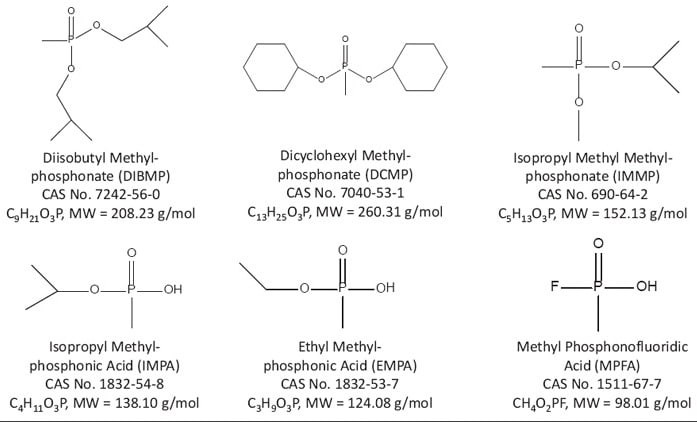
In addition to agents, recent work has focused on determination of the vapor pressure of agent precursors, degradation products, and simulants using two different ASTM International methods that are based on the differential scanning calorimetry (DSC) “pinhole” technique and vapor saturation (or transpiration). This research documents vapor pressure measurements, correlations, and derived properties for the organophosphorus G- and V-agent-related degradation products and simulants, whose structures, chemical names, Chemical Abstract Services (CAS) Registry Numbers, chemical formulas, and molecular weights are shown in the accompanying figure.
This work was done by Ann Brozena, James H. Buchanan, Patrice L. Abercrombie-Thomas, and Kenneth B. Sumpter, Research and Technology Directorate; Barry R. Williams, Leidos, Inc.; and David E. Tevault, Joint Research and Development, Inc. for the Defense Threat Reduction Agency. DTRA-0007
This Brief includes a Technical Support Package (TSP).

Vapor Pressure Data and Analysis for Selected Organophosphorous Compounds: DIBMP, DCMP, IMMP, IMPA, EMPA, and MPFA
(reference DTRA-0007) is currently available for download from the TSP library.
Don't have an account?
More From SAE Media Group
Aerospace & Defense Tech Briefs
pH-Dependent Spin State Population and ¹⁹F NMR Chemical Shift Via Remote Ligand Protonation in An Iron(II) Complex
Aerospace & Defense Tech Briefs
Luminescence Materials as Nanoparticle Thermal Sensors
Aerospace & Defense Tech Briefs
Matrix-Free Assisted Laser Desorption Ionization Using Metal-Organic Frameworks
Tech Briefs
Extrans Permeation Measurement System
Aerospace & Defense Tech Briefs
New AFRL Chamber Enhances Equipment Performance in Extreme Environments
Aerospace & Defense Tech Briefs
Phonon Confinement Effect in TiO₂ Nanoparticles as Thermosensor Materials

Aerospace & Defense Tech Briefs
Combustion Characteristics of Hydrocarbon Droplets Induced by Photoignition of Aluminum Nanoparticles

Aerospace INSIDER
A New Quantum Materials Research System
Aerospace INSIDER
Supercritical Fluid Extractor
Aerospace & Defense Tech Briefs
Ruggedizing Coaxial and Fiber Optic Cable Assemblies from Mechanical Strain
Aerospace & Defense Tech Briefs
New Zealand and LeoLabs Establish the First Low-Earth Orbit Regulatory Platform
Aerospace & Defense Tech Briefs
Permeation Tests on Polypropylene Fiber Materials
Aerospace & Defense Tech Briefs
3D Meta-Optics for High-Energy Lasers
Aerospace & Defense Tech Briefs
Influence of Leading-Edge Oscillatory Blowing on Time-Accurate Dynamic Store Separation
Tech Briefs
Macroflash Cup Cryostat

Tech Briefs
Advanced Supercritical Water Oxidation Reactor
Aerospace & Defense Tech Briefs
Inter-Laboratory Combat Helmet Blunt Impact Test Method Comparison
Aerospace & Defense Tech Briefs
Thermal Conductivities of Some Polymers and Composites
Aerospace INSIDER
Engineers Assess Flow Quality in Wind Tunnel Test Facility
Aerospace & Defense Tech Briefs
Designing for Space and Other Extreme Environments

Aerospace INSIDER
Using Ultrabright X-Rays to Test Materials for Ultrafast Aircraft
Aerospace & Defense Tech Briefs
MOVPE Growth of LWIR AlInAs/GaInAs/InP Quantum Cascade Lasers: Impact of Growth and Material Quality on Laser Performance
Aerospace & Defense Tech Briefs
Development of Hydrophobic Coatings for Water-Repellent Surfaces Using Hybrid Methodology

Aerospace INSIDER
Acrylic Flow Meters

Overview
The document titled "Vapor Pressure Data and Analysis for Selected Organophosphorus Compounds" presents a detailed study conducted by a team of researchers from the U.S. Army Edgewood Chemical Biological Center (ECBC) and associated organizations. The research focuses on the vapor pressure characteristics of six specific organophosphorus compounds: DIBMP, DCMP, IMMP, IMPA, EMPA, and MPFA. The study was authorized under the Chemical and Biological Technology Base Program and was conducted from December 2015 to October 2016.
The report is structured into several key sections, including an introduction, experimental procedures, results, discussion, and conclusions. The introduction outlines the significance of understanding vapor pressure in the context of chemical safety and environmental impact, particularly for compounds that may be used in military or industrial applications.
In the experimental procedures section, the methodologies employed to measure the vapor pressures of the selected compounds are described. This includes the specific techniques and equipment used, ensuring that the data collected is reliable and reproducible.
The results section is divided into subsections for each compound, providing detailed findings on their respective vapor pressures. Each subsection presents data in a clear format, allowing for easy comparison between the compounds. The results are critical for understanding the behavior of these chemicals under various environmental conditions, which is essential for risk assessment and management.
The discussion section interprets the results, highlighting the implications of the vapor pressure data in terms of safety, handling, and potential environmental effects. It also addresses any limitations of the study and suggests areas for further research.
Finally, the conclusions summarize the key findings and their relevance to the field of chemical safety and environmental science. The report emphasizes the importance of this data for regulatory compliance and the development of safety protocols.
The document is approved for public release, ensuring that the findings are accessible to researchers, policymakers, and industry professionals. It serves as a valuable resource for those involved in the study and management of organophosphorus compounds, contributing to a better understanding of their properties and potential risks.
Top Stories
NewsSensors/Data Acquisition
 Microvision Aquires Luminar, Plans Relationship Restoration, Multi-industry Push
INSIDERRF & Microwave Electronics
 A Next Generation Helmet System for Navy Pilots
INSIDERWeapons Systems
 New Raytheon and Lockheed Martin Agreements Expand Missile Defense Production
NewsAutomotive
 Ford Announces 48-Volt Architecture for Future Electric Truck
INSIDERAerospace
 Active Strake System Cuts Cruise Drag, Boosts Flight Efficiency
ArticlesTransportation

Webcasts
Aerospace
 Cooling a New Generation of Aerospace and Defense Embedded...
Energy
 Battery Abuse Testing: Pushing to Failure
Power
 A FREE Two-Day Event Dedicated to Connected Mobility
Automotive
 Quiet, Please: NVH Improvement Opportunities in the Early Design Cycle
Electronics & Computers
 Advantages of Smart Power Distribution Unit Design for Automotive &...
Unmanned Systems
 Sesame Solar's Nanogrid Tech Promises Major Gains in Drone Endurance