




New Form of Carbon Is Hard as a Rock, But Elastic Like Rubber
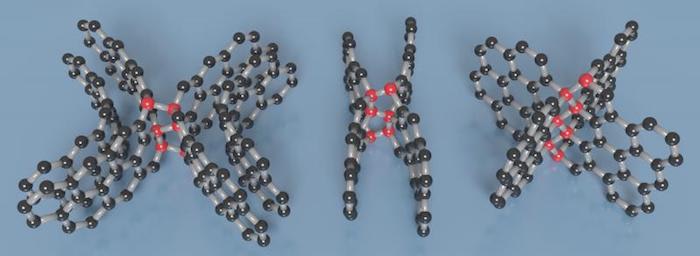
A team of scientists has developed a form of ultra-strong, lightweight carbon that is also elastic and electrically conductive. A material with such a unique combination of properties could serve a wide variety of applications from aerospace engineering to military armor.
Carbon is an element of seemingly infinite possibilities. This is because the configuration of its electrons allows for numerous self-bonding combinations that give rise to a range of materials with varying properties. For example, transparent, superhard diamonds, and opaque graphite, which is used for both pencils and industrial lubricant, are comprised solely of carbon.
In this international collaboration between Yanshan University and Carnegie, scientists pressurized and heated a structurally disordered form of carbon called glassy carbon. The glassy carbon starting material was brought to about 250,000 times normal atmospheric pressure and heated to approximately 1,800 degrees Fahrenheit to create the new strong and elastic carbon.
Scientists had previously tried subjecting glassy carbon to high pressures at both room temperature (referred to as cold compression) and extremely high temperatures. But the so-called cold-synthesized material could not maintain its structure when brought back to ambient pressure, and under the extremely hot conditions, nanocrystalline diamonds were formed.
The newly created carbon is comprised of both graphite-like and diamond-like bonding motifs, which gives rise to the unique combination of properties. Under the high-pressure synthesis conditions, disordered layers within the glassy carbon buckle, merge, and connect in various ways. This process creates an overall structure that lacks a long-range spatial order, but has a short-range spatial organization on the nanometer scale.
“Light materials with high strength and robust elasticity like this are very desirable for applications where weight savings are of the utmost importance, even more than material cost,” explained Zhisheng Zhao a former Carnegie fellow, who is now a Yanshan University professor. “What’s more, we believe that this synthesis method could be honed to create other extraordinary forms of carbon and entirely different classes of materials.”
More From SAE Media Group
Aerospace & Defense Tech Briefs
Thermal Conductivities of Some Polymers and Composites



Medical Design Briefs
3D Printable Polymer Nanocomposite Ink
Aerospace & Defense Tech Briefs
Biobased Carbon Fibers and Thermosetting Resins for Use in DOD Composites Applications

Aerospace & Defense Tech Briefs
Researchers Reduce Graphene-Enhanced Composite Development Time Using Neural Networks
Aerospace & Defense Tech Briefs
Molecular Engineering for Mechanically Resilient and Stretchable Electronic Polymers and Composites
Tech Briefs
Water Purification System Engineered from Wood
Aerospace & Defense Tech Briefs
The Next Material Disruption

Tech Briefs
Conductive Carbon Fiber Polymer Composite


Aerospace & Defense Tech Briefs
Metal-Plated, High-Temperature Plastics
Aerospace & Defense Tech Briefs
Modeling and Experimenting with 2D Materials for CMOS Type Devices and Digital Integrated Circuits

Defense INSIDER
Multifunctional Nanofiber Protects Against Explosions
Aerospace INSIDER
Composites Self-Heal at Very Low Temperatures

Aerospace Manufacturing and Machining
Scaling Low-Cost Carbon Fiber Production with Oxidation Technology
Aerospace Manufacturing and Machining INSIDER
Researchers Push Limits in High-Temp, Polymer Additive Manufacturing
Photonics & Imaging Technology INSIDER
Transparent Graphene Electrodes Might Lead to New Generation of Solar Cells
Aerospace & Defense Tech Briefs
Robotic Paint Removal System
Aerospace & Defense Tech Briefs
New Diamond Super-Material Enhances Aircraft Survivability
Aerospace & Defense Tech Briefs
Fiber-Reinforced Thermoplastic Composites
Top Stories
INSIDERManufacturing & Prototyping
 How Airbus is Using w-DED to 3D Print Larger Titanium Airplane Parts
INSIDERManned Systems
 FAA to Replace Aging Network of Ground-Based Radars
NewsTransportation
 CES 2026: Bosch is Ready to Bring AI to Your (Likely ICE-powered) Vehicle
NewsSoftware
 Accelerating Down the Road to Autonomy
EditorialDesign
 DarkSky One Wants to Make the World a Darker Place
INSIDERMaterials
 Can This Self-Healing Composite Make Airplane and Spacecraft Components Last...
Webcasts
Defense
 How Sift's Unified Observability Platform Accelerates Drone Innovation
Automotive
 E/E Architecture Redefined: Building Smarter, Safer, and Scalable...
Power
 Hydrogen Engines Are Heating Up for Heavy Duty
Electronics & Computers
 Advantages of Smart Power Distribution Unit Design for Automotive...
Unmanned Systems
 Quiet, Please: NVH Improvement Opportunities in the Early Design...
