




Robotic Paint Removal System
Air Force Research Laboratory
Wright-Patterson Air Force Base, OH
+1 937-255-0017
www.wpafb.af.mil
AFRL Materials Integrity engineers recently played a key role in enabling the safer and more efficient removal of paint from F-16 aircraft through the newly-adopted Robotic Laser Coating Removal System.
At the request of the Air Force Life Cycle Management Center Engineering Division, the research team, part of the Materials and Manufacturing Directorate, contributed technical expertise in the form of test coupon analysis, test procedure development and execution, and many forms of guidance and consultation throughout a seven-year effort that completely reimagined paint removal for certain types of metallic aircraft surfaces. Through this novel process, a laser-equipped robotic arm—mapped individually and specifically to each aircraft—is moved over the vehicle surface, essentially vaporizing paint layer by layer. The process is completely contained, meaning all waste materials as well as potentially harmful chemicals are vacuumed into the tool. A vision system recognizes when the stripping reaches the appropriate stopping point.
It's a completely automated process that removes the direct human element, both in terms of error and exposure. Instead, operators guide the effort from a computer console in a nearby control room.
Because the paint is removed with a laser, as opposed to traditional mechanical or chemical methods, the AFRL team had to take into consideration a whole new set of factors when developing test plans and evaluating the structural soundness of test specimens.

Three areas were of concern because this is a thermal process: Cadmium embrittlement (the formation of intermetallics on the material); thermal damage to the material itself; and thirdly, any relaxation of residual stress due to thermal effects.
Paint removal is a common maintenance procedure for military aircraft and is performed for a variety of reasons, most notably for inspections and for repainting purposes. Typically, it is performed manually, with maintenance crews applying a chemical solution, performing media blasting, or by meticulously scraping or sanding off the paint. These procedures are time-consuming and create a large amount of potentially hazardous waste material. It is also labor-intensive, requiring teams of maintainers equipped with multiple types of safety gear.
The laser de-paint process is much safer, significantly reducing the environmental hazards posed by chromium-based paint products. The fully-automated process does not require maintenance crews to be in the paint stripping area. And since the process is contained, waste is automatically removed to a collection area, requiring very little cleanup by human maintainers. As an added plus, the process is also faster, saving significant labor hours and associated costs.
Although not every surface material is suitable for laser paint removal, the system is approved for use with specific types of aluminum and graphite epoxy composites with a service temperature greater than 350 degrees Fahrenheit. These materials constitute the outer moldline of the F-16. The system is currently being investigated for a number of other materials and air platforms as well, and AFRL will play a continuing role in these efforts.
For Free Info Visit here .
More From SAE Media Group
Tech Briefs
Large-Scale Robotic Inkjet Printing System
Aerospace & Defense Tech Briefs
Removing Aircraft Paint Using Laser-Equipped Robots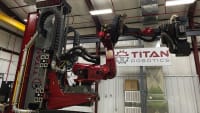
Aerospace & Defense Tech Briefs
New Diamond Super-Material Enhances Aircraft Survivability
Aerospace & Defense Tech Briefs
Laser Cleaner Robot
Photonics & Imaging Technology
Military Optics Technology
Aerospace Manufacturing and Machining
Does Your Coating Thickness Meet Spec?
Photonics & Imaging Technology
Advanced Laser Cleaning Robotic Work Cells Turbocharge Industrial Processes
Tech Briefs
Sensor Film for Aerospace
Tech Briefs
Compact, Lightweight, CMC-Based Acoustic Liner
Aerospace & Defense Tech Briefs
Combating Infrared Threats on the Battlefield
Aerospace & Defense Tech Briefs
Cold Sprayed Coatings with Dual Nanoparticle Reinforcements for Wear and Corrosion Protection
Tech Briefs
Thin Heat Shield for Superfast Aircraft
Aerospace & Defense Tech Briefs
Hybrid Ultra-Low VOC and Non-HAP Rain Erosion Coatings
Aerospace & Defense Tech Briefs
Fiber-Reinforced Thermoplastic Composites
Tech Briefs
Painting 3D-Printed Objects
Tech Briefs
Products of Tomorrow
Aerospace & Defense Tech Briefs
Taming the Thermal Behavior of Solid-State Military Lasers
Aerospace & Defense Tech Briefs
Thermal Management Techniques in Avionics Cooling
Aerospace & Defense Tech Briefs
Evaluation of the Effects of Hydrogen Peroxide on Common Aircraft Electrical Materials
Aerospace & Defense Tech Briefs
SAE International Extends Call for Abstracts, Seeks Submissions for AeroTech Conference
Tech Briefs
Copolyimide Surface-Modifying Coating
Photonics & Imaging Technology
Clean Technology Lasers: The New Tool in Surface Pre-Treatment for Superior Coating Adhesion
Aerospace & Defense Tech Briefs
Advanced CT Inspection and Data Analysis


Top Stories
NewsRF & Microwave Electronics
 Microvision Aquires Luminar, Plans Relationship Restoration, Multi-industry Push
INSIDERAerospace
 A Next Generation Helmet System for Navy Pilots
INSIDERDesign
 New Raytheon and Lockheed Martin Agreements Expand Missile Defense Production
INSIDERMaterials
 How Airbus is Using w-DED to 3D Print Larger Titanium Airplane Parts
NewsPower
 Ford Announces 48-Volt Architecture for Future Electric Truck
ArticlesAR/AI

Webcasts
Electronics & Computers
 Cooling a New Generation of Aerospace and Defense Embedded...
Automotive
 Battery Abuse Testing: Pushing to Failure
Power
 A FREE Two-Day Event Dedicated to Connected Mobility
Unmanned Systems
 Quiet, Please: NVH Improvement Opportunities in the Early Design Cycle
Automotive
 Advantages of Smart Power Distribution Unit Design for Automotive &...
Energy
 Sesame Solar's Nanogrid Tech Promises Major Gains in Drone Endurance