




Small, Sensitive Antennas
Researchers create metamaterials by carefully designing and fabricating novel structures to exhibit patterns of electromagnetic properties—specifically, dielectric permittivity and/or magnetic permeability—at the micro-or nano-scale. This special spatial arrangement of elements ensures that the volumetric arrays interact with electromagnetic fields in desirable ways.
The resulting materials (or devices) can, for example, efficiently absorb or emit EM radiation across a wide bandwidth, or do so along specified directions, making them perfect for sensitive, highly directional antennas or beam-steering arrays. Such high-function, low-form-factor metamaterial antennas could be fully embedded in the skin and even conform to airframe contours without compromising aerodynamic performance.
It is little wonder then that a variety of companies are working in this field, according to a recent report by technology consultants Lux Research. Lead author Anthony Vicari and his Lux colleagues cited vigorous R&D effort on metamaterial antennas at startups such as Kymeta, Fractal Antenna Systems, and Metamaterial Tech; industrial firms including Harris Corp., Kyocera Wireless, and EMW; large aerospace and defense contractors like Lockheed Martin, Boeing, and Raytheon; and even consumer electronics giant, Samsung. Among the leading academic institutions in this area, they said, are Duke University and Queen Mary’s University of London.
Another big player in metamaterial antenna technology is BAE Systems, the British multinational aerospace and defense firm. Earlier this year, the company announced that company researchers had built a prototype metamaterial antenna lens that was significantly flatter and more compact than the conventional analogue on which it was based.
More From SAE Media Group
Aerospace & Defense Tech Briefs
Shape-Shifting Origami Could Help Antenna Systems Adapt On-the-Fly
Aerospace & Defense Tech Briefs
Airborne Antenna Considerations for C-Band Telemetry Systems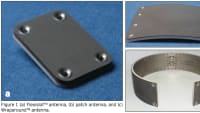
Tech Briefs
Toroidal Radiation Pattern Patch Antenna
Aerospace & Defense Tech Briefs
New, Portable Antenna Could Help Restore Communication After Disasters
Aerospace & Defense Tech Briefs
EMI Analysis Software Helps Telescope Group Simulate RFI Mitigation

Aerospace & Defense Tech Briefs
Pathfinder Radar ISR and SAR Systems: Tactical Eyes for the Warfighter

Aerospace & Defense Tech Briefs
Army and Universities Deploy New Warfighter Communication Technology
Aerospace & Defense Tech Briefs
Co-Prime Frequency and Aperture Design for HF Surveillance, Wideband Radar Imaging, and Nonstationary Array Processing
Tech Briefs
Products of Tomorrow
Aerospace & Defense Tech Briefs
Next-Generation Spectrometers for Rapid Analysis of Complex Mixtures
Aerospace & Defense Tech Briefs
From DC to Daylight — How Innovations in Microwave Absorbers Shield the Warfighter
Aerospace & Defense Tech Briefs
A New Concept for Improving the Performance of Electrically Small Antennas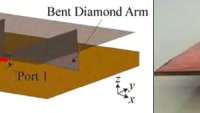

RF & Microwave Technology
System Could Detect Concealed Person-Borne Bombs at a Distance
Aerospace & Defense Tech Briefs
Development of an Optically Modulated Scatterer Probe for a Near-Field Measurement System
Aerospace & Defense Tech Briefs
Terahertz (THz) Radar: A Solution For Degraded Visibility Environments (DVE)
Aerospace INSIDER
Metamaterials Antenna Makes Generational Leap in Multi-Band Connectivity
Tech Briefs
Lighter Radiation Shielding for Electronics
Aerospace & Defense Tech Briefs
Pushing the Boundaries of RF Passive Hardware with Additive Manufacturing
Aerospace & Defense Tech Briefs
Physicists Develop a New Type of Antenna
Aerospace & Defense Tech Briefs
Frequency Agile Plasmonic Antennas and Sensors
Motion Design INSIDER
Computer-Guided Drawing Machine Fabricates Paper Metamaterials
Aerospace & Defense Tech Briefs
New Technique Could Make Sub-Wavelength Images at Radio Frequencies
Aerospace & Defense Tech Briefs
Communicating from Space: The Front End of Multiscale Modeling
Tech Briefs
Cup Cylindrical Waveguide Antenna
Aerospace & Defense Tech Briefs
Nominal High-Altitude Electromagnetic Pulse (HEMP) Waveforms
Aerospace & Defense Tech Briefs
90° Hybrid Coupled Power Amplifier – Pros and Cons
Top Stories
INSIDERManufacturing & Prototyping
 How Airbus is Using w-DED to 3D Print Larger Titanium Airplane Parts
NewsAutomotive
 Microvision Aquires Luminar, Plans Relationship Restoration, Multi-industry Push
INSIDERAerospace
 A Next Generation Helmet System for Navy Pilots
INSIDERDesign
 New Raytheon and Lockheed Martin Agreements Expand Missile Defense Production
ArticlesAR/AI
 CES 2026: Bosch is Ready to Bring AI to Your (Likely ICE-powered) Vehicle
Road ReadyDesign

Webcasts
Semiconductors & ICs
 Advantages of Smart Power Distribution Unit Design for Automotive...
Unmanned Systems
 Quiet, Please: NVH Improvement Opportunities in the Early Design...
Electronics & Computers
 Cooling a New Generation of Aerospace and Defense Embedded...
Power
 Battery Abuse Testing: Pushing to Failure
AR/AI
 A FREE Two-Day Event Dedicated to Connected Mobility
