




Next-Generation Spectrometers for Rapid Analysis of Complex Mixtures
Spectrometers in chemical sensors are used in environmental and air quality monitoring, detection of hazardous gases and chemical warfare agents, and breath analysis in medical applications.
Molecules have internal motions that are characteristic of their structure and identity. These motions can be studied by spectroscopy in different regions of the electromagnetic spectrum. Molecular spectra can be used as a “fingerprint” to unambiguously state whether or not a particular chemical is present and in what amount. As such, small portable spectrometers are frequently used as components of chemical sensors.
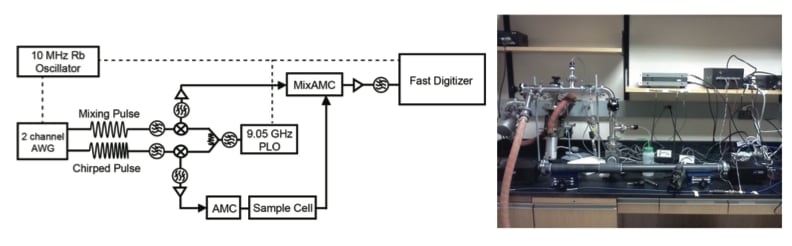
A fast mm-wave spectrometer was developed that is amenable to miniaturization. The work was done in three main steps. First, a new FPGA-based digitizer that can average molecular signals in real time was used to improve data throughput to allow for the acquisition of very large numbers of averages. Second, a chirped-pulse mm-wave spectrometer was constructed using x12 amplified multiplier chains (AMCs) to generate mm-wave radiation from cm-wave sources, and to detect it via heterodyne mixing with a cm-wave local oscillator. Third, schemes to reduce the size of the spectrometer sample cell were tested.
The real-time digitizer can acquire 1 million averages of a 10 ms trace, sampled at 40 GS/s (record length of 400,000 points), in just under 12 seconds. Once the speed enhancement was confirmed, phase stability of the digitizer was tested by collecting 1 and 100 million averages of a molecular sample (nitromethane) and verifying the expected factor of 10 improvement in signal-to-noise ratios. After completing digitizer testing in the cm-wave range, the 110-170 GHz spectrometer was assembled and tested. Once chirped-pulse generation and detection were tested, methanol was used to find optimal conditions for spectrum collection.
Overall, this project had three primary goals. The first was to incorporate real-time digitizers into spectrometers to drastically increase data throughput. The second was to construct a millimeter-wave spectrometer using this technology to benefit from the natural thermal population of molecules at room temperature. The third was to then use these combined benefits to explore reductions in sample cell volume for future miniaturization efforts. The first goal was definitely met and the digitizer performance was excellent. Spectra of 1 billion averages were collected over the course of a few hours. The second goal was met, but with some caveats. Output power limitations of the amplified multiplier chain required use of relatively low bandwidth chirped pulses to sufficiently excite the molecules, which in turn meant that the full 60-GHz bandwidth could not be covered with each repetition cycle. The third goal was not met, due in part to the fragility of these devices, and possibly due to the low power handling ability of the millimeter-wave receiver, which has a damage threshold below that of the typical output power of the amplified multiplier chain. Multi-pass designs that have longer effective pathlengths, but reduce instrument footprint, are likely the best route.
This work was done by Steven Shipman of New College of Florida for the Office of Naval Research. ONR-0032
More From SAE Media Group
Aerospace & Defense Tech Briefs
Towards Greater Sensitivity: A Brief FTIR and Infrared-Based Cavity Ring Down Spectroscopy Comparative Study
Tech Briefs
Correlation Spectrometer
Medical Design Briefs
Tunable Lasers Expand for Time-Resolved Spectroscopy
Aerospace & Defense Tech Briefs
Detecting Trace Levels of Explosives Using Vibrational Sum Frequency Spectroscopy
Aerospace & Defense Tech Briefs
Development of Photoacoustic Sensing Platforms

Aerospace & Defense Tech Briefs
Luminescence Materials as Nanoparticle Thermal Sensors

Tech Briefs
Compact Microwave Fourier Spectrum Analyzer
Aerospace & Defense Tech Briefs
Detecting Explosives by Use of LIBS

Photonics & Imaging Technology
High-Brightness Source of Coherent Light Spanning From the UV to THz
RF & Microwave Technology
System Could Detect Concealed Person-Borne Bombs at a Distance
Photonics & Imaging Technology
Ultra-Narrowband Optical Filters Pushing Boundaries from the UV to the LWIR
Photonics Tech Briefs
Fast Infrared Spectrometer
Aerospace & Defense Tech Briefs
Fabrication and Electrical Characterization of Correlated Oxide Field Effect Switching Devices for High Speed Electronics
Aerospace & Defense Tech Briefs
Advances in Millimeter-Wave Isolator Design Launch Manufacturers into Stratospheric Operating Frequencies
Tech Briefs
Wide-Area Chemical Sensor
Tech Briefs
Portable Acousto-Optic Spectrometers
Aerospace & Defense Tech Briefs
MOVPE Growth of LWIR AlInAs/GaInAs/InP Quantum Cascade Lasers: Impact of Growth and Material Quality on Laser Performance
Aerospace & Defense Tech Briefs
3D Meta-Optics for High-Energy Lasers
Aerospace & Defense Tech Briefs
This Laser Clock Could Transform Satellite Navigation Accuracy
Aerospace & Defense Tech Briefs
Stand-Off Scanning and Pointing with Risley Prisms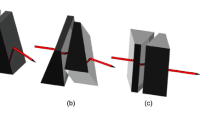
Aerospace & Defense Tech Briefs
Industry Invited to Participate in AeroTech Aerospace and Defense Technical Program
Top Stories
NewsRF & Microwave Electronics
 Microvision Aquires Luminar, Plans Relationship Restoration, Multi-industry Push
INSIDERAerospace
 A Next Generation Helmet System for Navy Pilots
INSIDERDesign
 New Raytheon and Lockheed Martin Agreements Expand Missile Defense Production
INSIDERMaterials
 How Airbus is Using w-DED to 3D Print Larger Titanium Airplane Parts
NewsPower
 Ford Announces 48-Volt Architecture for Future Electric Truck
ArticlesAR/AI

Webcasts
Electronics & Computers
 Cooling a New Generation of Aerospace and Defense Embedded...
Automotive
 Battery Abuse Testing: Pushing to Failure
Power
 A FREE Two-Day Event Dedicated to Connected Mobility
Unmanned Systems
 Quiet, Please: NVH Improvement Opportunities in the Early Design Cycle
Automotive
 Advantages of Smart Power Distribution Unit Design for Automotive &...
Energy
 Sesame Solar's Nanogrid Tech Promises Major Gains in Drone Endurance